Hyperbolic Functions (Edexcel A-Level Further Mathematics): Revision Notes
📚Revision Notes
4.1.3 Differentiating & Integrating Hyperbolic Functions
Differentiating Inverse Hyperbolic and Trig Functions
Introduction to Inverse Hyperbolic Functions
Inverse hyperbolic functions, denoted as , and , are the inverses of the hyperbolic sine, cosine, and tangent functions. These functions can be expressed in terms of natural logarithms, which are useful for simplifying and solving problems involving hyperbolic functions.
The logarithmic forms of inverse hyperbolic functions are derived using the definitions of hyperbolic functions and the properties of exponentials. These forms allow us to compute values for inverse hyperbolic functions without relying on numerical estimation of hyperbolic equations.
Logarithmic Forms of Inverse Hyperbolic Functions
Inverse Hyperbolic Sine ()****:
Inverse Hyperbolic Cosine ()****:
Inverse Hyperbolic Tangent ()****:
Worked Examples
Example
Example Differentiate
- Let and rearrange it to
- Find
- Find the reciprocal to get , then rearrange in terms of
Given
(Redundant gives in the denominator)
However, looking at the graph of :
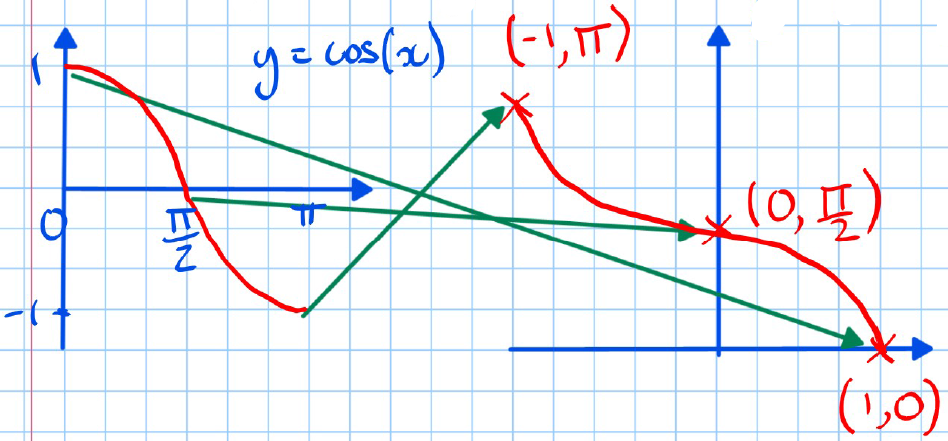
At points (), (), and (), the graph shows that the gradient is always negative.
Example
Example: Differentiate
[Hint: Use the chain rule and the above result.]
Example
Example: Differentiate
Example
Example: Find in full, showing detailed reasoning, the first derivative of
Since ,
Thus:
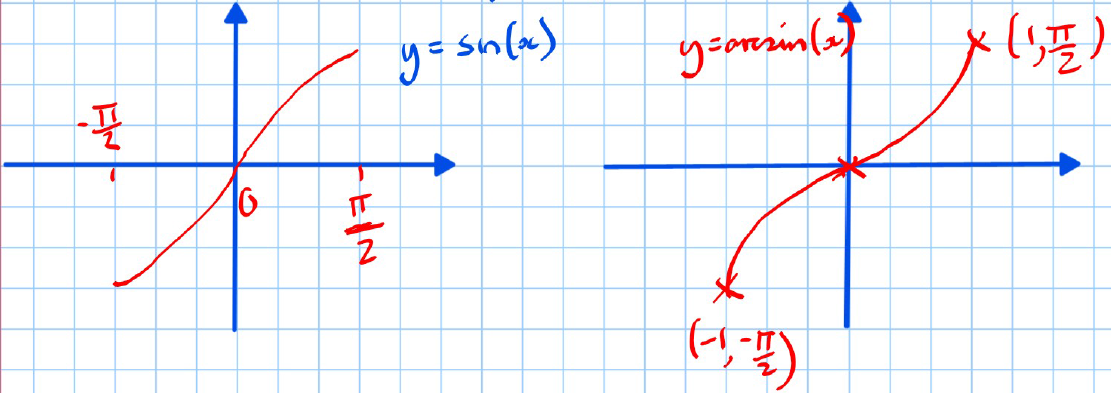
Note that the gradient is always positive, so:
Example
Example: Differentiate
Since
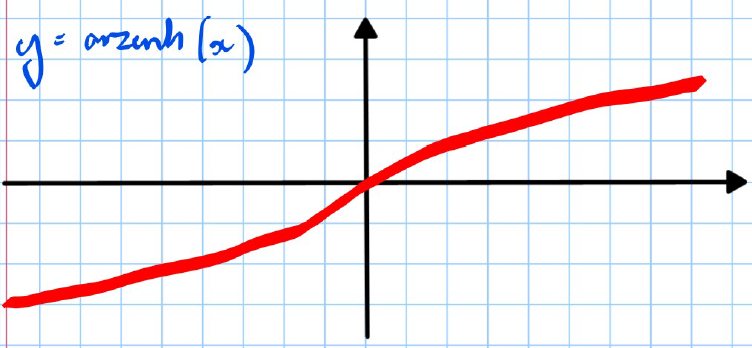
Since gradient is always Positive
Example
Example: Use the above result to find
We know .
Let , then
Since , we get:
Past Paper Worked Questions
Note
Q1. (June 2006, Q2) (i) Given that , prove that .
(ii) Verify that satisfies the equation
Solution:
(i) Let .
Thus,
(ii)
Differentiate again:
Substitute into the LHS of the expression:
Simplify:
Thus, the equation is verified.
Note
Q4. (Jan 2010, Q9) (i) Given that , for , prove that .
Let .
Multiply by
(ii) Given that , where a and b are positive constants:
(a) Given that , show that the curve with equation has no stationary points.
Since and has domain
no solutions and no stationary points
(b) In the case where and , show that has a minimum value of .
Let .
Differentiate:
Simplifying:
Finally, this simplifies to .
Note Summary
Note
Common Mistakes:
-
Confusing the formulas for and : For , the square root is ; for , it is
-
Using incorrect domains: is only valid for , and is only valid for
-
Sign errors when solving quadratic equations: Ensure you select the correct branch of the logarithmic solution based on the context.
-
Overlooking restrictions on : Logarithmic functions require positive arguments, so ensure
Note
Key Formulas:
- Domains: