Globalisation has led to the deregulation of capital markets and the emergence of new state forms (Edexcel A-Level Geography): Revision Notes
📚Revision Notes
Globalisation has led to the deregulation of capital markets and the emergence of new state forms
Low Tax Regimes & The Emergence of New State Forms
- National governments have reduce restrictions on who can invest in their countries, in order to encourage more FDI
- Some states attract TNCs to their country by offering low business rates
- Govs hope that they will prosper as a result of high volume of capital flows
- TNCs can be attracted by the prospect of increasing profit through paying less in tax
- TNCs risk damaging their brand, and are subject to accusations of lacking corporate responsibility
- TNCs are also at risk of being nationalised by hostile governments
- TNCs have to take into account the stability and security of the government of the country they move to - eg. risk of financial crisis
- Wealthy individuals also make use of tax havens
Alternatives
- Instead of moving home, many TNCs use Transfer Pricing to reduce their tax burden
- Involves routing profits through a subsidiary company, owned by the parent company
- These subsidiaries are often located in a low tax country or even a tax haven
Tax Avoidance & Evasion
Tax Avoidance → Using legal loopholes to legally reduce how much tax you have to pay Eg. Dyson moving their HQ from UK to Singapore
Tax Evasion → Illegally not paying the taxes that you owe
Tax Haven → A country where personal and corporation taxes are nil or minimal
↳ They offer different methods of tax avoidance:
- Corporate profit-shifting is when a TNC locates its HQ in a low-tax country and registers its profits there
- Individuals can move to a tax haven and live there
- Individuals an remain living in their home country but can invest their money in a trust in a tax haven
| Advantages | Disadvantages |
|---|---|
| ● Countries that offer tax incentives can develop quickly, or. Like Ireland can recover from severe recessions more quickly
● Most governments and IGOs accept tax havens and tax avoidance because of the boost to economic growth that they deliver
● When TNCs are located in several different nations, it would not be fair to tax them in full in each one | ● Investing abroad decreases the amount of money left to invest at home
● Tax havens allow individuals to hide income from their own governments (∴ increasing corruption)
● TNCs make huge profits in countries like the UK, but pay very little tax which means less money for government services (eg. NHS) |
Responses to Tax Avoidance
- Due to developed nations losing a lot to corporate tax avoidance, they have begun to collaborate on taking preventative measures
- Several IGOs such as the G20 want to see stricter regulations
- NGOs often work to raise awareness of the social costs of corporate tax avoidance
- NGO - Tax justice network Views & actions of different players in relation to tax avoidance by TNCs
| Views & actions | Evaluation | |
|---|---|---|
| IGOs | ● Since 2009, OECD (Organisation for Economic Cooperation and Development) have kept a blacklist of countries operating as tax havens ● In 2019, the EU published its own list of 15 states that lack tax transparency ● Action has been taken by the G20 countries to name and shame tax havens | ● While places such as the Cayman Islands remain legitimate places to register a business, more TNCs have become uncomfortable doing so due to the scrutiny they would face ● Firms have become more aware of the brand risk associated with being seen to avoid taxes |
| NGOs | ● NGOs such as WarOnWant and Oxfam have campaigned against tax havens and the TNCs that use them ● NGOs organised protests, consumer boycotts and demonstrations in order to pressure governments to clamp down on tax avoidance bt TNCs | ● High street protests = public relations problem for TNCs ● Both Starbucks and Google volunteered to pay additional taxes to the UK gov following protests in order to improve public relations, but campaigners said the amount paid was still too little |
Growing Global Inequalities
Recognised as a threat to the sustainability of the global economic system
Inequality has been increasing in some regions and nations since 1990: Red - growing inequality
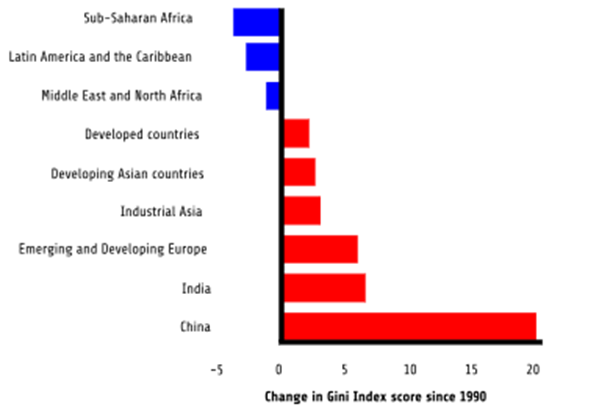
Growing Global Inequalities
Consequences of Inequality
In 2016, Oxfam calculated that the world's 62 richest people have a combined income equal to that of the poorest 3.6 billion people.
The consequences of this include:
- Unequal access to quality education
- Reduced life expectancy for the poorest
- Low-pay, low-skill jobs with no prospects
- Increased physical and mental health problems for the poorest
- Political instability as people reject the established political classes who they identify with the rich elite
Alternative Sustainable Economic Models
Growing global inequalities are threatening the sustainability of the global economic system which, if not regulated, could collapse entirely. Some governments (eg. Ecuador) have thus created alternative sustainable economic models which include:
- Limiting imports of essential resources such as food, water, raw materials
- Ensuring energy security, often using renewable sources
- Promoting local businesses to secure employment opportunities and generate tax, thereby reducing reliance on TNC's