Communist victory and its impact on China (Edexcel A-Level History): Revision Notes
📚Revision Notes
Communist victory and its impact on China
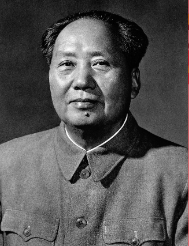
Mao Tse-tung

Chinese Communist Party
Main Phases of the Civil War
- The KMT attacked the main bases of the CCP in Manchuria and Northeastern China from 1947 to 1948 in an attempt to take initiative.
- The CCP successfully blocked the KMT's attacks.
- The CCP went on the offensive and moved south from 1947 onwards to take KMT-held areas in central and southern China.
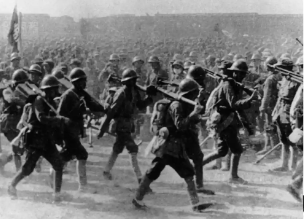
Communist troops at the end of the Chinese Civil War
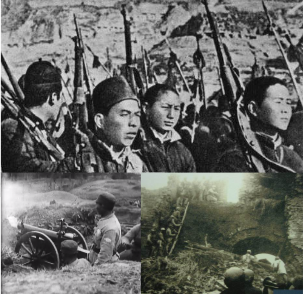
Chinese Civil War
Major Campaigns of the Civil War


The Struggle for Manchuria 1926-1947
The 'strong point offensive' 1947
The Liaoshen campaign, September-November 1948
The Huaihai campaign, November 1948-January 1949
The Pingjin campaign, November 1948-January 1949
The Liaoshen campaign gained the PLA cities of Jinzhou, Changchun and Shenyang. Eventually, this campaign led to the capture of Manchuria by the communists.
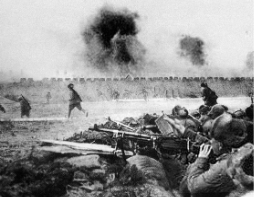
Liaoshen campaign
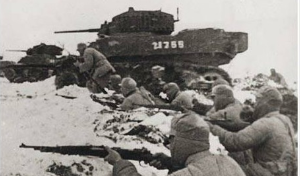
Battle of Huaihai
The Battle of Huaihai from 6 November 1948 to 10 January 1949 helped the communists gain control of the Kuomintang headquarters in Xuzhou and reach the north of the Yangtze. As they were gaining the upper hand, the US began to withdraw its support of the nationalist army.
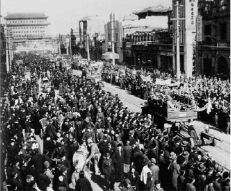
Pingjin campaign
The Pingjin campaign signified the end of the dominance of the nationalists in Northern China as the communists captured Beijing and Tianjin.
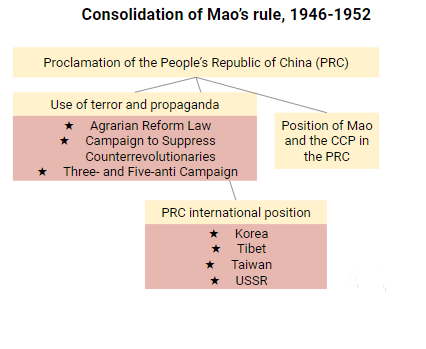
The US remained supportive of Chiang Kai-shek's government but refused to fully commit to the nationalists. By 1948, the communists had started to advance towards the south of Manchuria and encircled Beijing. Gradually, they began to march towards Shanghai. Chiang Kai-shek's government, the Republic of China (ROC), and his two million followers fled to Taiwan. By 1 October 1949, Mao Tse-tung had proclaimed the People's Republic of China (PRC).
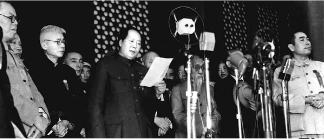
Proclamation of the People's Republic of China