The PRC’s international position and relations with Korea, Tibet, Taiwan and the USSR (Edexcel A-Level History): Revision Notes
📚Revision Notes
The PRC's international position and relations with Korea, Tibet, Taiwan and the USSR
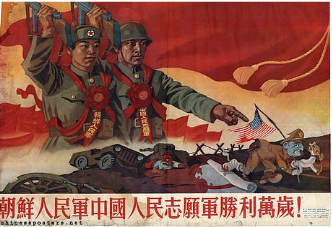
Chinese propaganda poster for the Korean War
Involvement in the Korean War
One of the aims of Mao Tse-tung was to make the People's Republic of China (PRC) economically secure and independent.
After suffering from financial losses due to the Second World War, the Chinese Civil War and the Korean War, several policies needed to be implemented in order to align with the ideals of communism.
On 30 September 1950, Zhou Enlai, the premier of the PRC, warned the United States that if US and UN troops crossed the 38th parallel, the border between North and South Korea, China would intervene.
In November 1950, Chinese volunteer forces intervened on behalf of North Korea and eventually drove the UN troops below the 38th parallel. This action was spurred by Mao Tse-tung's intentions to spread communism in Asia and its defiance over US intervention.
Relations with the USSR
In Moscow December 1949, Mao Tse-tung met Joseph Stalin, the leader of the Soviet Union, to sign the Treaty of Friendship, Alliance and Mutual Assistance that gave financial aid and technological assistance to modernise China.
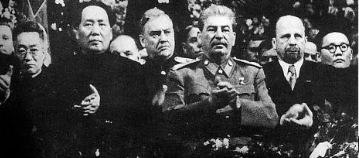
Mao Tse-tung and Joseph Stalin
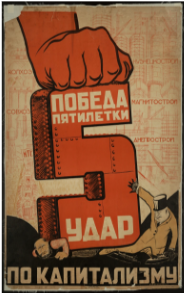
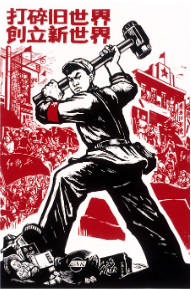
Posters showing the Five Year Plans of Stalin for Russia (left) and Mao Tse-tung for China (right)
Upon signing the treaty, the Soviets had great influence over the developments in China. Although the financial aid received by China from the Soviets was minimal, it did however provide approximately 10,000 engineers to boost the country's industry and economy.
Mao's Five-Year Plan for China was even influenced by Joseph Stalin's own Five-Year Plan for Russia.
Relations with Tibet
Tibet, as a neighbouring state of China, had political independence. In 1949, Mao Tse-tung, supported by his communist followers and the People's Liberation Army (PLA), invaded the region. As the Seventeen Point Agreement was signed in 1951, China granted autonomy to the state under the 14th Dalai Lama's leadership.
In 1959, an uprising occurred as the conflict between the Tibetan guerillas and the PLA intensified. It forced the Dalai Lama to flee to India and to establish a government-in-exile. The agreement was then renounced.
Relations with Taiwan
By the 1950s, several western countries had begun to recognise the People's Republic of China (PRC) as a legitimate state. By 1971, it had replaced the Republic of China (ROC) – Taiwan – in the UN Security Council as the representative of China. Thus, the majority of the nations in the council switched their diplomatic relations to the PRC, strengthening the rocky relationship of the two states.
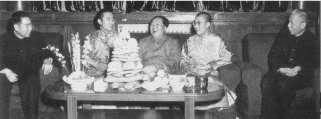
Mao and Zhou Enlai meeting with the Dalai Lama and Panchen Lama
Glossary of Terms
National People's Congress
The highest body of the new government of the People's Republic of China
Democratic Centralism
A Leninist organisational system in which political decisions reached by voting processes are binding for all members of the political party
Agrarian Reform Law
The law passed in China in 1950 with the main objective of equitable redistribution of land to landless peasants by seizing it from wealthy landlords
Three- and Five-anti Campaigns
The reforms issued by Mao Tse-tung to combat corruption and the people who were considered enemies of the state
Campaign to Suppress Counterrevolutionaries
Aimed to suppress opposition, mainly from former supporters of the Kuomintang, which included academics, businessmen and former officials
Seventeen Point Agreement
An agreement in 1951 that granted autonomy to Tibet under the 14th Dalai Lama's leadership