Applications of Differentiation (Edexcel A-Level Mathematics): Revision Notes
📚Revision Notes
7.2.6 Modelling with Differentiation including Optimisation
Modelling with differentiation involves using derivatives to analyse real-world problems and optimize functions. This includes finding the maximum or minimum values of a function, which is crucial in fields like economics, engineering, and physics.
1. Overview of Modelling with Differentiation:
Note
- Differentiation is the process of finding the derivative of a function, which represents the rate of change. It is used to understand how a function behaves and to solve problems involving optimization.
Note
- Optimization involves finding the maximum or minimum values of a function, which could represent the highest profit, lowest cost, shortest distance, or most efficient use of resources.
2. Steps for Modelling with Differentiation:
- Define the Problem
- Set Up the Function to Be Optimized
- Differentiate the Function
- Find the Critical Points
- Classify the Critical Points
- Analyse the Results
Note
Step 1: Define the Problem
- Clearly understand and define what needs to be optimized (e.g., maximizing area, minimizing cost, etc.).
- Identify the variables involved and how they are related.
Step 2: Set Up the Function to Be Optimized
- Formulate the objective function, which represents the quantity you want to maximize or minimize.
- Express the function in terms of a single variable, if possible.
Step 3: Differentiate the Function
- Find the first derivative of the objective function. This derivative represents the rate of change of the function with respect to the variable .
Step 4: Find the Critical Points
- Solve to find the critical points. These are the points where the function could have a maximum or minimum.
- Check where the derivative is undefined, as these points may also be critical.
Step 5: Classify the Critical Points
- Use the second derivative test to determine whether each critical point is a local maximum, local minimum, or neither:
- If , the function has a local minimum at that point.
- If , the function has a local maximum.
- If , the test is inconclusive, and further analysis is needed.
Step 6: Analyse the Results
- Determine the maximum or minimum value of the function based on the critical points.
- Consider the domain of the function and check any endpoints if the domain is restricted.
3. Example Problems Involving Modelling with Differentiation:
Note
Example 1: Maximizing Area with a Fixed Perimeter
Problem: You have 100 meters of fencing to enclose a rectangular area. What dimensions should the rectangle have to maximize the enclosed area?
- Step 1: Define the Problem:
- Let the length of the rectangle be l and the width be w.
- The perimeter constraint is
- Step 2: Set Up the Function to Be Optimized:
- The area of the rectangle is
- Using the perimeter constraint, express
- Substitute into the area function:
- Step 3: Differentiate the Function:
- Find the first derivative: .
- Step 4: Find the Critical Points:
- Set the derivative equal to zero:
- Step 5: Classify the Critical Points:
- Find the second derivative:
- Since , the function has a local maximum at
- Step 6: Analyse the Results:
- The rectangle should have dimensions meters and meters to maximize the area.
- The maximum area is A = 25 × 25 = 625 square meters.
Note
Example 2: Minimizing Cost
Problem: A company needs to manufacture a cylindrical can that holds 1 litre (1000 cm³) of liquid. The cost of the material for the top and bottom is higher than for the side. Find the dimensions that minimize the cost of the material.
- Step 1: Define the Problem:
- Let the radius of the base be r and the height of the cylinder be h.
- The volume constraint is
- The cost function involves the surface area: (for the top and bottom) plus (for the side).
- Step 2: Set Up the Function to Be Optimized:
- Express h from the volume constraint:
- Substitute into the cost function:
- Step 3: Differentiate the Function:
- Find the first derivative: .
- Step 4: Find the Critical Points:
- Set the derivative equal to zero:
- Step 5: Classify the Critical Points:
- Use the second derivative test:
- Since , the cost function has a local minimum at this critical point.
- Step 6: Analyse the Results:
- The optimal radius is
- The corresponding height is
- These dimensions minimize the cost of the material for the can.
4. Applications of Modelling with Differentiation:
- Economics: Optimization of profit, cost, revenue, or utility functions.
- Engineering: Minimizing material usage, maximizing efficiency, or optimizing design parameters.
- Physics: Finding maximum or minimum values in motion, energy, and other physical quantities.
- Environmental Science: Optimizing resource allocation or minimizing environmental impact.
Summary:
Note
- Modelling with differentiation involves setting up a mathematical function that describes the problem, differentiating it to find the rate of change, and then using this information to find optimal solutions.
- Optimization is a key application, where critical points found via differentiation help identify the best solution to a problem.
- This approach is widely applicable across many fields, making it an essential tool in both theoretical and applied mathematics.
Modelling with Differentiation
The differential of a function is only when the variables used are and , with as the subject.
e.g.
If different variables are used, say in terms of p, the differential would be written as .
Note
Examples:
- Often in practical situations, the letters are not and .
Note
Example Problem: The surface area, , of an expanding sphere of radius is given by . Find the rate of change of the area with respect to the radius at the instant when the radius is 6 cm.
Note
Another Example: A sector of a circle has an area of 100 cm².
a) Show that the perimeter () of this sector is given by the formula:
b) Find the minimum value for the perimeter.
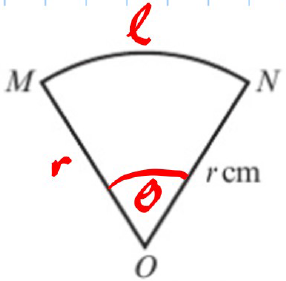
Solution for (a): Write out the info given in question. This will be used to eliminate a variable.
Write the formula for the required quantities.
Use to eliminate the unnecessary variable:
Note
(b) Solution:
Differentiate to find the minimum:
Since represents a length, we take .
:::
Note
Q4 (Edexcel 6664, Jan 2012, Q8) Figure shows a flowerbed. Its shape is a quarter of a circle of radius meters with two equal rectangles attached to it along its radii. Each rectangle has a length equal to meters and width equal to meters.
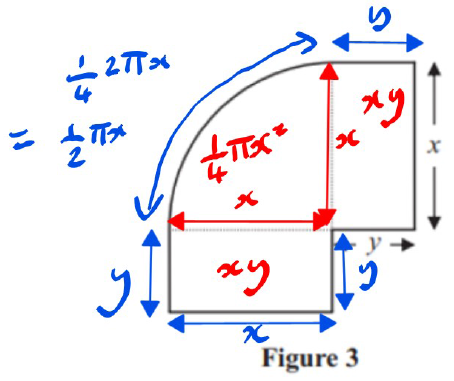
Given that the area of the flowerbed is 4 m²,
(a) Show that
(b) Hence show that the perimeter meters of the flowerbed is given by the equation
Note: No 's, so use (a) to eliminate 's.
(c) Use calculus to find the minimum value of .
(d) Find the width of each rectangle when the perimeter is a minimum. Give your answer to the nearest centimetre.
Solution: (a)
Note
(b)
Note
(c)
Note
(d)
:::