First Principles Differentiation - Trigonometry (Edexcel A-Level Mathematics): Revision Notes
📚Revision Notes
7.3.1 First Principles Differentiation - Trigonometry
First principles differentiation (or differentiation from first principles) is the process of finding the derivative of a function using the basic definition of the derivative, without relying on shortcuts or standard rules. When applied to trigonometric functions, this method involves using the limit definition of the derivative.
1. Definition of the Derivative:
Note
The derivative of a function with respect to x at a point x is defined by the limit: This formula represents the slope of the tangent line to the curve at the point x.
2. Differentiating from First Principles:
Note
To find the derivative of using first principles, we use the definition of the derivative:
Step 1: Use the Sine Addition Formula:
The sine addition formula states: Substitute this into the limit definition:
Step 2: Factor and Simplify:
Factor out from the terms involving \sin(x):
This expression can be separated into two limits:
Step 3: Evaluate the Limits:
There are two important trigonometric limits to know:
- Using these limits:
So, the derivative of is:
3. Differentiating from First Principles:
Note
To find the derivative of using first principles, follow a similar process:
Step 1: Use the Cosine Addition Formula:
The cosine addition formula states: Substitute this into the limit definition:
Step 2: Factor and Simplify:
Factor out :
This can be separated into two limits:
Step 3: Evaluate the Limits:
Using the same trigonometric limits:
So, the derivative of is:
4. Summary of First Principles Differentiation for Trigonometric Functions:
- The derivative of
- The derivative of These results are fundamental in calculus and are often used as a basis for deriving the derivatives of other trigonometric functions.
Differentiating Trig Functions
Note
- Proof:
- Expand using compound angle formula:
- Small Angle Approximations:
Note
- Proof:
- Expand using compound angle formula:
Note
Let
Using the quotient rule:
Note
Proof:
Let
Using the chain rule:
Using the Formula Sheet
Differentiation:
Note
e.g. If . Using the chain rule:
(Differentiate expression without looking in bracket by diff of bracket)
Note
e.g. Find the differential of . Using the quotient rule:
Note
Find for .
Using the product rule:
:::
Note
Example: Find 3. Rewrite
- Use Chain Rule
Note
[OCR 4753, Jan 2010, Q8
] Fig. 8 shows part of the curve .The curve crosses the x-axis at O, P and Q.
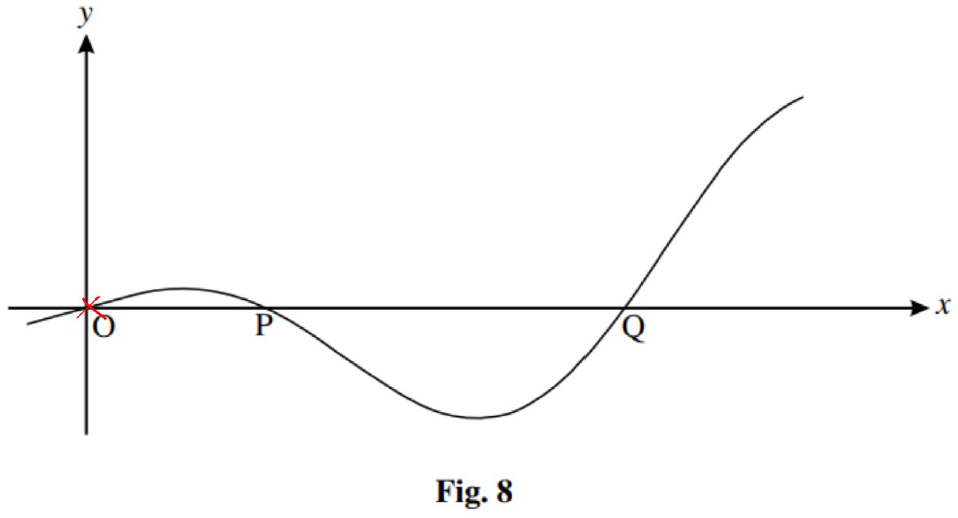
(i) Find the exact coordinates of P and Q.
(ii) Find the exact gradient of the curve at the point P.
Show also that the turning points of the curve occur when .
Solution: (i) At
Note
(ii)
Let
Note
Turning points occur when
:::