Further Applications of Differentiation (Edexcel A-Level Mathematics): Revision Notes
📚Revision Notes
7.4.3 Connected Rates of Change
Connected rates of change (also known as related rates) involve problems where two or more quantities are changing with respect to time or another variable, and these rates of change are related through a given equation. These problems typically arise in physical situations where multiple quantities depend on each other.
1. Understanding Connected Rates of Change:
In related rates problems, you are typically given:
- The rate of change of one quantity with respect to time (or another variable).
- A relationship between the quantities involved (usually an equation).
- You need to find the rate of change of another quantity.
2. Steps to Solve Related Rates Problems:
Note
- Identify the quantities involved: Determine which quantities are changing with respect to time (or another variable).
- Write down the relationship: Express the relationship between the quantities using an equation.
- Differentiate the equation with respect to time: Use implicit differentiation to find the rates of change of the quantities with respect to time (or the other variable).
- Substitute known values: Plug in the given values (including the known rate of change) and solve for the unknown rate of change.
- Interpret the result: Make sure the solution makes sense in the context of the problem.
3. Example Problems:
Note
Example 1: Expanding Circle
Problem: A circle's radius is increasing at a rate of per second. How fast is the area of the circle increasing when the radius is ?
- Step 1: Identify the quantities involved:
- Let be the radius of the circle at time .
- Let be the area of the circle at time .
- Given: =
- Find: when
- Step 2: Write down the relationship:
- The area of a circle is given by
- Step 3: Differentiate the equation with respect to time:
- Step 4: Substitute known values:
- When
- Step 5: Interpret the result:
- The area of the circle is increasing at a rate of square centimetres per second when the radius is .
Note
Example 2: Draining Water from a Conical Tank
Problem: Water is draining from a conical tank at a rate of cubic meters per minute. If the tank has a height of meters and a base radius of 6 meters, how fast is the water level falling when the water is meters deep?
- Step 1: Identify the quantities involved:
- Let V(t) be the volume of water in the tank at time t .
- Let h(t) be the height of the water in the tank at time t .
- Given: = -3 (negative because the volume is decreasing).
- Find: when h = 4 meters.
- Step 2: Write down the relationship:
- The volume of a cone is
- The radius of the water surface and the height h of the water are related by similar triangles:
- So,
- Step 3: Substitute into the volume formula:
-
Step 4: Differentiate the equation with respect to time:
-
Step 5: Substitute known values:
-
Given meters:
-
-
Step 6: Interpret the result:
-
The water level is falling at a rate of meters per minute when the water is meters deep.
4. Common Applications of Related Rates:
- Geometry Problems: Changing dimensions of geometric shapes (e.g., expanding circles, shrinking spheres, growing triangles).
- Physics: Motion problems where different rates (e.g., speed, acceleration) are related.
- Fluid Dynamics: Problems involving the rate of change of volume, surface area, or height of fluids in containers.
- Engineering: Systems where multiple variables change over time and are interdependent.
5. Key Points to Remember:
Note
- Always start by identifying the relationship between the quantities involved.
- Use implicit differentiation when necessary, and always differentiate with respect to the independent variable, typically time.
- Pay attention to the signs of the rates (positive for increasing quantities, negative for decreasing quantities).
Note
Connected Rates of Change
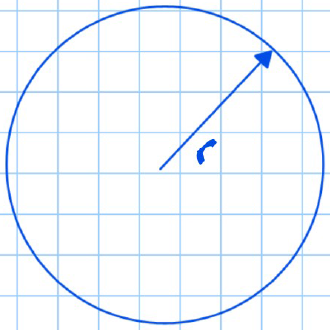
The radius of a circle is increasing at a constant rate of .
a) Show that the perimeter of the circle is increasing at the rate of .
b) Find the rate at which the area of the circle is increasing when the radius is .
c) Find the radius of the circle when its area is increasing at the rate of .
Solution:
a)
b)
c)
Note
The area of a circle is decreasing at a constant rate of . a) Find the rate at which the radius of the circle is decreasing when the radius is .
b) Find the rate at which the perimeter of the circle is decreasing when the radius is .
Solution:
a)