8.2.10 Area between 2 curves
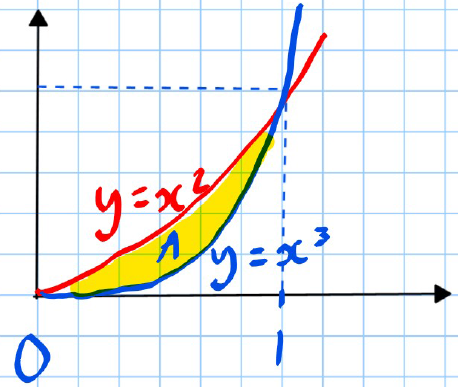
Integration: Further Area Area Between Two Curves Find the area of the shaded region A A A
Area between the uppermost curve and the x x x -axis, take the area between the lowermost curve and the x x x -axis.
A 1 = ∫ 0 1 x 2 d x = [ 1 3 x 3 ] 0 1 = ( 1 3 ( 1 ) 3 − 1 3 ( 0 ) 3 ) = 1 3 A_1 = \int_0^1 x^2 \, dx = \left[ \frac{1}{3}x^3 \right]_0^1 = \left( \frac{1}{3}(1)^3 - \frac{1}{3}(0)^3 \right) = \frac{1}{3} A 1 = ∫ 0 1 x 2 d x = [ 3 1 x 3 ] 0 1 = ( 3 1 ( 1 ) 3 − 3 1 ( 0 ) 3 ) = 3 1 A 2 = ∫ 0 1 x 3 d x = [ 1 4 x 4 ] 0 1 = ( 1 4 ( 1 ) 4 − 1 4 ( 0 ) 4 ) = 1 4 A_2 = \int_0^1 x^3 \, dx = \left[ \frac{1}{4}x^4 \right]_0^1 = \left( \frac{1}{4}(1)^4 - \frac{1}{4}(0)^4 \right) = \frac{1}{4} A 2 = ∫ 0 1 x 3 d x = [ 4 1 x 4 ] 0 1 = ( 4 1 ( 1 ) 4 − 4 1 ( 0 ) 4 ) = 4 1 Therefore:
A = 1 3 − 1 4 = 1 12 A = \frac{1}{3} - \frac{1}{4} = \frac{1}{12} A = 3 1 − 4 1 = 12 1 Alternative Method ∫ 0 1 x 2 − x 3 d x = [ 1 3 x 3 − 1 4 x 4 ] 0 1 = ( 1 3 ( 1 ) 3 − 1 4 ( 1 ) 4 ) − ( 1 3 ( 0 ) 3 − 1 4 ( 0 ) 4 ) = 1 12 \int_0^1 x^2 - x^3 \, dx = \left[ \frac{1}{3}x^3 - \frac{1}{4}x^4 \right]_0^1 = \left( \frac{1}{3}(1)^3 - \frac{1}{4}(1)^4 \right) - \left( \frac{1}{3}(0)^3 - \frac{1}{4}(0)^4 \right) = \frac{1}{12} ∫ 0 1 x 2 − x 3 d x = [ 3 1 x 3 − 4 1 x 4 ] 0 1 = ( 3 1 ( 1 ) 3 − 4 1 ( 1 ) 4 ) − ( 3 1 ( 0 ) 3 − 4 1 ( 0 ) 4 ) = 12 1 Area Between a Curve and the y y y -Axis The formula for the area under a curve (i.e., between the curve and the x x x
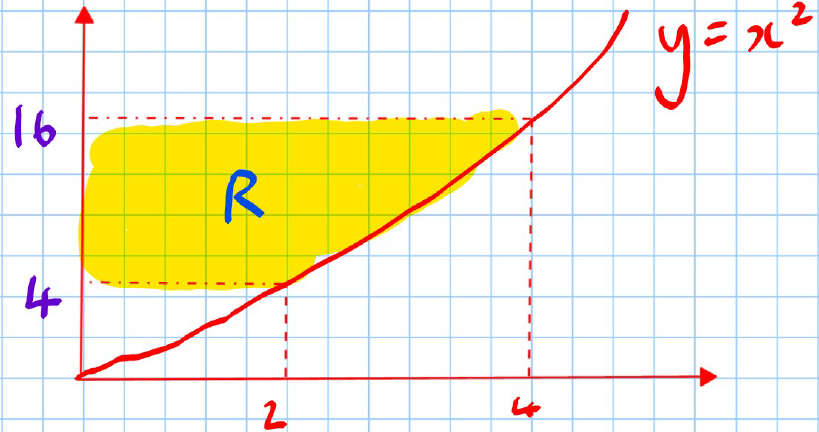
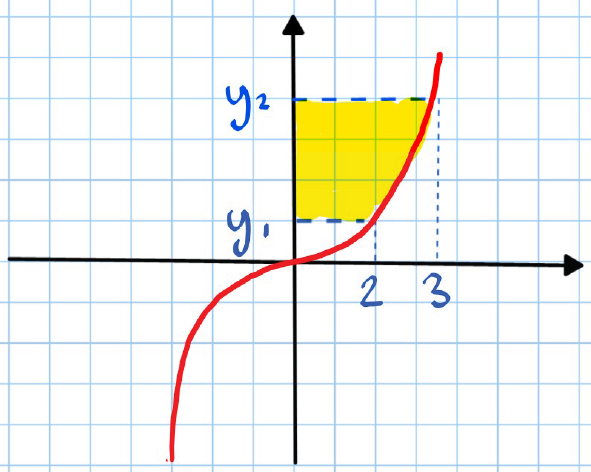
∫ x 1 x 2 y d x \int_{x_1}^{x_2} y \, dx ∫ x 1 x 2 y d x The formula for the area between a curve and the y y y
∫ y 1 y 2 x d y \int_{y_1}^{y_2} x \, dy ∫ y 1 y 2 x d y
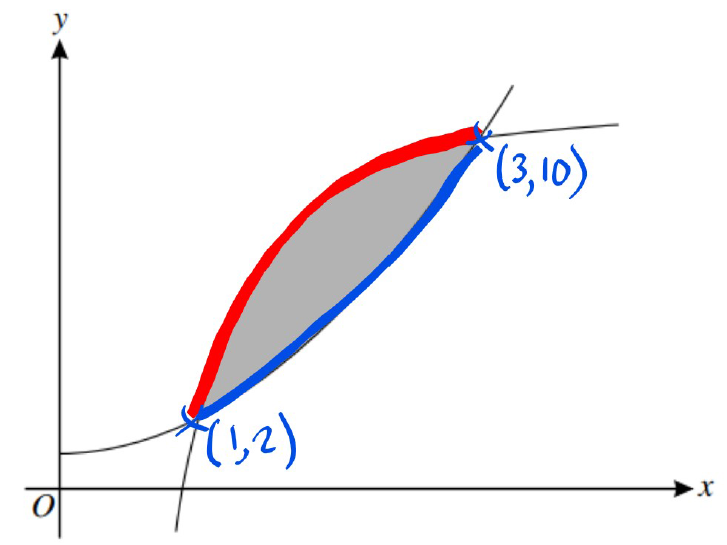
Find the area between the "upper curve" (red) and the x-axis:
∫ 1 3 ( 11 − 9 x 2 ) d x = ∫ 1 3 11 − 9 x − 2 d x \int_1^3 \left( 11 - \frac{9}{x^2} \right) dx = \int_1^3 11 - 9x^{-2} dx ∫ 1 3 ( 11 − x 2 9 ) d x = ∫ 1 3 11 − 9 x − 2 d x = [ 11 x + 9 x − 1 ] 1 3 = \left[ 11x + 9{x^{-1}} \right]_1^3 = [ 11 x + 9 x − 1 ] 1 3 = ( 11 ( 3 ) + 9 ( 3 ) − 1 ) − ( 11 ( 1 ) + 9 ( 1 ) − 1 ) = 16 = (11(3) + 9(3)^{-1}) - (11(1) + 9(1)^{-1}) = 16 = ( 11 ( 3 ) + 9 ( 3 ) − 1 ) − ( 11 ( 1 ) + 9 ( 1 ) − 1 ) = 16
Find the area between the "lower curve" (blue) and the x x x -axis:
∫ 1 3 ( x 2 + 1 ) d x = [ x 3 3 + x ] 1 3 = ( 3 3 3 + 3 ) − ( 1 3 3 + 1 ) = 32 3 \int_1^3 \left( x^2 + 1 \right) dx = \left[ \frac{x^3}{3} + x \right]_1^3 = \left( \frac{3^3}{3} + 3 \right) - \left( \frac{1^3}{3} + 1 \right) = \frac{32}{3} ∫ 1 3 ( x 2 + 1 ) d x = [ 3 x 3 + x ] 1 3 = ( 3 3 3 + 3 ) − ( 3 1 3 + 1 ) = 3 32
Subtract:
A = 16 − 32 3 = 16 3 A = 16 - \frac{32}{3} = \frac{16}{3} A = 16 − 3 32 = 3 16 Alternative Method: Subtract Before Evaluating Limits ∫ 1 3 11 − 9 x − 2 − ( x 2 + 1 ) d x = ∫ 1 3 10 − 9 x − 2 − x 2 d x \int_1^3 11 - 9{x^{-2}} - (x^2 + 1)\ dx = \int_1^3 10 - 9{x^{-2}} - x^2 \ dx ∫ 1 3 11 − 9 x − 2 − ( x 2 + 1 ) d x = ∫ 1 3 10 − 9 x − 2 − x 2 d x = [ 10 x + 9 x − 1 − x 3 3 ] 1 3 = \left[ 10x + 9{x^{-1}} - \frac{x^3}{3} \right]_1^3 = [ 10 x + 9 x − 1 − 3 x 3 ] 1 3 = ( 10 ( 3 ) + 9 ( 3 ) − 1 − 3 3 3 ) − ( 10 ( 1 ) + 9 ( 1 ) − 1 − 1 3 3 ) = 16 3 = \left( 10(3) + 9(3)^{-1} - \frac{3^3}{3} \right) - \left( 10(1) + 9(1)^{-1} - \frac{1^3}{3} \right) = \frac{16}{3} = ( 10 ( 3 ) + 9 ( 3 ) − 1 − 3 3 3 ) − ( 10 ( 1 ) + 9 ( 1 ) − 1 − 3 1 3 ) = 3 16
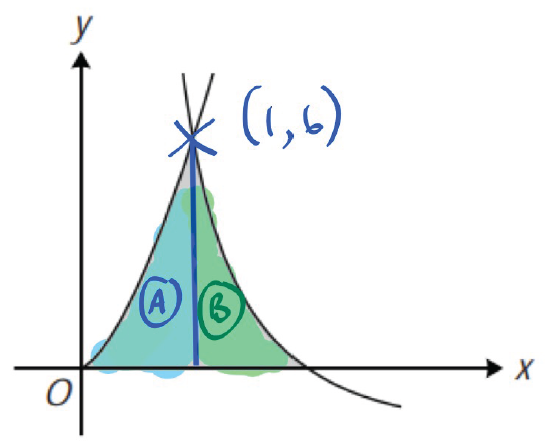
The diagram shows the curve y = 6 x 3 2 y = 6x^{\frac{3}{2}} y = 6 x 2 3 y = 8 x 2 − 2 y = \frac{8}{x^2} - 2 y = x 2 8 − 2 ( 1 , 6 ) (1, 6) ( 1 , 6 )
Region (A)
∫ 0 1 6 x 3 2 d x = [ 2 5 × 6 x 5 2 ] 0 1 = [ 12 5 x 5 2 ] 0 1 = ( 12 5 ( 1 ) ) − ( 12 5 ( 0 ) ) \int_0^1 6x^{\frac{3}{2}} \, dx = \left[ \frac{2}{5} \times 6x^{\frac{5}{2}} \right]_0^1 = \left[ \frac{12}{5} x^{\frac{5}{2}} \right]_0^1 = \left( \frac{12}{5}(1)\right) - \left( \frac{12}{5}(0) \right) ∫ 0 1 6 x 2 3 d x = [ 5 2 × 6 x 2 5 ] 0 1 = [ 5 12 x 2 5 ] 0 1 = ( 5 12 ( 1 ) ) − ( 5 12 ( 0 ) ) = 12 5 = \frac{12}{5} = 5 12
Region (B)
Root of y = 8 x 2 − 2 y = \frac{8}{x^2} - 2 y = x 2 8 − 2 :
Let y = 0 ⇒ 0 = 8 x 2 − 2 ⇒ 0 = 8 − 2 x 2 ⇒ 8 = 2 x 2 = 8 ⇒ x 2 = 4 \text{Let } y = 0 \Rightarrow 0 = \frac{8}{x^2} - 2 \Rightarrow 0 = 8 - 2x^2 \Rightarrow 8 = 2x^2 =8 \Rightarrow x^2 = 4 Let y = 0 ⇒ 0 = x 2 8 − 2 ⇒ 0 = 8 − 2 x 2 ⇒ 8 = 2 x 2 = 8 ⇒ x 2 = 4 ⇒ x = 2 or x = − 2 ( not valid since x > 0 ) \Rightarrow x = 2 \text{ or } x = -2 \, (\text{not valid since } x > 0) ⇒ x = 2 or x = − 2 ( not valid since x > 0 ) ∴ ∫ 1 2 8 x − 2 − 2 d x = [ − 8 x − 1 − 2 x ] 1 2 = ( − 8 ( 2 ) − 2 − 2 ( 2 ) ) − ( − 8 ( 1 ) − 1 − 2 ( 1 ) ) \therefore \int_1^2 8{x^{-2}} - 2 \ dx = \left[- 8x^{-1}- 2x \right]_1^2 = \left( -8(2)^{-2} - 2(2) \right) - \left( -8(1)^{-1} - 2(1) \right) ∴ ∫ 1 2 8 x − 2 − 2 d x = [ − 8 x − 1 − 2 x ] 1 2 = ( − 8 ( 2 ) − 2 − 2 ( 2 ) ) − ( − 8 ( 1 ) − 1 − 2 ( 1 ) ) = 2 = 2 = 2
Total Area:
Area = ( A ) + ( B ) = 12 5 + 2 = 22 5 \text{Area} = (A) + (B) = \frac{12}{5} + 2 = \frac{22}{5} Area = ( A ) + ( B ) = 5 12 + 2 = 5 22 Integration: Area Between a Curve and the y y y -Axis To find the area between a curve and the x x x
∫ x 1 x 2 y d x \int_{x_1}^{x_2} y \, dx ∫ x 1 x 2 y d x To find the area between a curve and the y y y
∫ y 1 y 2 x d y (using y-limits, not x-limits) \int_{y_1}^{y_2} x \, dy \quad \text{(using y-limits, not x-limits)} ∫ y 1 y 2 x d y (using y-limits, not x-limits)
Solution
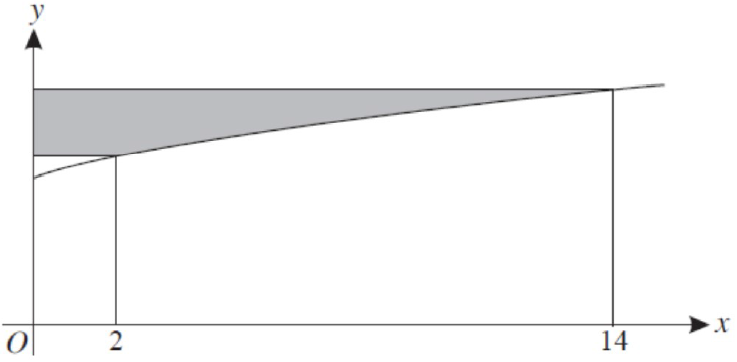
(i) Start with the equation of the curve:
y = 3 + x + 2 y = 3 + \sqrt{x+2} y = 3 + x + 2 Rearrange to solve for x x x
y − 3 = x + 2 ⇒ ( y − 3 ) 2 = x + 2 ⇒ x = ( y − 3 ) 2 − 2 y - 3 = \sqrt{x+2} \Rightarrow (y-3)^2 = x+2 \Rightarrow x = (y-3)^2 - 2 y − 3 = x + 2 ⇒ ( y − 3 ) 2 = x + 2 ⇒ x = ( y − 3 ) 2 − 2 = y 2 − 6 y + 9 − 2 = y 2 − 6 y + 7 =y^2-6y+9-2 = y^2-6y+7 = y 2 − 6 y + 9 − 2 = y 2 − 6 y + 7 When x = 2 ⇒ y = 3 + 2 + 2 = 5 x = 2 \Rightarrow y =3+\sqrt {2+2} = 5 x = 2 ⇒ y = 3 + 2 + 2 = 5
When x = 14 ⇒ y = 3 + 14 + 2 = 7 x = 14 \Rightarrow y = 3 + \sqrt {14+2} = 7 x = 14 ⇒ y = 3 + 14 + 2 = 7
Therefore Area
∫ 5 7 y 2 − 6 y + 7 d y \int_5^7 y^2 - 6y + 7 \, dy ∫ 5 7 y 2 − 6 y + 7 d y (ii) Calculate the area using the integral:
∫ 5 7 ( y 2 − 6 y + 7 ) d y = [ y 3 3 − 3 y 2 + 7 y ] 5 7 \int_5^7 (y^2 - 6y + 7) \, dy = \left[\frac{y^3}{3} - 3y^2 + 7y\right]_5^7 ∫ 5 7 ( y 2 − 6 y + 7 ) d y = [ 3 y 3 − 3 y 2 + 7 y ] 5 7 Substitute the limits 5 and 7 :
= ( 7 3 3 − 3 ( 7 2 ) + 7 ( 7 ) ) − ( 5 3 3 − 3 ( 5 2 ) + 7 ( 5 ) ) = \left(\frac{7^3}{3} - 3(7^2) + 7(7)\right) - \left(\frac{5^3}{3} - 3(5^2) + 7(5)\right) = ( 3 7 3 − 3 ( 7 2 ) + 7 ( 7 ) ) − ( 3 5 3 − 3 ( 5 2 ) + 7 ( 5 ) ) = 44 3 = \frac{44}{3} = 3 44