Proof by Exhaustion (Edexcel A-Level Mathematics): Revision Notes
📚Revision Notes
1.1.3 Proof by Exhaustion
In this type of proof, you consider every possible case to validate the proof.
Steps to Perform Proof by Exhaustion:
- Identify the statement to be proven and the possible cases that need to be considered.
- Break down the problem into a finite number of distinct cases. Make sure that all cases cover every possible scenario.
- Prove the statement for each case individually, showing that it holds true in each situation.
- Conclude that the statement is true for all cases, thereby proving the original statement.
Note
Example: Prove that the sum of two odd numbers is always even for all cases involving single-digit odd numbers.
Step 1: Identify possible cases
The single-digit odd numbers are: 1, 3, 5, 7, 9
Step 2: List all pairings of odd numbers:
Step 3: Calculate each sum
- (even)
- (even)
- (even)
- (even)
- (even)
- (even)
- (even)
- (even)
- (even)
- (even)
- (even)
- (even)
- (even)
- (even)
- (even)
Step 4: Conclusion
Since all possible cases yield even results, we conclude that the sum of two odd numbers is always even.
This is an example of proof by exhaustion, as we've checked every possible case.
Note
Example: Prove by exhaustion that 47 is prime.
- The idea: Check every possible factor of to see if an integer is obtained.
- : not a factor
- : not a factor
- : not a factor
- : not a factor
- : not a factor
Note: Only need to go up to the last integer less than
Conclusion
- Since all integers are not factors of ,
- Therefore, 47 is prime.
Alternative Method Using the Calculator
Steps:
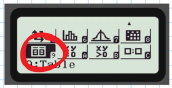
- Go to table mode:
- Input the number we are checking as prime, denoted by a variable x:
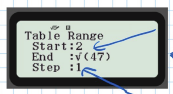
- Set start, end, and increment values:
- Start:
- End: Integer closest to but less than
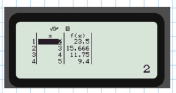
- Read off answers: