Bond Enthalpies (OCR A-Level Chemistry A): Revision Notes
📚Revision Notes
Bond Enthalpies
What is average bond enthalpy?
When we study chemical reactions, we need to understand the energy changes that occur when bonds break and form. Average bond enthalpy is defined as the energy required to break one mole of a specific type of bond in a gaseous molecule.
This concept allows us to estimate enthalpy changes for reactions without conducting experiments in the laboratory. However, it's important to understand both the usefulness and limitations of this approach.
Key characteristics of bond enthalpies
Important
There are three fundamental points you must remember about bond enthalpies:
- Breaking bonds always requires energy - you must supply energy to overcome the attractive forces holding atoms together in a bond
- Bond breaking is an endothermic process - this means energy is absorbed from the surroundings
- Bond enthalpies always have positive values - this reflects the endothermic nature of bond breaking
The table below shows average bond enthalpies for common covalent bonds that you'll encounter in A-Level chemistry:
| Bond | Average bond enthalpy (kJ mol⁻¹) |
|---|---|
| C—H | 413 |
| C—C | 347 |
| C—O | 358 |
| O—H | 464 |
| O=O | 498 |
| N≡N | 945 |
| C=C | 612 |
| C=O | 805 |
| N—H | 391 |
| H—H | 436 |
| Cl—Cl | 243 |
| Br—Br | 193 |
| I—I | 151 |
| H—Cl | 432 |
| H—Br | 366 |
| H—I | 298 |
Note
Notice how triple bonds (like N≡N) have much higher bond enthalpies than single bonds, indicating they are much stronger and require more energy to break. This pattern reflects the relationship between bond order and bond strength.
Why do bond enthalpies vary?
A crucial limitation of using average bond enthalpies is that the actual energy needed to break a specific bond can vary depending on its chemical environment. The molecule's structure and neighbouring atoms influence the bond strength.
Consider the C—H bond in different hydrocarbon molecules:
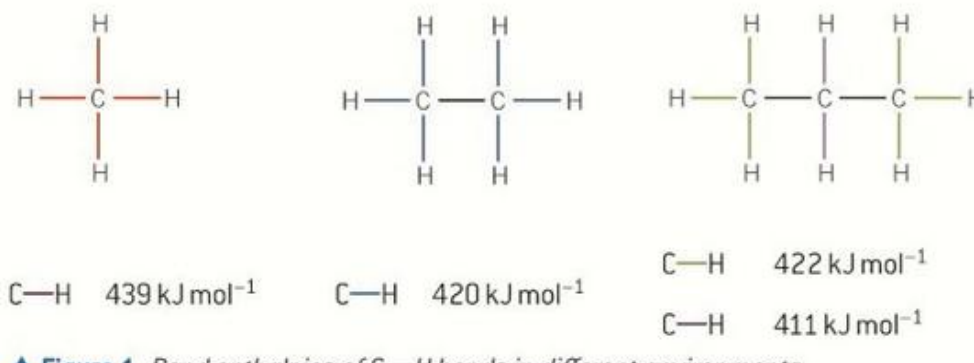
The C—H bond enthalpy varies from 411 kJ mol⁻¹ to 439 kJ mol⁻¹ depending on whether the carbon is in methane, ethane, or propane. This variation occurs because:
- The electronic environment around the carbon atom differs in each molecule
- Adjacent carbon atoms affect electron distribution
- The position of the carbon (primary, secondary, or tertiary) influences bond strength
Note
The values in data tables represent an average calculated from bond enthalpies measured in many different chemical environments. When you use these values in calculations, you're working with an approximation rather than an exact figure.
Bond breaking and bond making in reactions
During chemical reactions, existing bonds in reactants must break, and new bonds form to create products. Understanding the energy changes in these two processes is essential for determining whether a reaction is exothermic or endothermic.
Energy changes in bond processes
The energy changes can be summarised as follows:
Important
Bond breaking:
- Requires energy input
- Is an endothermic process
- Results in a positive enthalpy change ( is positive)
Bond making:
- Releases energy to the surroundings
- Is an exothermic process
- Results in a negative enthalpy change ( is negative)
The overall enthalpy change of a reaction depends on the balance between these two opposing processes. If more energy is released during bond making than is required for bond breaking, the reaction is exothermic overall. Conversely, if bond breaking requires more energy than is released during bond making, the reaction is endothermic.
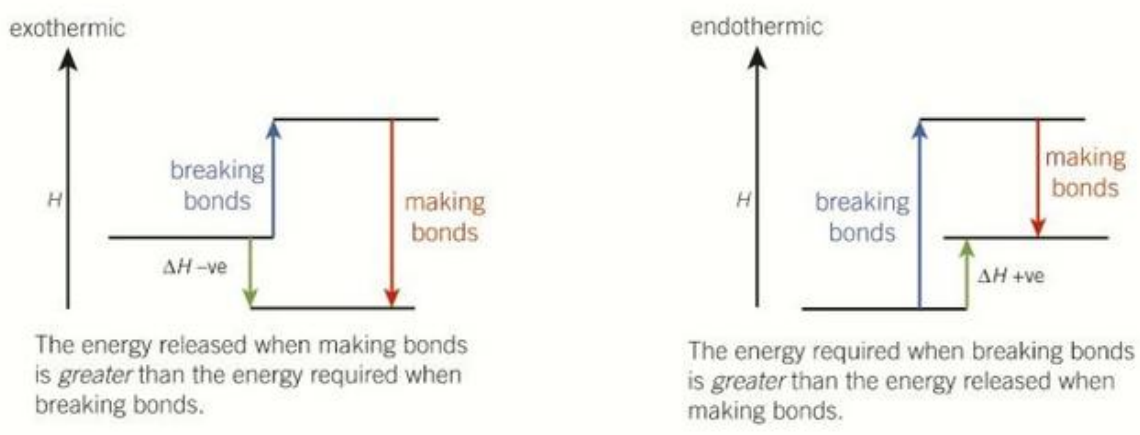
The energy profile diagrams above illustrate this principle clearly. In an exothermic reaction (left diagram), the energy released when making bonds exceeds the energy needed to break bonds, giving a negative overall . In an endothermic reaction (right diagram), breaking bonds requires more energy than making bonds releases, resulting in a positive .
Calculating enthalpy changes using bond enthalpies
You can calculate the enthalpy change for a reaction involving gaseous covalent substances using average bond enthalpies. The key formula you need to remember is:
The symbol (Greek letter sigma) represents "sum of", indicating you must add up all the relevant bond enthalpies.
Example
Worked Example: Combustion of Propane
Let's calculate the enthalpy change for the complete combustion of propane:
Step 1: Identify all bonds in reactants and products
When working through this type of problem, always draw out the structural formulae showing all bonds. This prevents the common mistake of counting bonds incorrectly.
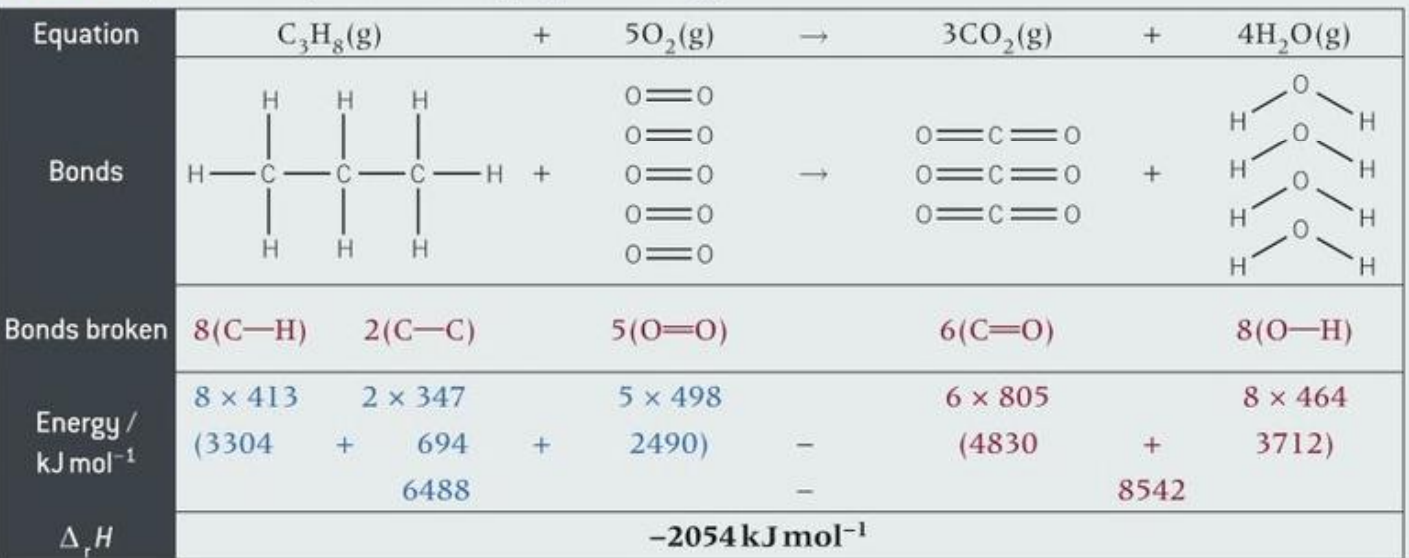
Step 2: Count the bonds and calculate energies
Bonds broken in reactants:
- 8 × C—H bonds:
- 2 × C—C bonds:
- 5 × O=O bonds:
- Total energy required =
Bonds formed in products:
- 6 × C=O bonds:
- 8 × O—H bonds:
- Total energy released =
Step 3: Calculate the overall enthalpy change
The negative value confirms this is an exothermic reaction, as expected for combustion.
Important limitations to remember
While bond enthalpy calculations are useful, you must be aware of their limitations:
Limitation 1: Chemical environment effects
Important
As we discussed earlier, the actual bond enthalpy varies with chemical environment. The values we use are averages, so the calculated enthalpy change will be slightly different from the actual value you'd measure experimentally. However, despite this limitation, calculated values should be in general agreement with experimental results.
Limitation 2: Gaseous molecules requirement
Important
Bond enthalpy calculations require all species to be gaseous molecules. This is because bond enthalpies are defined for breaking bonds in gaseous molecules.
If your reaction involves liquids or solids, the calculated enthalpy change is not a standard enthalpy change. For example, in the propane combustion above, water is produced as a gas, , not as a liquid. If you wanted the standard enthalpy change of combustion, you'd also need to account for the enthalpy change when water vapour condenses to liquid water.
Common exam mistakes and tips
Note
Common mistake 1: Incorrect bond counting
Many students lose marks by miscounting bonds, especially in organic molecules. Always draw out the full structural formula showing every bond before starting your calculation.
Common mistake 2: Sign errors
Remember that bonds broken are positive (energy required) and bonds made are negative (energy released). The formula subtracts bonds made from bonds broken.
Common mistake 3: Using wrong bond type
Make sure you identify the correct bond type. For example, C=O in carbon dioxide is a double bond (805 kJ mol⁻¹), while C—O is a single bond (358 kJ mol⁻¹).
Exam tip: In questions where you're only provided with an equation, always take the time to draw out all the bonds first. This systematic approach, though it takes an extra minute, prevents costly errors in counting bonds.
Practice context: bond enthalpies and combustion
Understanding how bond enthalpies relate to combustion patterns can help deepen your understanding. For example, the enthalpy change of combustion becomes more negative (releases more energy) as the carbon chain length increases in alcohols:
Note
This trend exists because each additional CH₂ group adds more C—H and C—C bonds that can be broken and more opportunities for C=O and O—H bonds to form, with the energy balance favouring greater energy release.
Remember!
Summary
Key Points to Remember:
- Average bond enthalpy is the energy required to break one mole of a specific bond type in a gaseous molecule
- Bond breaking is always endothermic (positive ) while bond making is always exothermic (negative )
- Calculate enthalpy changes using:
- Always draw out all bonds in molecules before attempting calculations to avoid counting errors
- Bond enthalpy values are averages - actual values vary with chemical environment, so calculated results are approximations
- Calculations using bond enthalpies require gaseous species - they don't give standard enthalpy changes if liquids or solids are involved
- Triple bonds are much stronger than double bonds, which are stronger than single bonds - this is reflected in their bond enthalpy values