The Periodic Table (OCR A-Level Chemistry A): Revision Notes
📚Revision Notes
The Periodic Table
Historical development of the periodic table
The periodic table stands as one of chemistry's most important organizational tools, but its development took considerable time and insight. Understanding how the table evolved helps us appreciate its modern structure and predictive power.
Mendeleev's periodic table
In the mid-19th century, when Dimitri Mendeleev began his work, approximately 60 chemical elements had been discovered. At this time, scientists had no knowledge of subatomic particles or atomic numbers. Working with the information available, Mendeleev made a crucial decision: he arranged the known elements in order of increasing atomic mass.
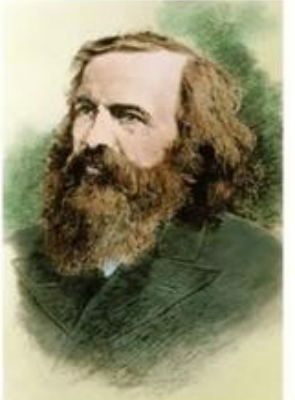
However, Mendeleev went further than simple ordering. He recognized that elements with similar chemical and physical properties appeared at regular intervals when arranged by mass. This led him to organize elements into groups based on these shared characteristics. When the pattern didn't quite fit, Mendeleev made a bold move - he assumed that some atomic mass measurements contained errors and that undiscovered elements would fill the gaps in his table.
Note
Mendeleev's confidence in his periodic system was so strong that he predicted the properties of missing elements using trends within groups. These predictions proved remarkably accurate when the elements were later discovered, validating his organizational approach.
Example
Worked Example: Mendeleev's Prediction of Ekasilicon
In 1871, Mendeleev predicted an element he called "ekasilicon," which would fit in the gap below silicon in Group 14.
Mendeleev's Predictions (1871):
- Atomic mass: approximately 72
- Density: about 5.5 g cm⁻³
- Formula of oxide: EO₂
- Oxide density: around 4.7 g cm⁻³
When germanium was discovered in 1886:
- Actual atomic mass: 72.61
- Actual density: 5.35 g cm⁻³
- Formula of oxide: GeO₂
- Oxide density: 4.70 g cm⁻³
These accurate predictions, made for an element Mendeleev had never seen, demonstrated the power of his periodic system.
The true basis for the periodic table's organization became clear only in the early 1900s, when protons were discovered and scientists realized that atomic number, not atomic mass, was the fundamental organizing principle.
The modern periodic table
Today's periodic table contains 114 elements (as recognized in 2014) arranged in seven horizontal periods and 18 vertical groups. This table serves as the primary reference tool in chemistry - you'll find it displayed prominently in virtually every chemistry laboratory and classroom worldwide.
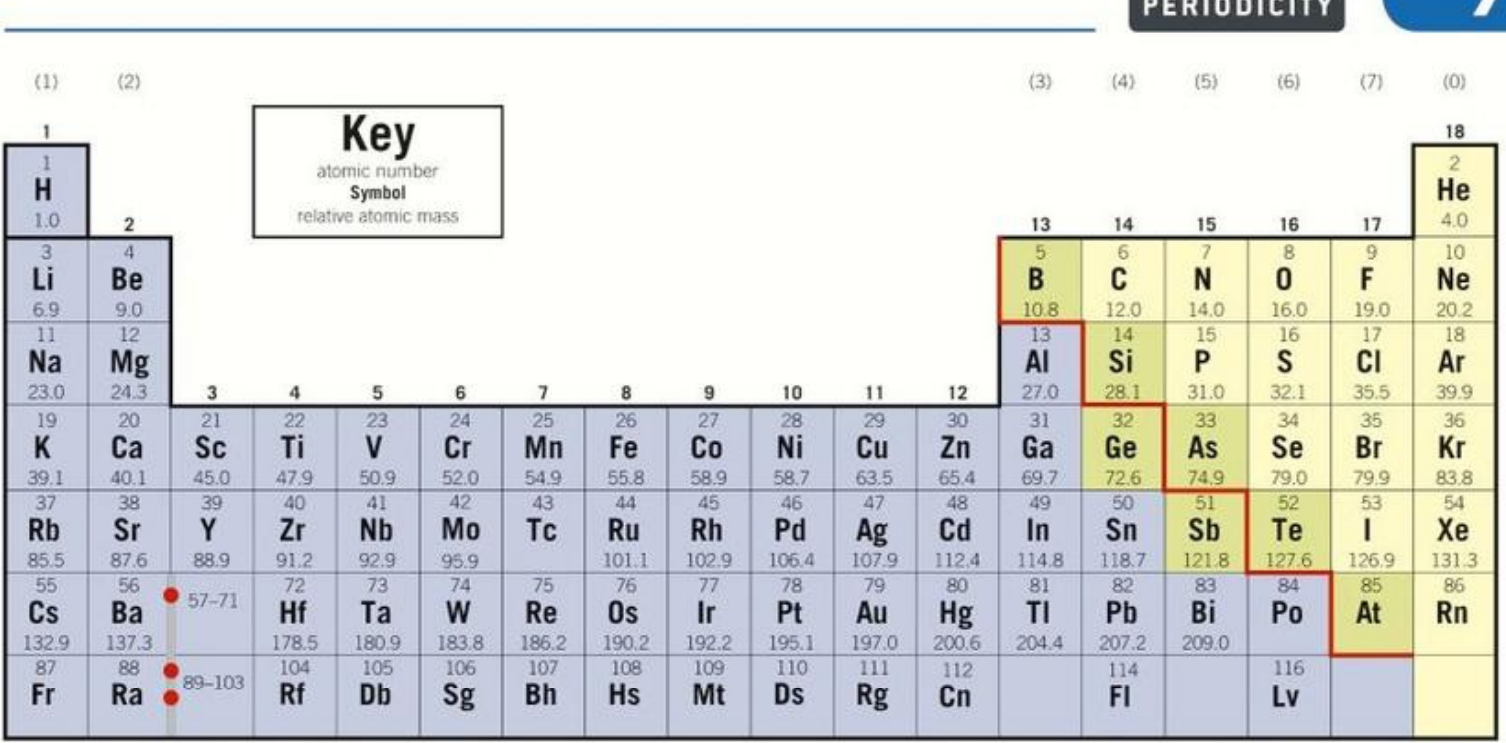

The periodic table's enduring importance comes from the direct relationship between an element's position and its properties. The arrangement pattern reveals trends that help chemists predict element behaviour, compound formation, and reaction outcomes. While you don't need to memorize the entire table, familiarity with common element positions proves extremely valuable. Most chemistry students naturally learn the atomic numbers and relative atomic masses of frequently encountered elements like hydrogen, carbon, nitrogen, and oxygen through regular use.
Organization of elements
The periodic table's structure reveals fundamental patterns in element properties. Understanding how elements are positioned helps you predict their chemical behaviour and recognize trends.
Atomic number
When reading the periodic table from left to right, elements appear in order of increasing atomic number. The atomic number represents the number of protons in an atom's nucleus. Moving from one element to the next adds exactly one proton. For example:
- Hydrogen (H) has 1 proton
- Helium (He) has 2 protons
- Lithium (Li) has 3 protons
- Beryllium (Be) has 4 protons
Important
This sequential arrangement by atomic number forms the fundamental organizing principle of the modern periodic table, replacing Mendeleev's original arrangement by atomic mass. The atomic number determines an element's identity and position, which in turn relates to its electron configuration and chemical properties.
Groups
The periodic table contains vertical columns called groups. Each group represents a family of elements that share important characteristics. The key factor uniting elements within a group is that their atoms contain the same number of electrons in their outer shell.
This similarity in outer-shell electron configuration leads directly to similar chemical properties. Elements in the same group typically:
- Form compounds with similar formulas
- Show similar reactivity patterns
- Display similar physical properties
- Undergo similar types of chemical reactions
Note
For example, all Group 1 elements (alkali metals) have one electron in their outer shell, which explains why they all react vigorously with water and form compounds with similar formulas (like NaCl, KCl, RbCl).
Periods and periodicity
The periodic table arranges elements in horizontal rows called periods. The period number indicates the highest energy electron shell occupied in an element's atoms. For instance:
- Period 2 elements have electrons in the first and second shells
- Period 3 elements have electrons filling up to the third shell
- Period 4 elements have electrons in shells up to the fourth level
Moving across any period from left to right reveals a repeating trend in properties called periodicity. This term describes the regular, predictable patterns that emerge as you progress through each period. Several important properties show periodic trends:
- Electron configuration patterns
- Ionization energy values
- Atomic structure types
- Melting point variations
The most obvious periodic trend involves the transition from metallic elements on the left side of each period to non-metallic elements on the right side. This chapter explores periodicity in several key properties, helping you understand how position in the periodic table relates to element behaviour.
Electron configuration patterns
An element's chemistry is determined primarily by its electron configuration, particularly the arrangement of electrons in the outer, highest energy shell. The periodic table's structure directly reflects systematic patterns in how electron shells and sub-shells fill.
Trend across a period
Each new period begins when electrons start occupying a new highest energy shell. The filling pattern within this shell follows a predictable sequence that repeats for each period.
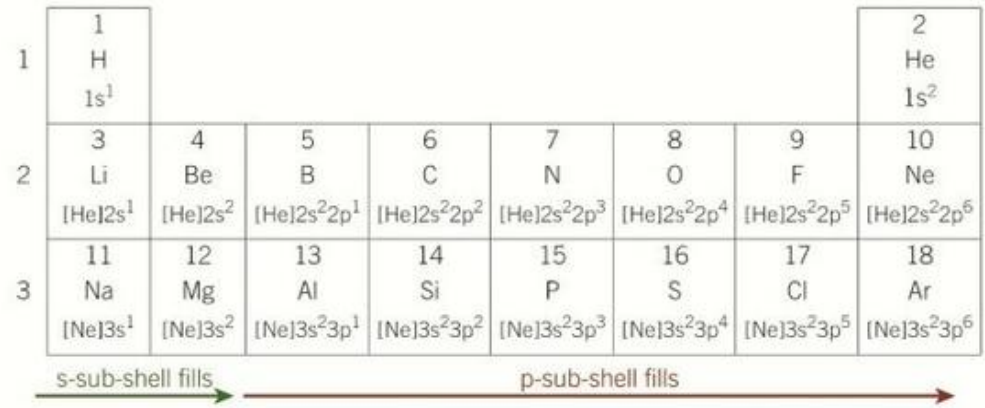
Consider what happens across Period 2:
- The 2s sub-shell fills first, accommodating two electrons
- Then the 2p sub-shell fills, holding six electrons
- This gives a total of eight electrons being added across Period 2
Period 3 follows exactly the same pattern:
- The 3s sub-shell fills with two electrons
- The 3p sub-shell fills with six electrons
- Eight elements span Period 3, matching the filling sequence
Even in Period 4, though the situation becomes more complex with the 3d sub-shell becoming involved, the highest shell number is . From the shell, only the 4s and 4p sub-shells are occupied by elements in Period 4.
Important
Key Pattern: For each period, the s- and p-sub-shells fill in the same way - creating a periodic pattern. This repeating sequence of sub-shell filling as you move across periods gives the periodic table its name and explains why similar chemical properties recur at regular intervals.
Trend down a group
Elements within the same group share a critical characteristic: their atoms contain the same number of outer-shell electrons. Furthermore, elements in each group have atoms with identical numbers of electrons in each occupied sub-shell.
For example, all Group 1 elements have a single s¹ electron in their outer shell, whether it's 2s¹ for lithium or 6s¹ for caesium. Similarly, Group 17 elements (halogens) all have an outer configuration ending in s²p⁵.
Note
This similarity in electron configuration, particularly in the outer shell, directly causes the similar chemistry observed within groups. The same number of outer electrons means elements in a group:
- Form similar types of bonds
- Show similar oxidation states
- React in comparable ways with the same reagents
- Form compounds with similar formulas and structures
The main difference between elements in a group is the principal quantum number (shell number) of the outer electrons, which affects properties like atomic radius and ionization energy, but the fundamental chemical behaviour remains similar due to the matching outer electron arrangement.
Blocks in the periodic table
The periodic table can be divided into distinct regions called blocks, classified according to the highest energy sub-shell being filled in that region. This creates four main blocks: s, p, d, and f.
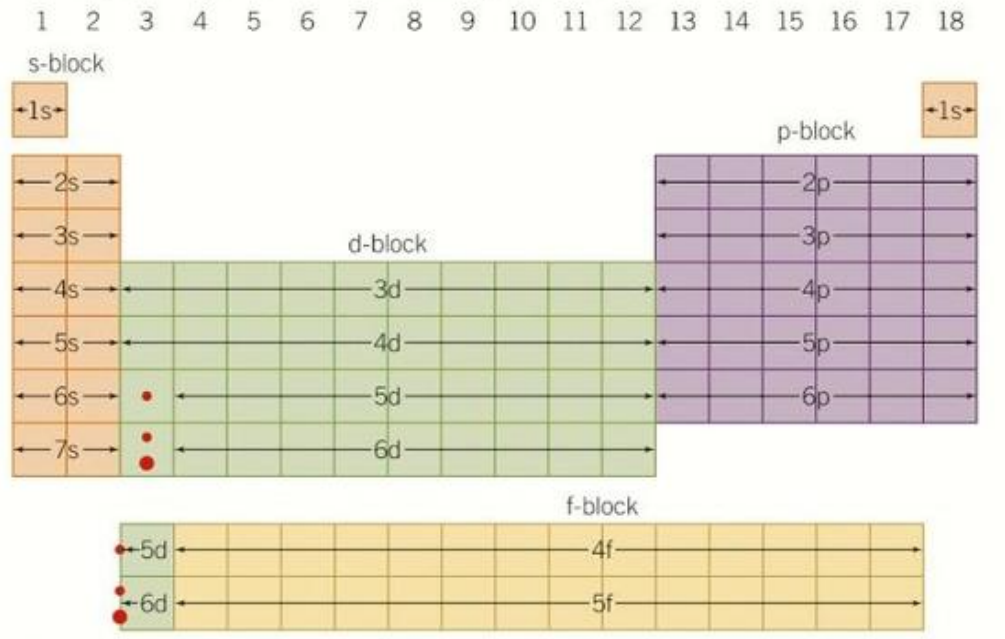
The s-block occupies the left side of the periodic table, comprising Groups 1 and 2. Elements in this block have their highest energy electrons in an s sub-shell. Since s sub-shells hold a maximum of two electrons, the s-block spans two groups in width.
The p-block sits on the right side of the periodic table, encompassing Groups 13-18. Elements here fill p sub-shells as their highest energy orbitals. Because p sub-shells accommodate up to six electrons, the p-block contains six groups.
The d-block forms the central section, containing the transition elements found in Groups 3-12. These elements fill d sub-shells, which can hold ten electrons maximum, resulting in ten groups within the d-block. An important feature of d-block elements is that whilst their highest energy electrons enter d sub-shells, these d sub-shells actually belong to the shell one below the period number (e.g., Period 4 elements fill the 3d sub-shell).
The f-block appears separately at the bottom of the periodic table and includes the lanthanides (Period 6) and actinides (Period 7). These elements fill f sub-shells, which can hold fourteen electrons. The f-block is typically shown detached from the main table simply to keep the periodic table's width manageable.
Note
Understanding the block structure helps you quickly determine which sub-shell is being filled for any element, allowing you to predict electron configurations and chemical behaviour more easily.
Group naming and numbering
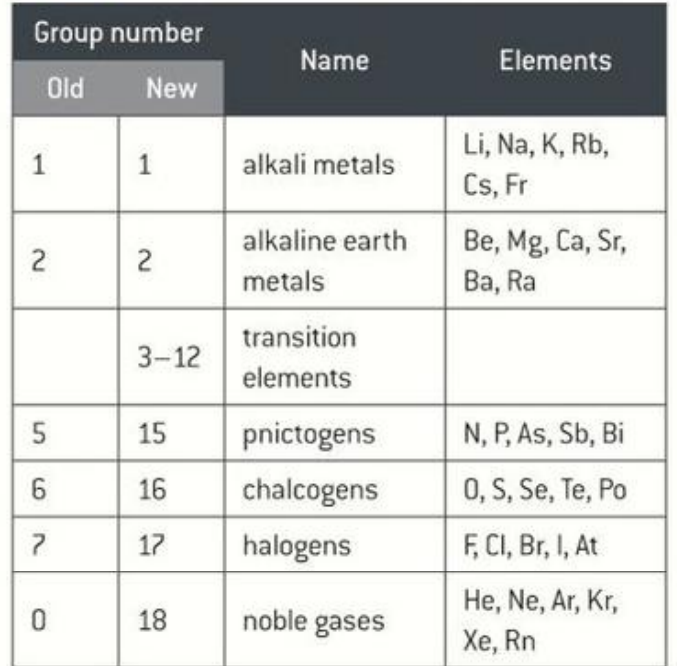
Groups can be identified using either numbers or names, and two different numbering systems are currently in use, which can initially cause confusion.
Numbering systems
The old numbering system uses Groups 1-7 followed by Group 0. This system developed based on the s- and p-blocks only, before the position of transition elements was fully understood. A useful feature of this old system is that the group number matches the number of electrons in the highest energy electron shell for s- and p-block elements. For instance, Group 5 elements (old numbering) have five outer electrons.
The new numbering system runs from 1-18, numbering each column sequentially across the entire periodic table. The International Union of Pure and Applied Chemistry (IUPAC) approved this system in 1988, but changing established practices takes time. Many periodic tables show both numbering systems, with old numbers often in brackets.
Group names
Several groups have specific names that you should recognize:
Group 1 elements are called alkali metals and include lithium (Li), sodium (Na), potassium (K), rubidium (Rb), caesium (Cs), and francium (Fr).
Group 2 elements are known as alkaline earth metals: beryllium (Be), magnesium (Mg), calcium (Ca), strontium (Sr), barium (Ba), and radium (Ra).
Groups 3-12 collectively form the transition elements (or transition metals), occupying the d-block.
Group 15 elements are called pnictogens: nitrogen (N), phosphorus (P), arsenic (As), antimony (Sb), and bismuth (Bi).
Group 16 elements are known as chalcogens: oxygen (O), sulfur (S), selenium (Se), tellurium (Te), and polonium (Po).
Group 17 elements are the halogens: fluorine (F), chlorine (Cl), bromine (Br), iodine (I), and astatine (At).
Group 18 (or Group 0 in old numbering) contains the noble gases: helium (He), neon (Ne), argon (Ar), krypton (Kr), xenon (Xe), and radon (Rn).
Note
You should definitely know the names "halogens" and "transition elements" as these appear frequently in A-Level chemistry. Other group names like pnictogens and chalcogens are less commonly used but may appear in reference materials.
Summary
Key Points to Remember:
-
Mendeleev organized elements by atomic mass and grouped them by similar properties, leaving gaps for undiscovered elements and making accurate predictions (like ekasilicon/germanium).
-
The modern periodic table arranges 114 elements by atomic number in 7 periods (horizontal rows) and 18 groups (vertical columns), with the period number indicating the highest occupied electron shell.
-
Groups contain elements with the same number of outer-shell electrons, which explains why elements in the same group show similar chemical properties and reactions.
-
Periodicity describes the repeating trends across periods, with the same pattern of s- and p-sub-shell filling occurring in each period, creating predictable patterns in properties.
-
The four blocks (s, p, d, f) organize elements by their highest energy sub-shell, with s-block (Groups 1-2), p-block (Groups 13-18), d-block (transition elements, Groups 3-12), and f-block (lanthanides and actinides) forming distinct regions.