Catalysts (OCR A-Level Chemistry A): Revision Notes
📚Revision Notes
Catalysts
What does a catalyst do?
A catalyst is a substance that increases the rate of a chemical reaction while remaining chemically unchanged at the end of the reaction. This means the catalyst is not permanently consumed or altered during the reaction process.
Key characteristics of catalysts:
- The catalyst is not used up during the reaction - it is regenerated at the end
- The catalyst may interact with a reactant to form a temporary intermediate species, or it may provide a surface where the reaction occurs
- Only small amounts of catalyst are needed because it can be used repeatedly
How catalysts work
Catalysts speed up reactions by providing an alternative reaction pathway that has a lower activation energy than the uncatalysed reaction. The activation energy () is the minimum energy required for reactant particles to successfully collide and form products.
By lowering the activation energy, more reactant particles have sufficient energy to overcome this barrier at a given temperature. This means more successful collisions occur per second, increasing the reaction rate.
Important
Catalysts do not change the enthalpy change () of the reaction. They only affect the activation energy and the reaction pathway, not the energy difference between reactants and products.
Enthalpy profile diagrams
The effect of a catalyst can be shown using enthalpy profile diagrams, which plot energy against the progress of reaction.
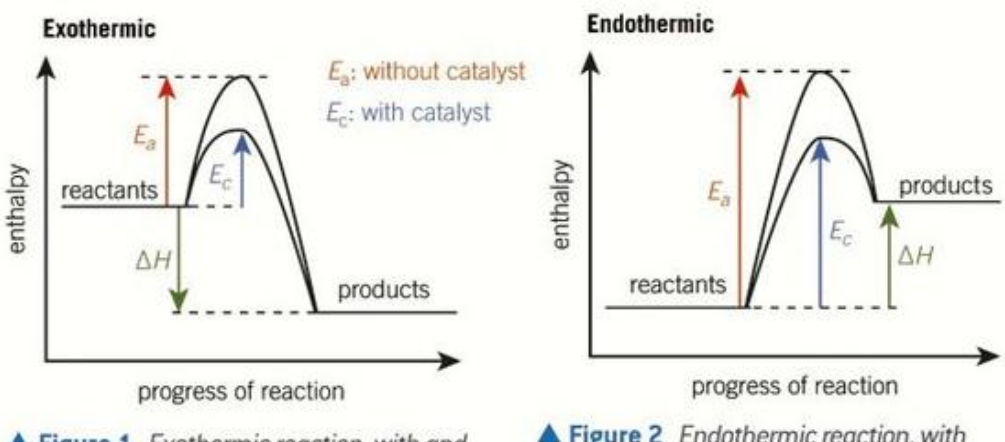
In these diagrams:
- The uncatalysed reaction pathway (shown by the higher curve) has a higher activation energy ()
- The catalysed reaction pathway (shown by the lower curve) has a lower activation energy ()
- The enthalpy change () remains the same for both pathways
- For exothermic reactions, products are at a lower energy level than reactants ( is negative)
- For endothermic reactions, products are at a higher energy level than reactants ( is positive)
Note
Exam tip: When drawing enthalpy profile diagrams, always ensure:
- Reactants and products are at the correct energy levels relative to each other
- is shown with an arrow pointing in the correct direction (down for exothermic, up for endothermic)
- The activation energy is shown with an upward arrow from the reactants level to the peak
Types of catalyst
Catalysts are classified into two main types based on their physical state relative to the reactants: homogeneous and heterogeneous.
Homogeneous catalysts
A homogeneous catalyst exists in the same physical state as the reactants. For example, if the reactants are gases, the catalyst is also a gas; if the reactants are in solution, the catalyst is also dissolved in the same solution.
Note
Mechanism of homogeneous catalysis:
- The catalyst reacts with the reactants to form an intermediate compound
- This intermediate then breaks down to give the products
- The catalyst is regenerated in its original form
Examples of homogeneous catalysis:
Example
Worked Example 1: Esterification reactions
When making esters, concentrated sulfuric acid acts as a homogeneous catalyst. All reactants and the catalyst are liquids.
Catalyst:
In this reaction, ethanol reacts with ethanoic acid to form the ester ethyl ethanoate and water. The sulfuric acid catalyst is in the same liquid phase as all the reactants.
Example
Worked Example 2: Ozone depletion
Chlorine radicals (Cl•) act as a homogeneous catalyst in the breakdown of ozone in the upper atmosphere. Both the ozone and the chlorine radicals are gases.
The reactant (ozone) and catalyst (chlorine radicals) are both in the gaseous state, making this homogeneous catalysis.
Heterogeneous catalysts
A heterogeneous catalyst has a different physical state from the reactants. Typically, heterogeneous catalysts are solids that catalyse reactions involving gaseous or liquid reactants.
Note
Mechanism of heterogeneous catalysis:
- Adsorption: Reactant molecules are attracted to the surface of the solid catalyst and weakly bond (adsorb) onto it
- Reaction: The reaction takes place on the catalyst surface where reactant molecules are held in the correct orientation
- Desorption: Product molecules leave the surface of the catalyst, freeing up active sites for more reactant molecules
The catalyst provides a large surface area where reactant molecules can come together and react more easily. This lowers the activation energy for the reaction.
Industrial processes using heterogeneous catalysts
Many important industrial chemical processes rely on heterogeneous catalysis. These catalysts are typically transition metals or their compounds.
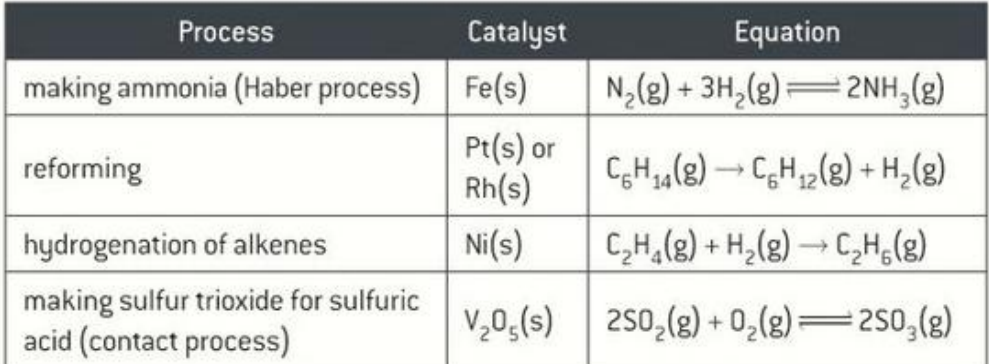
Key industrial processes:
1. Haber process (ammonia production):
Catalyst: Iron, Fe(s)
Ammonia is essential for manufacturing fertilizers. The solid iron catalyst allows the gaseous nitrogen and hydrogen to react more readily.
2. Reforming (petroleum refining):
Catalyst: Platinum, Pt(s), or Rhodium, Rh(s)
This process converts straight-chain alkanes into branched isomers and cyclic compounds to improve petrol octane ratings.
3. Hydrogenation of alkenes:
Catalyst: Nickel, Ni(s)
Used in the food industry to convert unsaturated fats (alkenes) into saturated fats (alkanes).
4. Contact process (sulfuric acid production):
Catalyst: Vanadium(V) oxide,
This produces sulfur trioxide, which is then converted to sulfuric acid - one of the most important industrial chemicals.
Catalytic converters and atmospheric pollution
Since 1992, all petrol vehicles manufactured in the UK must be fitted with a catalytic converter to reduce harmful exhaust emissions and meet MOT test standards.
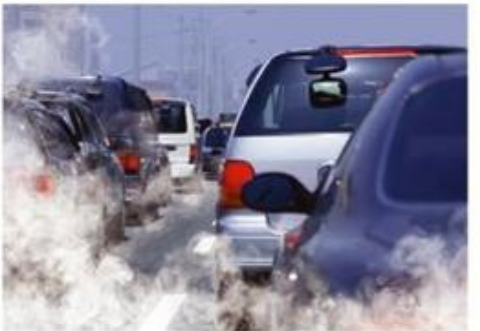

Structure and function:
Catalytic converters contain a ceramic honeycomb structure coated with precious metal catalysts (platinum, rhodium, and palladium). This honeycomb design provides a very large surface area for the heterogeneous catalysis to occur.
As hot exhaust gases pass over the catalyst surface, harmful pollutants are converted into less harmful products:
Important
Environmental Impact:
1. Carbon monoxide oxidation:
- Carbon monoxide (CO) is a toxic gas produced by incomplete combustion
- The catalyst oxidises CO to carbon dioxide (CO₂)
- CO₂ is non-toxic and can be safely released into the atmosphere
2. Nitrogen monoxide reduction:
- Nitrogen monoxide (NO) forms during high-temperature combustion in engines
- The catalyst reduces NO to nitrogen gas (N₂)
- N₂ makes up 78% of the atmosphere and is harmless
3. Hydrocarbon oxidation:
- Unburnt hydrocarbons from incomplete combustion are oxidised
- They are converted to water (H₂O) and carbon dioxide (CO₂)
This process converts toxic emissions into safer products before they enter the atmosphere, significantly reducing air pollution from vehicles.
Catalysis - sustainability and economic importance
Catalysts play a crucial role in modern industry and sustainable chemistry. It is estimated that approximately 90% of all chemical materials are manufactured using catalysts.
Note
Economic benefits:
When catalysts lower the activation energy of industrial reactions, they reduce the temperature required for the process. Lower operating temperatures mean:
- Less energy consumption (reduced electricity or fossil fuel use)
- Lower operating costs
- Faster production rates
- Increased profitability
The economic advantages of using catalysts typically far outweigh the initial costs of developing and implementing the catalytic process.
Environmental and sustainability benefits:
Using catalysts supports sustainable chemistry by:
- Requiring less energy input, which reduces fossil fuel consumption
- Producing fewer carbon dioxide emissions from energy generation
- Reducing pollutant emissions through processes like catalytic converters
- Operating at lower temperatures, improving safety and reducing equipment wear
The focus on sustainability requires industries to use processes with high atom economy and minimal waste. Catalysts enable many reactions to proceed efficiently at lower temperatures, supporting these environmental goals and helping reduce contributions to global warming.
Autocatalysis
Autocatalysis occurs when a product of a reaction acts as a catalyst for that same reaction. The reaction typically starts slowly, then speeds up progressively as the catalytic product accumulates.
Example
Worked Example: Permanganate and oxalate reaction
The reaction between acidified manganate(VII) ions and ethanedioate ions demonstrates autocatalysis:
This reaction is very slow initially in the absence of ions. However, manganese(II) ions are a product of this reaction, and they can act as a catalyst for it.
How autocatalysis works in this reaction:
Manganese exists in multiple oxidation states and can easily change between them, making it an effective catalyst:
Step 1: The ions produced reduce to :
Step 2: The ions then oxidise the ethanedioate ions to carbon dioxide, reforming :
As the reaction proceeds, more catalyst is produced, causing the reaction rate to increase. This creates a positive feedback effect where the reaction accelerates as it progresses.
Summary
Key Points to Remember:
-
Catalysts increase reaction rates by providing an alternative pathway with lower activation energy, but they remain chemically unchanged and can be regenerated
-
Homogeneous catalysts are in the same physical state as the reactants and work by forming temporary intermediate compounds
-
Heterogeneous catalysts are in a different physical state (usually solid) and work through adsorption of reactants onto their surface, followed by reaction and desorption of products
-
Major industrial processes including the Haber process (Fe catalyst), contact process ( catalyst), and hydrogenation (Ni catalyst) all use heterogeneous catalysts
-
Catalytic converters use precious metal catalysts to convert toxic vehicle emissions (CO, NO, and unburnt hydrocarbons) into less harmful products (CO₂, N₂, and H₂O)
-
Economic and environmental benefits of catalysts include reduced energy consumption, lower operating costs, and decreased carbon emissions, supporting sustainable chemical production