Berlin Wall (OCR A-Level History A): Revision Notes
📚Revision Notes
Berlin Wall
The ruling Communist government in East Germany remained loyal to the USSR. Under the leadership of Walter Ulbricht, industry remained nationalised.
In 1953, however, a workers' revolt flared up in East Germany. It was crushed by the Soviet troops, but a number of East Germans sought refuge in West Germany.
In response to the migration to West Germany, on 13 August 1961 the GDR constructed a barbed wire fence along the border of East and West Berlin. These wire barriers were later replaced by a concrete wall.
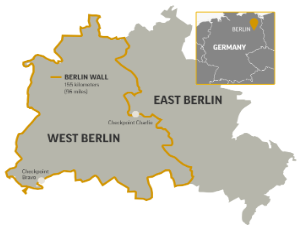
Map showing the division between East and West Berlin
Note
Also known as the 'inner German border', the Berlin Wall divided East and West Germany from 1961 until 1989.
In 1961, Soviet leader Nikita Khrushchev publicly announced that Berlin was part of East Germany. He also warned the West German government against taking military action. In response to the threat, the West German government decided to also build a wall that they called an 'anti-fascist protective wall'. The USSR ordered the placement of fences, trenches, and watchtowers along the wall. Moreover, guards were allowed to shoot anyone who attempted to cross it. When the second barrier was built, the gap between the walls was called the Death Strip.
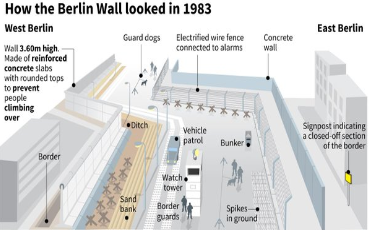
Special crossing points were built and required special permits. Checkpoint Charlie was one of the more popular points where non-Germans could cross to the East.
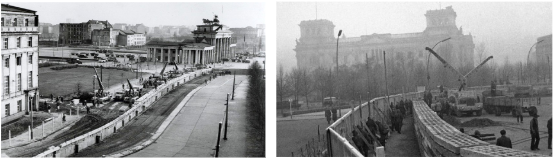
-
**Image of the Berlin Wall construction, 1961***
During the division, hundreds of East Berliners were shot while trying to cross the wall. Guards were given financial rewards for every person who died trying to escape. For 28 years, the Berlin Wall was a physical reminder of the Cold War and the division of Germany. Here are several impacts of the wall:
- Years were lost for families who were separated by the wall.
- Those who tried to escape the East were either imprisoned or killed.
- Industrial and agricultural production in the East gradually increased.
- The possibility of a nuclear war was averted.
- East Berliners began to accept their life in East Germany.