The creation of West Germany and the DDR (OCR A-Level History A): Revision Notes
📚Revision Notes
The creation of West Germany and the DDR
The defeat of Germany in WWII resulted in a period of division. Between 1945 and 1949, the West was occupied by Allied powers (US, Great Britain and France), while the East was under the Soviet Union (USSR).
Following the Allied Trizone, the Federal Republic of Germany (FRG) which covered about two-thirds of Germany was created on 24 May 1949. The republic which lasted until 1990 consisted of 10 states - Baden-Wurttemberg, Bayern, Bremen, Hamburg, Hessen, Niedersachsen, Nordrhein-Westfalen, Rheinland-Pfalz, Saarland, Schleswig-Holstein and the western part of Berlin, with Bonn as capital.
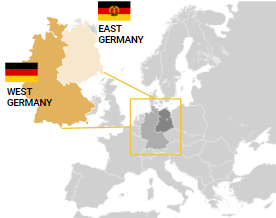
Location of East and West Germany on the map of Europe
Note
The SPD preferred Frankfurt as the capital of FRG, while the CDU/CSU chose Bonn.
When the establishment of the FRG became clear, Joseph Stalin approved the election for a People's Congress in May 1949. However, instead of choosing a candidate to vote, East Germans were only allowed to approve or reject a 'unity list'. In addition to the Soviet sponsored SED, two more political parties were added - Democratic Farmers' Party and the National Democratic Party.
In October 1949, the People's Congress created the German Democratic Republic in the Soviet zone. Berlin became the capital of East Germany. The People's Congress was later renamed as the People's Chamber (Volkskammer) and composed of delegates from the five Länder - Brandenburg, Mecklenburg-Vorpommern, Saxony, Saxony-Anhalt and Thuringia. On 11 October 1949, Wilhelm Pieck, leader of the SED, was named as the first president of the GDR. The following day, Otto Grotewohl, a former Social Democrat was installed as premier at the head of a cabinet.
In theory, the GDR was established under a parliamentary democracy. However, the SED had decisive power in the government, particularly the German Communist Walter Ulbricht.
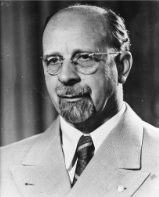
Walter Ulbricht in 1960