Hitler's character, ideologies and style of government as Führer (OCR A-Level History A): Revision Notes
📚Revision Notes
Hitler's character, ideologies and style of government as Führer
Adolf Hitler
Adolf Hitler was born on 20 April 1889 in Austria-Hungary. He fought in WWI and was awarded an Iron Cross for bravery.
After Germany's defeat in WWI, Hitler entered politics and joined the German Workers' Party (DAP) in Munich in 1919. Come 1920, he was in charge of the party's propaganda, for which he showed talent, and devoted himself to improving his position within the party. The German Worker's Party was then renamed the National-sozialistische Deutsche Arbeiterpartei (NSDAP or the Nazi).
As the leader, Hitler set out to create a mass movement using mystique and power to foster loyalty to him. He used constant propaganda through the party newspaper, the Völkischer Beobachter, to achieve this. Hitler was a charismatic and dynamic leader able to attract a devoted cadre, including Johann Dietrich Eckart, Alfred Rosenberg, Rudolf Hess, Hermann Göring and Julius Streicher.
Conditions were ideal for the development of a party like the Nazis as resentment after losing the war was high and the peace terms contributing to German economic woes spread discontent. Hitler found the party ineffective and committed to nationalist and socialist ideas but this divided its leadership. Because of his talent for propaganda, he leveraged his importance by threatening to resign to increase his power within the party. Within two years, the party had grown to around 55,000 members, with 15,000 as part of the militia - SA, Stormtroopers and Brownshirts.
When President Hindenburg died on 2 August 1934, Hitler declared himself the Führer, president, chancellor, and head of the German Army. He imposed the following:
- The German Army took a personal oath of allegiance not to Germany but to Hitler. He neutralised any sources of opposition within the military.
- The cult of Führer worship continued to grow because of Hitler's propagandist Goebbels. Hitler gained absolute power over Germany.
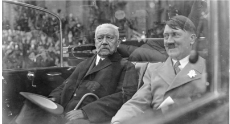
Paul von Hindenburg and Adolf Hitler in an open parade in Berlin, May 1933
Note
As the Führer, he set up the Third Reich and promised the German people relief from their struggles.
The Reich Government has enacted the following law, which is hereby promulgated.
Section 1. The office of Reich President will be combined with that of Reich Chancellor. The existing authority of the Reich President will consequently be transferred to the Führer and Reich Chancellor, Adolf Hitler. He will select his deputy.
Section 2. This law is effective as of the time of the death of Reich President von Hindenberg.
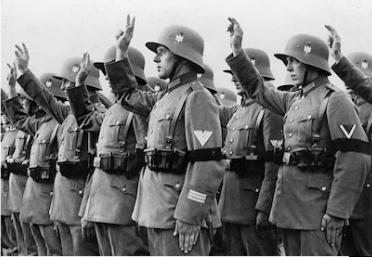
Members of the regular German Army swear the oath of allegiance to the Führer Adolf Hitler.