Key Nazi leaders (OCR A-Level History A): Revision Notes
📚Revision Notes
Key Nazi leaders
Heinrich Himmler
Heinrich Himmler joined the Nazi Party in 1923. As a fervent Nazi loyalist and anti-Semite, he was appointed by Hitler as the new head of the SS in January 1929. Under his leadership, the group's role and size expanded. Himmler established the Waffen-SS (originally the SS-VT) at the outset of the Second World War. Its members' main task was to terrorise people from the different territories occupied by the Nazis. Moreover, they were also tasked with operating the concentration camps.
Originally, its membership was limited to Germans to maintain Aryan supremacy. Due to the demands of the Third Reich's operations, however, it opened its membership to foreign volunteers and conscripted men from Nazi-occupied territories.
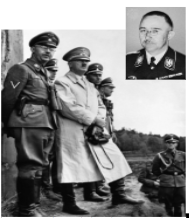
Top: A portrait of Heinrich Himmler, the director of the SS. Bottom: image of Hitler and Himmler in 1940
As early as the Reichstag Fire, Himmler, who was then the police commissioner in Munich, played a significant role in rounding up dissidents such as the communists and trade unionists.
In April 1933, Himmler was promoted to Commander of the Bavarian Political Police which gave him the authority over concentration camps, particularly Dachau.
In 1935, Himmler created the Lebensborn programme to secure racial 'purity' of future SS soldiers. He anticipated that about 200 to 300 pure Aryan children would be born each year. Young boys will be trained as superior soldier, while young girls as superior wives.
Note
Under the SS leadership of Himmler, the Waffen-SS (SS-VT) and SS-TV were established.
In addition to eliminating the SA under Ernst Röhm, Himmler had monopolised camps. When WWII broke out, the SS repression system and establishment of concentration and death camps expanded further. Many believed that without the SS, it would have been impossible for the Third Reich to survive until the end of WWII.
As overseer of the Nazi extermination programmes, Himmler was held responsible for the death of millions. By the end of the war, Himmler attempted to open peace talks with the Allies. After hearing about this, Hitler dismissed him from his posts and ordered his arrest. On 23 May 1945, while in British custody, Himmler committed suicide.
Joseph Goebbels and Nazi propaganda
The Third Reich's Ministry of Public Enlightenment and Propaganda was established on 14 March 1933. Paul Joseph Goebbels was the Third Reich's propaganda minister from 1933 to 1945. The ministry's main objective was to indoctrinate the German people into supporting the Nazi ideals of anti-semitism and Aryan supremacy.
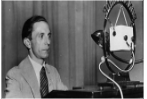
His eloquence and charisma made the ministry successful and gained it many supporters and followers. The ministry used mass media to promote Nazi ideals. Mass rallies, radio and cinema were effective tools in achieving their objectives.
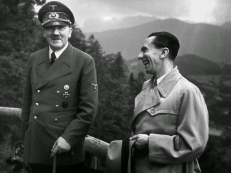
Hitler and Goebbels, 1943
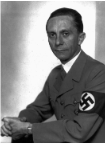
Joseph Goebbels
Under the Third Reich, radios were mass-produced and sold cheaply. Broadcasts and stations were controlled by the Reich Broadcasting Corporation serving under Goebbels' ministry. Speakers were also set up on streets in various German cities. Nazi ideals and updates on Hitler's administration were the main focus of the radio broadcasts.
They involved Nazi music and public speeches uplifting the Nazi party. Massive rallies were held annually in Nuremberg, Germany.
Goebbels' ministry also saw films as popular forms of entertainment. Hence, the ministry produced several films that promoted the ideals of the Nazi Party. Ideals were craftily inserted into the stories and carefully guarded by the Nazis. Popular Nazi films were Leni Riefenstahl's Triumph of the Will (1935), highlighting the Nuremberg rally, and Fritz Hippler's The Eternal Jew (1940) depicting Jews as evil, corrupt and intent on dominating the world.
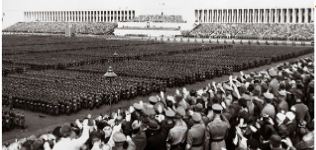
A 1934 mass rally in Nuremberg, Germany
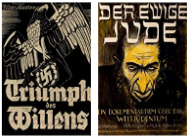
Film posters
Steered by Joseph Goebbels, Nazi propaganda was a success. The propaganda had three main themes:
- The Führer cult which depicted Hitler as the saviour of Germans.
- Volksgemeinschaft which gave the idea of one German community.
- Portrayal of Jews as the source of Germany's ills, often depicting them as sub-humans. Moreover, Hitler was an extraordinary and passionate speaker. His speeches were broadcast by Goebbels across the country. Most propaganda took the form of slogans, policies and radio broadcasts.
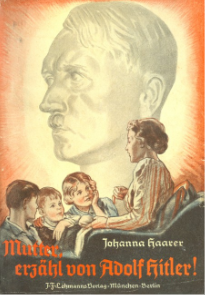
Early Nazi propaganda poster