Significance of Nuremberg Laws (OCR A-Level History A): Revision Notes
📚Revision Notes
Significance of Nuremberg Laws
During the annual NSDAP Party rally in Nuremberg in 1935, the Nazis announced new laws to systematise the separation of Jews in Germany. This became known as the Nuremberg Laws. The slow pace of change in Germany frustrated the far-right of the party. Discriminations and laws against Jews were not having an immediate and complete effect. In particular the far-right wanted the following:
- Prohibition of relationships between Aryans and Jews
- Stop the pollution of Aryan blood with foreign types and races
- Maintain citizenship and rights of residency for Germans and Aryans only
On 15 September 1935, the Law for the Protection of German Blood and German Honour and the Reich Citizenship Law were passed. The former stopped marriages and sex between 'Jews' and 'Germans' and the employment of 'German' females under 45 in Jewish households.
Meanwhile, the latter stripped Jews of their German citizenship and introduced a new distinction between 'Reich citizens' and Jewish 'nationals'. Certificates of Reich citizenship were in fact never introduced and all Germans, except Jews, were provisionally classed as Reich citizens until 1945.
The Nuremberg Laws did not define the Jewish people by religious affiliation, instead they were traced through their ancestors. As a result, many Germans who had not practised Judaism for a long time became victims of Nazi terror. Those who converted to other religions such as Christianity, but had Jewish grandparents, were also caught.
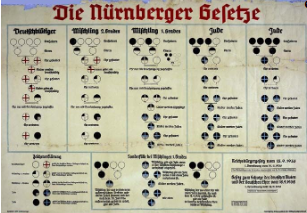
A chart explaining the pseudo-scientific racial categories established by the 1935 Nuremberg Laws.
Note
White circles identify ancestors of 'pure' German blood, while black circles identify Jewish ancestry. Only those with four non-Jewish grandparents were considered true German
Initially, Jews were not allowed to participate in the 1936 Olympics held in Berlin, but when threatened with a boycott of the games, Hitler allowed athletes of other ethnicities from other countries to participate. However, persecution returned after the event. Below are additional significances and impacts of the Nuremberg Laws.
- Economically, Jewish businesses were seized by non-Jewish Germans.
- Jewish doctors and lawyers were also banned from practice.
- Identity cards were always carried for checking.
- Jews were forbidden to display the Reich flag.
- They could not vote or work for any public office
- Jewish government officials were forced to retire in December 1935.

Jewish businessman Oskar Danker and his girlfriend, a Christian woman, were forced to carry signs discouraging Jewish-German integration.
Note
On 14 November, the laws were extended to other minorities who the Nazis deemed 'racially suspect'. It included Roma and African-Germans.
Glossary of Terms
GLEICHSCHALTUNG
Otherwise known as Nazification, the Gleichschaltung was the process of Nazi consolidation of power between 1933 and 1934.
GREAT DEPRESSION
Subsequent recession experienced in many parts of the world due to the Wall Street Crash in 1929.
ENABLING ACT
An act which granted Hitler and the German Cabinet absolute power to enact laws without the legislative bodies, both Reichstag and Reichsrat.
DICTATORSHIP
An authoritarian form of government known for having a single leader with a single party system.
LEBENSBORN
A policy of encouraging 'pure' Aryan women to have children with 'pure' Aryan members of the SS.
AUTARKY
A policy of Hitler which aimed to make Germany economically self-sufficient.