The structure of the German Empire in 1871 (OCR A-Level History A): Revision Notes
📚Revision Notes
The structure of the German Empire in 1871

1871
-
Unification of Germany
-
Prussian king William I proclaimed emperor/Kaiser of the German Empire
-
Otto von Bismarck as chancellor 1884
-
Germany takes part in the Scramble for Africa, annexing Togo, Cameroon and Angria Pequena
-
Berlin Conference 1888
-
After his father, Frederick III, Wilhelm II succeeds as German Emperor and King of Prussia 1890
-
Bismarck dismissed and replaced by Leo von Caprivi 1898
-
Under Alfred von Tirpitz, Germany starts to strengthen its navy 1905
-
The first U-boat (German submarine) is built. Production of massive battleships increased the following year. 1914
-
Outbreak of WWI
Also known as the Second Reich, the Kaiserreich was a period in Germany following the unification in 1871 until the abdication of Kaiser Wilhelm II in 1918. In 1871, 25 constituent states and an imperial territory unified as one under the new German Empire. Imperial Germany was divided into four kingdoms, six Grand Duchies, five Duchies, seven Principalities, three Free and Hanseatic Cities and one imperial territory.
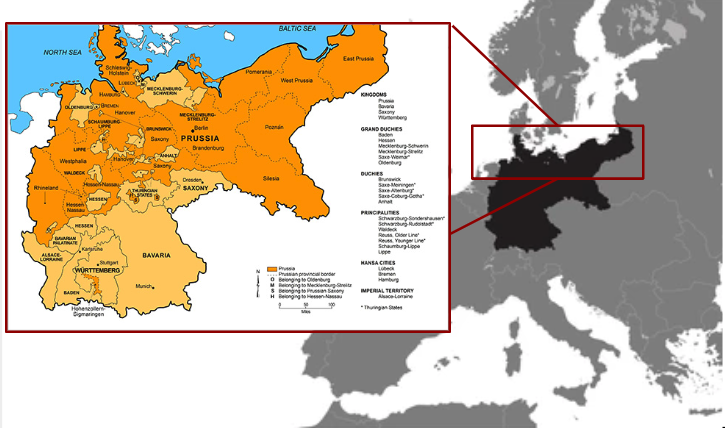
Map showing the position of the German Empire in Europe.
Note
Several of the states were gained from the dissolution of the Holy Roman Empire.
KINGDOMS
-
Bavaria
-
Prussia
-
Saxony
-
Württemberg KINGDOMS
-
Anhalt
-
Brunswick
-
Saxe-Altenburg
-
Saxe-Coburg and Gotha
-
Saxe-Meiningen GRAND DUCHIES
-
Baden
-
Hesse
-
Mecklenburg-Schwerin
-
Mecklenburg-Strelitz
-
Oldenburg
-
Saxe-Weimar-Eisenach PRINCIPALITIES
-
Lippe
-
Reuss-Gera
-
Reuss-Greiz
-
Schaumburg-Lippe
-
Schwarzburg-Rudolstadt
-
Schwarzburg-Sondershausen
-
Waldeck-Pyrmont FREE AND HANSEATIC CITIES
-
Bremen
-
Hamburg
-
Lübeck IMPERIAL TERRITORY
Alsace-Lorraine
Note
After unification into one German Empire, it was expected to be ruled under a constitutional monarchy wherein the monarch was supposed to lead with the advice of parliament. This did not happen, however, as the Kaiser ruled with absolute power.
Despite being considered as a federal empire, the German Empire was dominated by the Kingdom of Prussia. In addition to its large territory, Prussia also housed three-fifths of the empire's population. The House of Hohenzollern (ruling house of Prussia) also held the imperial crown. Moreover, 17 out of 58 votes in the Bundesrat were also representatives from Prussia.
Historians agreed that the retention of Junkers' influence in politics resulted in the absence of any significant peasant revolt.
Note
Junkers were Prussian landed elite who became influential in politics and military following the unification of Germany.
The king of Prussia was automatically named as the emperor of Germany, while the prime minister or minister president of Prussia also served as the chancellor of the empire.
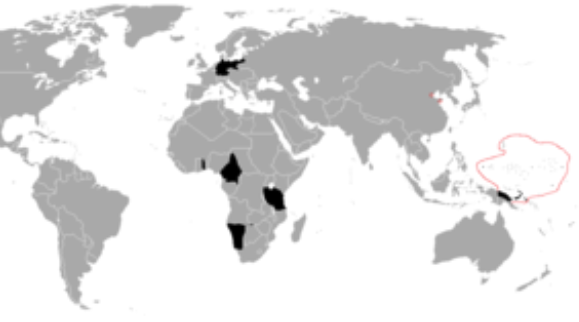
Map showing the German colonies and protectorates in 1914