Establishment and importance of the Weimar Government and constitution (OCR A-Level History A): Revision Notes
📚Revision Notes
Establishment and importance of the Weimar Government and constitution
The Weimar Republic was a short-lived democratic government of Germany, which began in 1919 and ended in 1933. It was formed in 1919 after the abdication of Kaiser Wilhelm II in 1918. Members of the Social Democratic Party and Independent Social Democratic Party of Germany served as the provisional government.
In December 1918, a National Assembly was formed with the main task of creating a new parliamentary constitution. By 6 February 1919, the Weimar Coalition was formed when the National Assembly met in the town of Weimar. They elected Friedrich Ebert as president.
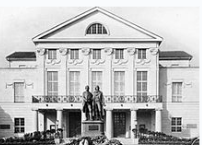
Deutsches Nationaltheater, Weimar
Note
The new government was named after the town of Weimar where it was formed by the National Assembly.
Structure of the Weimar Republic
Note
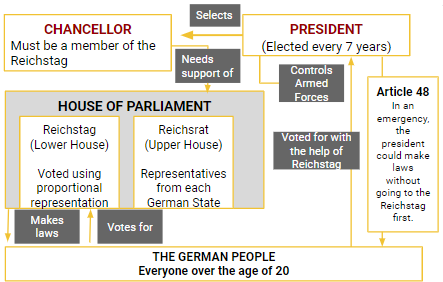
The Weimar Republic operated a Parliamentary Republic system type of government, which was headed by the executive branch, the president, but accountable to the legislature. The head of state was the president, while the head of the government was called a prime minister.
Weimar Constitution
Ideally, the Weimar Republic was established to look out for and protect the interests of the German people through a representative democracy.
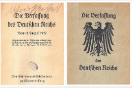
Image of the Weimar Constitution cover
Strengths
DEMOCRACY
Every four years, all Germans over 20 could vote for the members of the parliament and president.
REICHSTAG
Unlike the kaiser regime, the Reichstag body was created to appoint members of the government and make all laws.
BILL OF RIGHTS
Freedom of religion, speech and equality under the law were given to all German citizens.
Weaknesses
PROPORTIONAL REPRESENTATION
The same percentage of seats in parliament as the percentage of votes, which made passage of laws difficult for small parties.
ARTICLE 48
In case of emergency, the president had the power to enact laws without the parliament's approval.