Impact of WWI on Germany (OCR A-Level History A): Revision Notes
📚Revision Notes
Impact of WWI on Germany

1918
-
End of WWI
-
German Revolution
-
Abdication of Kaiser Wilhelm II
-
Formation of the Weimar Republic
-
Armistice talks 1919
-
Election of Ebert as president
-
Adoption of the Weimar Constitution
-
Signing of the Treaty of Versailles
-
Spartacist Uprising 1920
-
Treaty of Versailles takes effect
-
Kapp Putsch
Impact of WWI on Germany
1923
-
French and Belgian occupation of the Ruhr
-
Hyperinflation
-
Gustav Stresemann becomes chancellor
-
Munich Putsch 1924
-
Dawes Plan 1925
-
Hindenburg becomes president 1929
-
The Great Depression
Brief historical context
In the years prior to World War I, Kaiser Wilhelm II adopted foreign and domestic policies that ignited tension in Europe. German ideologies of militarism, imperialism and nationalism plus the Kaiser's ambitions set the stage for the Great War.
In July 1914, Germany employed the Schlieffen Plan, which would see the swift invasion and capture of France and Belgium in the coming months.
Germans and the First World War
In protecting the German people from the threatening dangers of anarchy, famine, and foreign rule. Proclaimed under our own hand and with the imperial seal attached. Amerongen, 28 November 1918. Signed WILLIAM
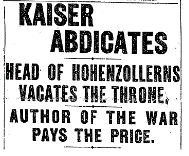
The Treaty of Versailles
The treaty changed the geography of Europe as we know it today. Germany lost territories including the provinces of Alsace and Lorraine, which were returned to France; parts of Schleswig were ceded to Denmark; to the east, new countries were created to roughly match the ethnic balance of the area and, finally, 'the Polish Corridor' was created, which gave the Poles a broad strip of land that connected it to the sea – and consequently separated Eastern Prussia from the rest of Germany
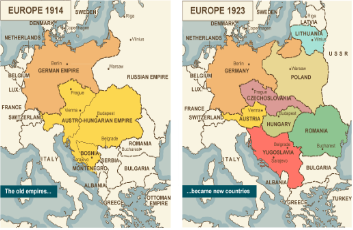
Map of Europe before and after Treaty of Versailles
The Treaty of Versailles blamed Germany for the First World War. As a result, Germany was held accountable for the cost of the war and the treaty dictated that compensation be paid to the Allies. The payments were called reparations.
The economic might of Germany had been stretched to the limits during the war. Having to rebuild the economy while paying reparations made it a particularly difficult task. In addition, Germany had lost some of its most valuable sources of raw materials as its colonies, and some of the areas ceded to other countries, were rich sources of income.
£6.6 billion
Equivalent to £248 billion in 2018, these factors would make it harder for the German economy to recover. Further to this, the casualties suffered during the war impacted the labour force. Germany lost approximately 1.7 million men during the war and a further 4.2 million were listed as wounded.
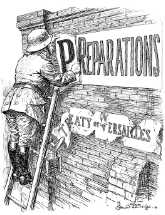
A jack-booted German soldier puts up the letter P in front of the word Reparations to spell Preparations, while an old bill poster Treaty of Versailles is tattered and falling off the wall
Note
Also under the treaty was the abolition of the German air force and a significant reduction of men in the army and navy.




A maximum of only 100,000 troops in the army
Conscription or compulsory enlistment of civilians in the national service was banned
0 tanks were allowed
0 submarines
Navy was reduced to 15,000 men and a maximum of 6 battleships
The government of the day resigned, having refused to sign the treaty. The incoming government had no choice but to sign the treaty but was accused by some of betraying the German people.
- The treaty also called for the trial of the former Kaiser. This never happened, as the Dutch government refused to hand him over.
- After the war, the monarchy was never restored, and Germany entered a period of isolation from international politics.
- Germany became an outcast in international politics and was feared and distrusted by the Allies.
- Political instability After the signing of the armistice in 1918, many Germans despised the government and called them November Criminals. This created uprisings on both sides of German politics.
Post-World War members of the Communist Party consisted of the Spartacists. They rebelled in Berlin in January 1919 but were defeated by the Freikorps or ex-soldiers. Its leaders, Rosa Luxemburg and Karl Liebknecht, were hanged.
After the treaty, membership of the Freikorps diminished. They were reorganised by right-wing nationalist Dr Wolfgang Kapp to take over Berlin. Even with the refusal of the army to attack the Freikorps,
Kapp did not succeed in his takeover even when a Berlin worker who refused to join was sent to prison for six months.
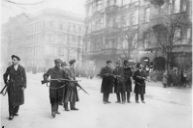
Spartacist irregulars holding a street in Berlin
Note
WWI led to the collapse of imperial dynasties: Habsburg (Austria-Hungary), Hohenzollerns (Germany), sultanate (Ottoman Empire) and the Romanovs (Russia)