The Stresemann Era (OCR A-Level History A): Revision Notes
📚Revision Notes
The Stresemann Era
Gustav Stresemann was born on 10 May 1878, in Berlin, Germany. He became the German chancellor in 1923 for three months and then foreign minister until his death in 1929. Stresemann was credited with restoring Germany's status on the world stage after WWI. In 1926, he was awarded a Nobel Peace Prize for his reconciliation efforts.
In 1918, after the signing of the armistice, Stresemann formed the German People's Party. He was elected to the National Assembly and became one of the architects of the new Constitution. In 1920, he was elected to the Reichstag, serving for the next three years, before becoming the chancellor from 13 August until 23 November 1923. Despite the impending failure of the Weimar government, Stresemann was regarded as the man who bridged the old and new Germany.
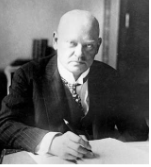
Gustav Stresemann, former Chancellor and Foreign Minister of Germany
Some historians question whether the 'Golden Age' of the Weimar Republic actually existed. However, there were some improvements that helped German working citizens during this time. They include:
Hourly wages rose above inflation annually between 1924 and 1930. In 1928 alone they rose by 10%.
Pensions and sickness benefits were introduced. Unemployment insurance
became compulsory in 1927.
Government subsidised the building of local parks, schools and sports facilities, and there was a significant programme of council house construction.
Note
Hyperinflation was due to excessive production of money, which led to an uncontrollable rise in the price of goods.
In order to stabilise the economy, Stresemann introduced a new currency based on the value of all German land and assets. The Rentenmark replaced the old mark.
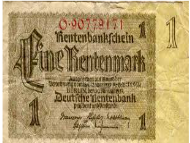
Stresemann and foreign affairs
As part of the Treaty of Versailles, the League of Nations was formed in 1919. It was an intergovernmental association established as a result of the Paris Peace Conference after WWI.
No more monarchy-driven countries but a new world of independent nation-states free from outside interference.
No more secret treaties between countries – open discussions and dispute resolutions only.
The system of military alliances would be replaced by a system of collective guarantees for security.
Disarmament would also prevent the recurrence of the arms race, which had created international tensions leading up to the war.
Note
The League of Nations was the most ambitious attempt that had ever been made to create a peaceful global order. Its main idea was to eliminate four fatal flaws of the old European states.
US investment
As a result of paying reparations and its efforts to mend international relationships, foreign businesses became more willing to invest in and assist the German economy. In addition to loaned money from US banks, American businesses began to set up factories in Germany. As a result, the German economy became highly reliant on the US economy.
The Locarno Treaties

Negotiated on 5-16 October 1925 at Locarno, Switzerland and formally signed on 1 December of the same year in London, the Locarno Treaties were a set of post-war agreements between the Allied Nations and Eastern European countries. Agreements were settled, including the following.
- Securing borders of European nations after WWI. As a result, Germany and France settled their borders and began an era of peace.
- Arbitration between Germany and Belgium and Germany and France on future disputes. Permanent demilitarisation of the Rhineland. Due to previous occupation by Germany in this French territory, France included the condition.
- Arbitration between Germany and Poland, and Germany and Czechoslovakia.
- Negotiations regarding the entrance of Germany into the League of Nations.
Note
Aside from improving foreign relations, it was an attempt to dissipate tension between France and Germany but, by 1936, Germany denounced the treaty and sent troops into the Rhineland.
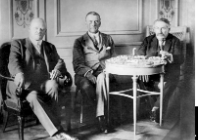
(From left to right) Gustav Stresemann, Sir Austen Chamberlain and Aristide Briand at the Locarno negotiations, c. October 1925
The Kellogg-Briand Pact
The Kellogg-Briand Pact was a 1928 international agreement in which signatories agreed not to use war as a means to resolve disputes or conflicts. Those who failed to uphold the agreement would be denied of the benefits offered by the treaty.
On 27 August 1928, the pact was signed by fifteen nations including France, the United States, the UK, Canada, Ireland, Australia, New Zealand, South Africa, Belgium, India, Poland, Germany, Italy, Japan and Czechoslovakia. Similar provisions were incorporated into the Charter of the United Nations. It's named after its authors, U.S. Secretary of State Frank B. Kellogg and French foreign minister Aristide Briand. The pact was concluded outside the League of Nations and remained in effect.
Also called the Pact of Paris, this agreement attempted to stop militarisation in the 1930s. They focused on disarmament and cooperation with the League of Nations in preventing another world war.
Note
The pact was violated in 1931 during the Japanese invasion of Manchuria (part of China).
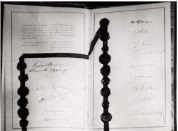
Signatures on the Kellogg-Briand Pact
Weimar Renaissance
While the Weimar Republic was facing economic and socio-political challenges, Germany became a hotbed of artistic developments in films, the visual arts, architecture, theatre and music. The period of German flourishing became known as the 'Golden Age' which centred on Berlin.
Founded by Walter Gropius in 1919, the Bauhaus movement became the most influential visual arts style in Weimar Germany. It focused on well-designed and industrially produced items in architecture including iconic door handles.
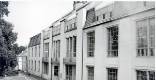
Bauhaus School in Weimar
Note
Bauhaus buildings were built in a Classical Modernist style which united functional design and fine art.
In the visual arts, geometric shapes and primary colours became one of the familiar hallmarks of Bauhaus.
Its influence was halted in 1933 when the Nazis consolidated power in Germany. Many Bauhaus artists fled abroad.
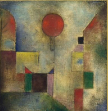
Red Balloon, 1922, by Paul Klee
In the fine arts, Dadaism and New Objectivity flourished in Germany. Like the Bauhaus School, they were suppressed by the Nazis in 1933 as they believed that modern art was morally corrupt.
Influenced by Cubism, Expressionism, Futurism and Constructivism, the Dada movement emerged during World War I in Zurich as a conceptual art movement. It was a form of protest against Western culture. Its mediums also included photography, sculpture, collage and poetry.
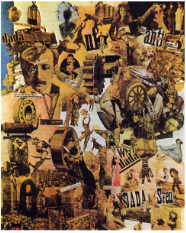
Hannah Hoch - Cut with the Kitchen Knife Through the First Epoch of the Weimar Beer-Belly Culture, 1919.
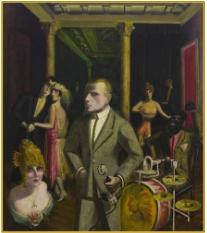
Otto Dix, An Die Schönheit, 1922.
Neue Sachlichkeit or New Objectivity emerged as an art movement which addressed contemporary issues following the war. Mediums often included the use of caricature and satire. Some historians regard their version of realism as retrograde.