Elizabeth I: Character, Accession, and Reign (OCR A-Level History A): Revision Notes
📚Revision Notes
Elizabeth I: Character, Accession, and Reign
The Reign of Elizabeth I**,** 1558-1603
Note
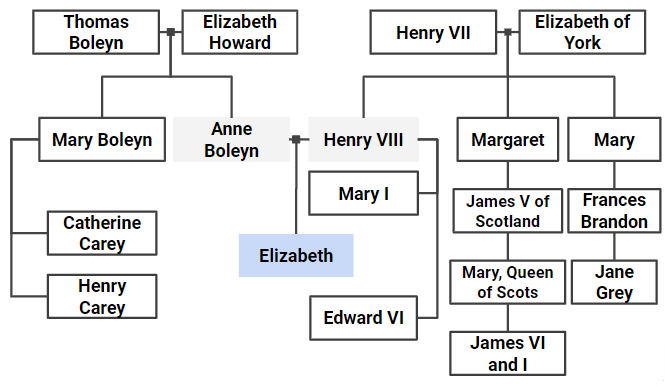
Elizabeth I was born on 7 September 1533. She was the daughter of Henry VIII with his second wife, Anne Boleyn, who he executed when Elizabeth was a baby.
She had an older half-sister, Mary I, who was the daughter of Henry's first wife, Catherine of Aragon. She also had a half-brother, Edward VI, who was the son of his third wife, Jane Seymour.
Character and claim to the throne
- Issue of gender, marriage and succession
Religious and Political Issues
- Religious Settlement: Puritan challenge and the Catholic threat
- Royal Government: Court, Privy Council and Parliament
Foreign Policy
- War on Spain
- Nine Years' War, 1594-1604
Social and Economic Conditions
- Management of financial, economic and social affairs
- English Renaissance literature, art and music
Family tree of Elizabeth I
Childhood
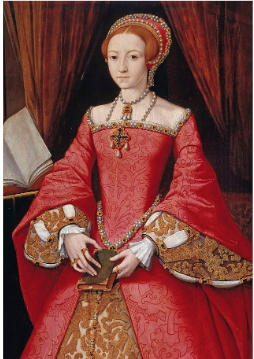
An early portrait of Elizabeth I, c.1546
Note
Henry VIII's marriage to Anne Boleyn quickly unravelled when she failed to produce a male heir. She was executed when Elizabeth was 2 and a half years old on dubious charges including treason, incest, adultery and witchcraft. Through the Second Act of Succession, Elizabeth, like Mary I, was stripped of her legitimacy.
At the request of Henry's sixth wife, Catherine Parr, Elizabeth received an excellent education despite being a woman. She was a conscientious and talented student and could speak French, Italian, Spanish and Latin. She could also read Greek. More than just intellectual, she was athletic - an accomplished horsewoman, dancer and archer - musical and adept at needlework.
"My illustrious mistress, the Lady Elizabeth shines like a star. So much solidarity of understanding, such courtesy and dignity, which I have never observed at so early an age. She hath the most ardent love of the true religion and the best kind of literature. Her mind is free of female weakness and she is [blessed] with a masculine power for hard work. No memory is more retentive than hers." An excerpt from a letter by Elizabeth's tutor, Roger Ascham, 1550
Characteristics
Elizabeth was a force to be reckoned with. Below are some of her more well-known characteristics:
- She was English, and single, and many considered her coronation as a fresh start.
- She was a politique, who preferred compromise and moderation.
- Highly educated, intelligent and witty.
- Sought and used expert advice.
- Ruthless and calculating when needed.
- Would use her charm and single status politically.
- Formidable speaker and debater.
- Won the hearts of common people at her coronation by making a good impression.
- A woman at a time when they weren't considered as leaders.
- Vain and enjoyed attention.
- Sentimental.
- Took time to make decisions.
- Loved flattery, which could sway her.
- Paranoid about plots to overthrow her.
- Used patronage to buy loyalty.
Accession to the Throne
Note
Elizabeth became Queen of England and Ireland from 17 November 1558 until her death on 24 March 1603. She was the last reigning monarch of the House of Tudor after succeeding her half-sister Mary I, whose marriage with Philip I of Spain remained childless.
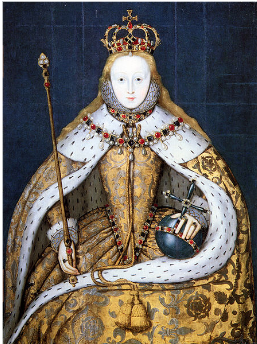
Portrait of Elizabeth I in her coronation robes, c. 1559
- Elizabeth's accession was one of the smoothest since Mary I accepted that her half-sister with a Protestant upbringing would rule after her.
- In early November 1558, Mary I asked Elizabeth to keep the re-established Catholic religion during her reign.
- However, Elizabeth's response was unclear: Catholic accounts claimed that she had declared herself a 'true Catholic' whilst the Protestant accounts stated otherwise.
- Nevertheless, the Lords and Commons proclaimed Elizabeth as queen.
- The coronation was spectacular and crowds of people attended, glad to welcome the Queen Regnant.