Golden Age and English Renaissance (OCR A-Level History A): Revision Notes
📚Revision Notes
Golden Age and English Renaissance
Note
The English Renaissance was linked to the pan-European Renaissance which is thought to have begun in Italy in the fourteenth century. The influence and development of the Renaissance reached England a century later and peaked during the Elizabethan era.
- This era was regarded as a golden age of progress and extravagance for England.
- Under Elizabeth's rule, national pride soared, peace largely prevailed, Protestantism progressed, exploration lent prestige, and the style and ideas of the English Renaissance flourished.
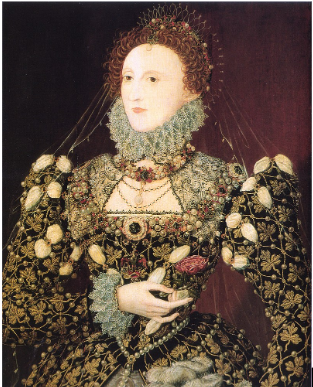
The Phoenix Portrait, c.1575, attributed to Nicholas Hilliard
- Elizabeth herself was a patron of the arts and encouraged a bloom of theatre, art, literature, architecture and music, which led to the rise of important figures from various disciplines.
- Unlike the Italian Renaissance, the dominant art forms of the English Renaissance were literature and music.
Literature
Note
The printing press allowed new ideas to spread rapidly. Apart from its significance to the spread of Protestant ideas during the first half of the sixteenth century, literature in the English vernacular also grew.
Early proponents of literature in the vernacular include William Tyndale and Roger Ascham, who was Elizabeth's tutor in Greek and Latin. Elizabethan literature was a great source of works by numerous writers who produced prose, poetry and drama.
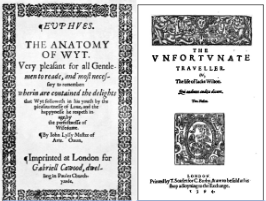
John Lily's work Thomas Nashe's work
Some notable Elizabethan prose were:
- Euphues: The Anatomy of Wit (1578) by John Lily
- The Unfortunate Traveller (1594) by Thomas Nashe
- The Arte of English Poesie (1589) by George Puttenham
- Greenes, Groats-worth of Witte (1592) by Robert Greene Elizabethan poets such as Henry Howard and Thomas Wyatt introduced the sonnet which was heavily influenced by Italy. Some of the most important poets from the period were Edmund Spenser and Sir Philip Sidney.
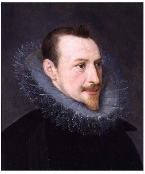
Edmund Spenser
Edmund Spenser was an English poet whose masterpiece The Faerie Queene gained him the court's favour. As a reward, he was granted a pension for life amounting to £50 a year by the Queen.
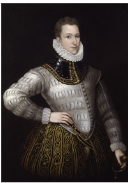
Sir Philip Sidney
Sir Philip Sidney was a courtier, soldier and poet whose works include Astrophel and Stella, The Defence of Poesy and The Countess of Pembroke's Arcadia.
Theatre
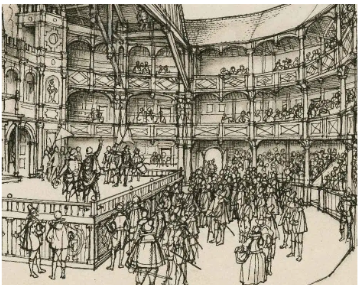
Audience in a theatre
- Elizabeth's love of theatre drove popular interest during the period.
- Before her accession, there were no theatres in England.
- Purpose-built theatres began to appear, particularly in London, and their structure accommodated the social divisions.
- The high culture of the Elizabethan Renaissance was best expressed in its theatre.
- Historical topics were popular, as were comedies and tragedies.
- Patronage supported the arts. Before Elizabeth's influence, the only drama was religious plays performed during festivals, and Greek and Roman dramas performed at the universities.
William Shakespeare
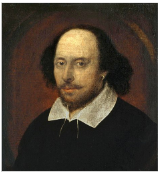
Whilst there were many playwrights in Elizabethan England, William Shakespeare is arguably the most well-known and popular.
He was a versatile playwright with comedies, romances, tragedies and dramas linked to English history. He wrote 37 plays in his career.
Aware of the Queen's vanity, he often flattered the Tudor dynasty. E.g. he depicted Richard III as an evil murderer and Elizabeth's grandfather, Henry VII, as a noble king.
Christopher Marlowe
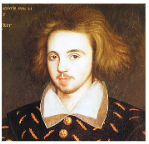
Christopher Marlowe was considered one of the important playwrights of the period.
His works include Dido, Queen of Carthage, Tamburlaine, The Jew of Malta, Doctor Faustus, Edward II and The Massacre at Paris. It is thought that some of his works were credited to Shakespeare.
Note
Other significant Elizabethan playwrights were Thomas Dekker, Thomas Kyd, Thomas Sackville and Ben Jonson.
Visual Arts
Note
It is considered that the Renaissance came late to England and the visual arts were not as dominant as their Italian counterpart. Most artists of the Tudor court came from other countries, such as Hans Holbein who produced some of the best paintings of the period. Ushered in by the English Reformation, iconoclasm was believed to have ended the skill of painting in England with the destruction of mediaeval religious art.
Portraiture dominated English art, which further gave way to the significant English invention, the portrait miniature. Portrait miniatures used the techniques of the illuminated manuscript and transferred them to small portraits worn in lockets. Nicholas Hilliard and Isaac Oliver produced the finest portrait miniatures of the time.
Note
Elizabeth's wealthier subjects began to wear her image as a sign of loyalty in the 1580s, at the outbreak of the Anglo-Spanish war.
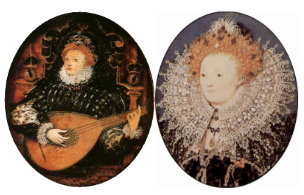
Portrait miniatures of Elizabeth I attributed to Hilliard
Music
Note
The Queen took an interest in music and could play the virginals and the lute. Her interest influenced her subjects who became eager to learn and be proficient in playing instruments. Unlike the visual arts, music was able to keep in touch with continental developments. Elizabethan music shifted from sacred to secular and gave rise to instrumentals. Some of the leading English composers during the period were William Byrd**,** Thomas Tallis**,** Thomas Morley and John Dowland.
The composers were commissioned by the Church and the Court and mainly used two styles, madrigal and ayre.
- Madrigal was a secular vocal music composition which consisted of two to eight voices.
- Ayre was a song-like vocal or instrumental composition. The Queen was a major patron of English composers, especially in the Chapel Royal, and she employed numerous foreign musicians in her consorts of viols, flutes, recorders, and sackbuts and shawms in her royal household
Architecture
Whilst palace building was not included in Elizabeth's programme, she encouraged her courtiers to build extravagantly. Then she would visit her courtiers and their great houses as her summer progressed. Additionally, courtiers, cottagers and homeowners rebuilt for improvement and usually deployed a symmetrical layout during this period. Elizabethan architecture was heavily influenced by European Renaissance styles.
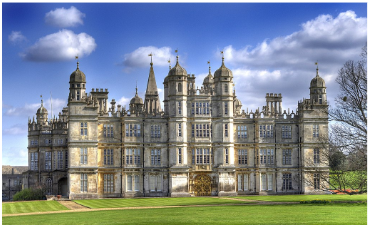
Burghley House, completed in 1587
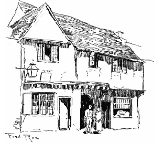
Half-timbered house
The prodigy house first manifested the English Renaissance style with its large, square and tall houses that hoped to attract the Queen's visit. Other features of huge English houses of the period were a long gallery, large windows, classical columns, profuse carvings, ornate decoration and strapwork. On the contrary, the small Elizabethan houses were less influenced by the Renaissance style and half-timbering was still common.