The Nine Years’ War (OCR A-Level History A): Revision Notes
📚Revision Notes
The Nine Years' War
Reasons and Significance of the Nine Years' War
The reasons for the Nine Years' War in Ireland could be traced back to the early sixteenth century when Henry VIII was declared King of Ireland after a failed rebellion led by Silken Thomas, the Earl of Kildare.
- Under the policy of surrender and regrant, Gaelic leadership assimilated into the new structure of the government of the Kingdom of Ireland and the Church of England under Henry VIII.
- English law, culture, language and religion were imposed on Ireland.
- However, the English Reformation failed to take hold in most of the country and had no significant influence on the Irish Parliament.
Note
Surrender and regrant allowed the power of the Irish clans to convert to the late-feudal system under the English legal system.
The Irish Parliament initially accepted Henry VIII's Act of Supremacy and the dissolution of monasteries.
- When the papal bull Regnans in Excelsis of 1570 came out, the Old English Catholic representatives in the Irish Commons disputed the authority of the Crown to introduce penal legislation against Catholics.
- Furthermore, the English presence in the country was opposed by the mercenary class and the Irish poets, whose status had diminished in English-ruled Ireland.
The Role of Tyrone

Hugh O'Neill, Earl of Tyrone
Note
The plantations of Ireland that were commissioned by the Crown had little success in pacifying and controlling the country. The situation became worse when the papal bull urged the Roman Catholics to deny Elizabeth's authority. By the time the English authorities attempted to put Ulster under their control, they clashed with Hugh O'Neill, Earl of Tyrone, a powerful Irish lord.
Tyrone initially supported the Crown but when he was refused to be named the Lord President of Ulster, he switched sides and resisted the English. His troops were in contact with Philip II of Spain since 1591. Their shared Catholicism empowered the resistance against English advances in Ulster.
Reasons for the Nine Years' War
- Elizabeth refused to grant Tyrone the whole of Ulster: Tyrone wanted to rule all twelve counties of Ulster.
- Local resistance to English authorities: Tyrone wanted to lead Ireland's break with Protestant England.
Timeline of the Nine Years' War
- In 1594, Irish forces raided an English supply column at the Battle of the Ford of the Biscuits.
- Fifty-six Englishmen were killed and 69 wounded.
- The rest fled the field and abandoned the supply train.
- In 1595, English troops were ambushed by a larger Irish Gaelic army at the Battle of Clontibret.
- The English suffered significant damage and the Tyrone-led Irish army was victorious.
- Tyrone asked for Spanish aid. In 1598, he raised an army of 10,000 and defeated the English troops at the Battle of Yellow Ford in August 1598.
- The English defeat in 1598 prompted the Queen to send a larger force under the command of the Earl of Essex.
- Essex concluded the campaign with a truce with the Irish rebels.
- His actions angered the Queen.
- Lord Mountjoy replaced Essex. In 1601, he secured the English victory during a severe storm at the Battle of Kinsale.
- Many Spanish and Irish soldiers fell in this battle.
- The English scorched earth tactics forced Tyrone to surrender in 1603.
Note
Thousands of soldiers and Irish civilians died in the battles and due to famine.
The Nine Years' War ended with the Treaty of Mellifont
- Tyrone's attainder was reversed. He was allowed a seat in the Irish House of Lords.
- In exchange for his pardon, Tyrone swore his loyalty to the Crown.
- English would be the official language in Ireland.
Significance of the Nine Years' War
- The outbreak of the Nine Years' War sparked a nationwide rebellion against English rule in Ireland from 1594 to 1603.
- It threatened the English authority in the country.
- The Battle of the Yellow Ford in 1598 became the only major military defeat inflicted by rebels on a government army during this period.
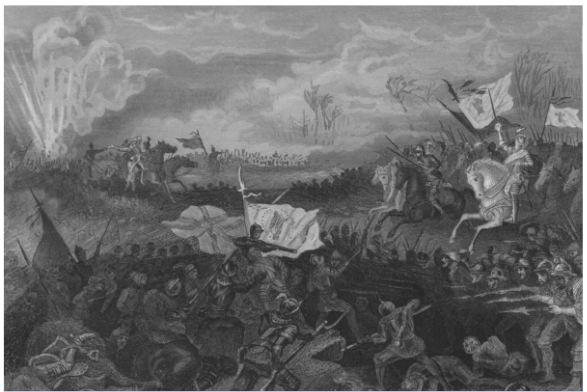
Battle of the Yellow Ford, 1598 of the Nine Years' War
- Whilst it had been costly for Elizabeth, the peace negotiation signed in 1603 completed the Tudor conquest of Ireland with the surrender of the Irish earls and tolerance of, if not submission to, Protestantism in Ireland.