The Spanish Armada, 1588 (OCR A-Level History A): Revision Notes
📚Revision Notes
The Spanish Armada, 1588
Note
Philip II of Spain had first thought to send an invasion force to England in 1585. It was not until 1588 that the Armada pushed through due to several factors that ultimately led to the war between Spain and England.
What were the reasons for the Spanish Armada?
- Philip wanted to restore Catholicism to England. He had the backing of the Pope who excommunicated Elizabeth I in 1570.
- As a Catholic power whose Spanish Empire had been expanding, Philip wanted to conquer England and lead its monarchy since the figurehead of Catholicism in England, Mary Queen of Scots had been executed.
- Philip wanted to halt the attacks of English privateers against Spanish galleys returning from the New World.
- Philip wanted to stop the English aid to Dutch rebels and French Protestants.
The reasons for the war between Spain and England were triggered by a combination of events in England that were seen as offences against Catholicism, including:
- The harsh penalties for Catholics.
- The passage of anti-Catholic laws.
- The execution of Mary, Queen of Scots. In 1588, Spain set the stage for the great invasion whilst England readied its coasts and troops.
The Spanish vs English Armies
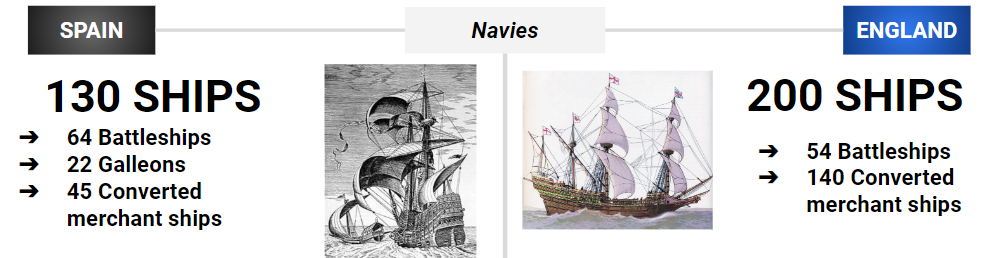
- The Spanish treasure fleet galleons were cumbersome and heavy.
- They carried up to 2,000 powerful cannons – best for short distances and slow to reload.
- Floating fortresses crowded with 20,000 soldiers ready for close combat.
- Hawkins developed the English galleon, which was lower, sleeker and consequently much faster and more manoeuvrable than Spanish galleons.
- The fleet had 200 smaller cannons that could fire over a long distance and were quick to reload.
- 14,000 men on board armed with longbows.
Key Events of the Armada
Date of the campaign: July-August 1588
Location of the campaign: The English Channel, the North Sea and the seas around the north and west of Scotland, the Orkneys and the west of Ireland.
- The Spanish Armada attempted to leave Lisbon, Spain, on 28 May 1588. Storms and the need for repairs caused delays and it finally set sail two months later, on 12 July.
- With the knowledge that a siege was coming, beacons along the south and southeastern coast of England were manned by watchmen around the clock. The Armada was sighted by the English from Lizard Point in Cornwall. The warning beacons were lit and quickly spread the word that the Spanish were coming.
- The Armada entered the Channel and took a fleet of 66 English ships by surprise, but they were not attacked.
- The English ships prepared for battle and began chasing the Armada but little damage was suffered.
- The Armada anchored near Calais. More troops from the Netherlands were meant to join but did not as they failed to anchor to pick them up.
- The English deployed fire ships, which scattered the fleet and they broke formation. Upon scattering, the Spanish ships were blown by strong storms/wind towards dangerous sandbanks.
- The English attacked again in the Battle of Gravelines. The battle was at close range, and despite Spain's preference for close battle, they experienced significant damage.
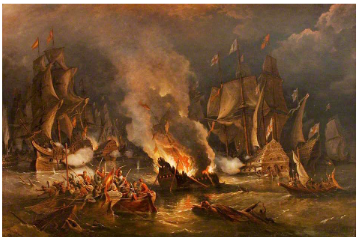
The Spanish Armada driven out of Calais by fire
- The Armada was forced north around the east coast of England and the English fleet turned back after food and ammunition supplies ran low.
- English fireships broke the Spanish formation on the night of 7 August. Sidonia's ships famously 'scattered in a thousand directions'.
- The English were wary of engaging but with wind and strong currents in their favour and the Spanish in danger of being driven onto the shore, England held the advantage.
- The Spanish anticipated English troops boarding their ships, but without this happening they were unable to make use of their larger manpower.
- The Armada had used a lot of its ammunition with front-line ships before the English closed in.
- In the Battle of Gravelines, the Spanish incurred significant damage compared to the English fleet.
- With the Spanish drifting towards the shoals, England broke off the fight in the evening.
- The following day, the winds shifted and the Spanish were able to move away from their dangerous situation and escape northwards.
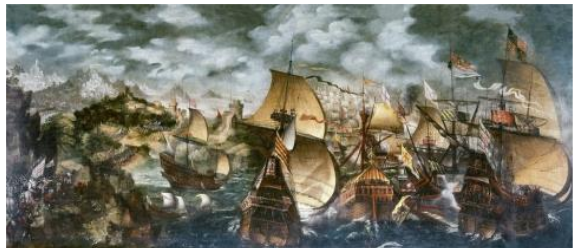
The Battle of Gravelines, 1588 by Nicholas Hilliard
- The Armada sailed north to go around Scotland and, though not followed by England who had turned back to resupply, that's where their troubles began. Trouble for the Armada
To return to Spain, the Armada needed to go around the top of Scotland and along the Irish coast. Severe weather caused significant losses for the fleet. Many ships sank or were wrecked on the coast and thousands of Spanish sailors drowned. Almost half their fleet was destroyed by the time they arrived back in Spain. The English celebrated the events as a major victory over the strongest nation in Europe.
Why the Spanish Armada was Defeated
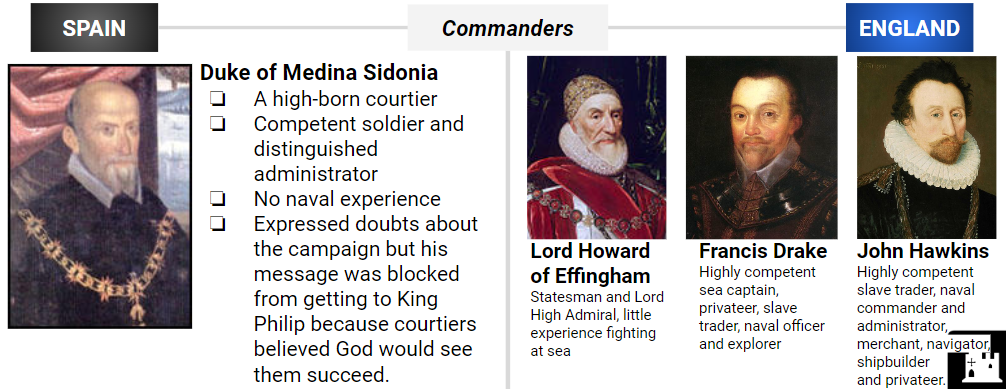
- Leaders: Spain had inexperienced leaders, leading to fatal errors in planning and tactics.
- Planning: The Armada's strength lay in its crescent formation. When this broke up they were exposed to attack.
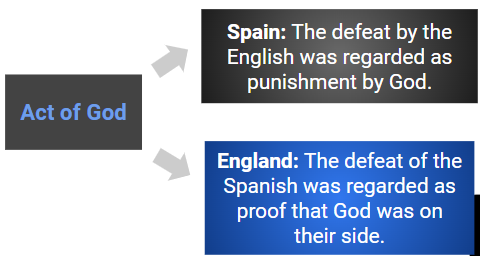
- Weather: Spain lacked somewhere to shelter in bad weather meaning they were buffeted by the wind. Thought God was siding with Elizabeth.
- Weapons: England's cannons could fire faster and over longer distances. Spain had more, but they lacked range and were slow.
- Tactics: Spain planned on close-up battles where their numbers would work in their favour. England never got close.
- No backup: Spain relied on picking up the Duke of Parma's army to boost numbers, but failed to anchor.