Yorkist Opposition (OCR A-Level History A): Revision Notes
📚Revision Notes
Yorkist Opposition
Note
What you need to know - Yorkist opposition to Henry VII was driven by figures like Lovel, Stafford, and the de la Pole family (Suffolk), who sought to restore Yorkist rule. Key pretenders such as Lambert Simnel and Perkin Warbeck, supported by foreign powers like Margaret of Burgundy, posed significant threats, with Simnel backed by the Earl of Lincoln and Warbeck gaining support from Sir William Stanley.
With Henry VII's significant actions aimed at securing his position, threats still existed as various Yorkist claimants to the throne made their moves.
Who were the threats to Henry VII's throne?
Viscount Lovell and the Staffords, 1486
Francis, Viscount Lovell, a key supporter of Richard III, attempted to raise a rebellion against Henry VII in the North Riding of Yorkshire. Humphrey Stafford's attempt to gather support in the Midlands led to his capture and execution but Henry VII pardoned his younger brother, Thomas Stafford. The rebellion gained little support and Lovell managed to escape to the court of Margaret of Burgundy, sister of Richard III.
Coat of arms of Lovell and the Staffords
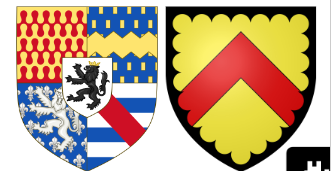
Lambert Simnel and the Earl of Lincoln, 1487
The failure of the Lovell and Stafford rebellion led to the Yorkists' change of tactics to overthrow Henry VII.
- John de la Pole, Earl of Lincoln, put together a conspiracy assigning Lambert Simnel the role of a young Yorkist prince who was the rightful heir to the throne with Margaret of Burgundy acting as the wealthy financier.
- Simnel, who was trained in impersonation, pretended to be the Earl of Warwick and was crowned King of England in Ireland in May 1487.
- This deception was exposed by Henry VII by showing the real Earl of Warwick around London.
- In response to this rebellion, Henry VII reinstated to power the previously untrustworthy Earl of Northumberland in the north. He also gathered a group of advisors including Yorkists who had afflicted relations with Richard III in the south and Midlands, efficiently led by the Earl of Oxford.
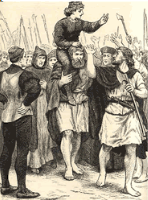
An illustration depicting Irish supporters carrying Simnel
Simnel's army was crushed at the battle of Stoke Field, and Lincoln was killed. The victory of Henry VII at Stoke Field made the king's position safer but not completely secure and his mild treatment of the rebels (Simnel was given a job in the royal kitchens) weakened the Yorkist cause.
Perkin Warbeck, 1491 – 1499
- Perkin Warbeck, a cloth trader from Tournai in Flanders, claimed to be Richard, Duke of York, the younger of the Princes in the Tower.
- He started impersonating the young prince in 1491 in Ireland.
- He then appeared briefly at the court of Charles VIII of France before proceeding to the court of Margaret of Burgundy, where he learned the manners of a Yorkist prince and began to attract English nobles into his conspiracy.
- In 1495, Warbeck's attempt to invade England came to a defeat and the pretender was forced to flee to the court of James IV of Scotland, where he was offered men and a noble bride.
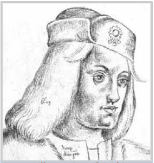
An illustration of Perkin Warbeck
- In 1496, his troops attempted to invade England again but quickly withdrew back to Scotland.
- James IV gave in to Henry VII's offer of marriage to his daughter Margaret.
- Warbeck made another attempt to steal the throne during the Cornish Rebellion in 1497, which led to his capture.
- Henry's leniency towards Warbeck ended when the rebel allegedly tried to escape from the Tower of London with the Earl of Warwick. Warbeck and Warwick were executed in 1499.
Sir William Stanley, 1495
Sir William Stanley, step-uncle of the king, was appointed as the Lord Chamberlain after their support at Bosworth decisively won Henry VII the crown. However, the loyalty of the Stanleys heavily relied on which was more beneficial for their family's survival. When Stanley was discovered to be in support of Perkin Warbeck, he was convicted of treason and beheaded.
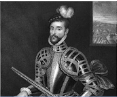
Sir William Stanley
Edmund de la Pole, Earl of Suffolk, 1501
Note
Suffolk had a legitimate claim to the throne unlike the pretenders Simnel and Warbeck.
The security of Henry VII's dynasty was tested by the younger brothers of the Earl of Lincoln**,** Edmund de la Pole**,** Earl of Suffolk**,** and Richard de la Pole. Suffolk's grievances against Henry VII were rooted in some lands lost to the Crown, huge relief payments, and his demotions from Duke to Earl**.** Suffolk fled England to seek the support of Philip of Habsburg against Henry VII**.** Henry VII then arrested members of his family and friends and negotiated the handing over of Suffolk from Philip in 1506. Suffolk stayed in the Tower of London until he was executed in 1513.
The Importance of Margaret of Burgundy
Margaret of York, the sister of both Edward IV and Richard III**,** became the Duchess of Burgundy by her marriage to Charles the Bold. After the death of her husband, she acted as a protector of the Burgundian State.
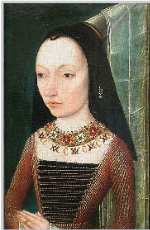
Margaret of Burgundy
What was her role in the Yorkist opposition?
Margaret of Burgundy became involved in early Tudor politics as she held onto the Yorkist succession to the throne. Her support was instrumental to the rebellion of the pretenders: Lambert Simnel and Perkin Warbeck.
- She provided 2,000 mercenaries, led by the German Martin Schwarz, to the rebellion led by Simnel.
- She funded and supported Warbeck's rebellion.
Note
EXAMINE: What do you think were Margaret of Burgundy's reasons for supporting the rebellions led by the pretenders?