Government (OCR A-Level History A): Revision Notes
📚Revision Notes
Government
Note
What you need to know - Government: changing parliaments from 'King and Parliament' to 'King in Parliament', reform of the Privy Council 1540
Note
Monarchs were in control of government in the 16th century. They were in charge of deciding whether to go to war or when to choose peace, upholding justice and the law, and summoning and dismissing parliament. To be a successful ruler and to avoid rebellions and usurpation, the monarch should not ignore the laws made by parliament and the traditions and customs of the kingdom.
Unlike his father, Henry VIII left the details of day-to-day government to his trusted ministers while enforcing that he was in charge. Parliament's role of granting taxation continued but this time to fund the Crown's military campaigns against its traditional enemies, Scotland and France.
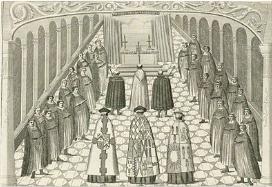
A depiction of the state opening of parliament
Parliament
Parliament was easily persuaded to grant taxation early on in Henry VIII's reign especially when England was on the winning side of the war. However, the king's foreign policy became costly by 1517 and parliament became more discerning to permit additional taxes and loans as the burdens were felt by the people.
Anticlericalism
Note
Anticlericalism is the criticism of the Church, often aimed at its apparent corruption and wealth.
- The Parliament of 1512 passed an act to limit the 'benefit of clergy'
- This reflected the anticlerical feeling during the period.
- This anti-clerical feeling resurfaced in 1515 due to the Hunne affair
- A wealthy London merchant accused of heresy was found dead in the Bishop of London prison. Murder was rumoured but the Church claimed that it was suicide.
- This case contributed to the anticlericalism in Parliament.
The Reformation Parliament
During the early years of Henry VIII's reign (1509-1529), Parliament was summoned only four times specifically in 1510, 1512–14, 1515 and 1523.
- In 1529, Wolsey was already removed from power and Henry VIII's annulment remained a problem yet to be solved.
- When the King summoned Parliament that year, his 'great matter' was not yet discussed since only the Pope could grant what he wanted.
- Henry VIII then threatened the authority of Pope Clement VII in 1531 by claiming that he would instead refer to Parliament for his annulment.
- In 1532, Thomas Cromwell had been appointed in the King's Council and he explored various ways including the use of Parliament's authority to resolve the King's annulment.
- Through a series of acts designed by Cromwell that put pressure on the Catholic Church in 1533-1534, Henry VIII's first marriage was declared void.
Note
The Parliament that aided the King's 'great matter' came to be known as the Reformation Parliament. The break with Rome was made possible through the acts of Parliament that served the King's interests. The Parliament continued to be of great use to Henry VIII and Cromwell throughout the 1530s.
King in Parliament
Due to the shifts in the 1530s, the notion of 'King and Parliament' changed to 'King in Parliament'. In essence, the King acting in conjunction with Parliament became the most important institution in the Kingdom and had the authority over the Church in England. Without the Parliament, Henry VIII had less power.
Note
Whilst Parliament might have gained more power, it was never more powerful than the monarch.
What were the effects of the Reformation Parliament?
- Parliament met more frequently
- House of Commons became increasingly confident
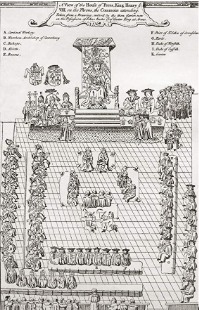
Henry VIII and the parliament
Reform of the Privy Council, 1540
Note
During Wolsey's chancellorship, he planned to reduce the number of members of the council from 40 to 20 under the Eltham Ordinances. This plan never fully materialised. However, in 1537, a council that resembled what he planned for emerged, and became known as the Privy Council.
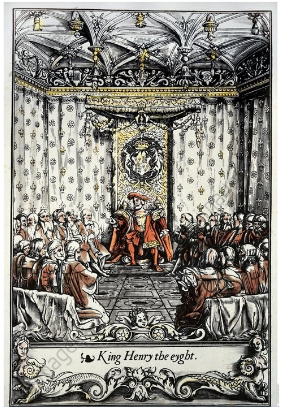
A colour woodcut of Henry VIII and the Privy Council
- The Privy Council was created out of necessity in 1536, in which a serious rebellion required a small council of trusted men to come up with an action plan.
- When Cromwell fell out of the king's favour in 1540, it gained a significant role since there seemed to be a need to restructure Henry VIII's government.
- The king's reliance on his chief ministers led to both Wolsey and Cromwell gaining more control and authority.
- To prevent that, the Privy Council turned itself into a 'chief minister', that way, power would not be concentrated on one individual.
- In essence, the members of the newly formed council took the roles and duties previously held by Wolsey and Cromwell.