Henry VIII and Wolsey (OCR A-Level History A): Revision Notes
📚Revision Notes
Henry VIII and Wolsey
Note
What you need to know - Henry VIII's character, addressing Henry VII's legacy, Tudor subsidy of 1513, Henry VIII's government to 1529, Wolsey's role in the government, finances, law and relations with the Church
The Reign of Henry VIII**,** 1509-1547
1509-1529
- Character
- Aims
- Henry VII's legacy
- Government
- Wolsey's role in government, finances, justice and the Church
- Foreign policy
1529-1547
- Royal Supremacy
- English Reformation and Henrician religious changes
- Changes in government
- Society and economy
- Foreign relations
- Rise and fall of Cromwell
- Relations with France and Scotland
Succession to the Throne
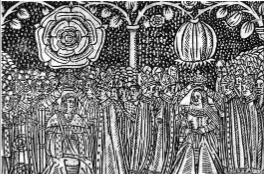
Woodcut of the coronation of Henry VIII with Catherine of Aragon
Note
In 1509, King Henry VII died and his son, Henry VIII, ascended to the throne. About nine weeks later, under the impetus of Spain, Henry married Catherine of Aragon**.**
Catherine was previously married to Henry VIII's brother, Arthur**,** Prince of Wales. However, Arthur died of sweating sickness only a few months later. Therefore, they never consummated their marriage. Considering Catherine's circumstances, Pope Julius II and the Archbishop of Canterbury, William Warham, doubted the validity of this union and allowed the marriage of Henry VIII and Catherine.
The coronation ceremony was held in Westminster Abbey on 24 June 1509 and the marriage strengthened the Anglo-Spanish alliance against France.
Character and Aims
Note
Although his best features do not conform to modern-day beauty standards, Henry VIII was considered an incredibly attractive man. He was around 6-ft tall, was athletic, had blonde hair, and very attractive legs. Only later on in life did he become obese, tyrannical and ruthless.
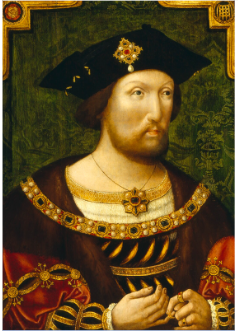
Henry VIII, c.1520
Personality: He was known as a jovial and chivalrous king who possessed great knowledge of the humanities. He always wanted to impress others and to stand out. According to some, he was charming and interesting.
Education: He could speak fluent Latin, French and Spanish. He also had a genuine interest in theology thanks to the strong religious education he received during his childhood. Before he became the heir to the throne, Henry was destined for an ecclesiastical career.
Skills: He was a true Renaissance man and was gifted in many areas. He was a very talented musician and composer. He wrote poetry and his dancing skills were notable.
Tastes: He loved eating, drinking and hunting. Since he felt the need to make a good impression on everyone around him, Henry lived in lavish abundance: his court was decorated with expensive artwork and furniture. He felt the need to be second to none.
Religion: He was Catholic. Although he separated from the Church of Rome and the papal authority, Henry VIII remained a fervent Catholic.
What were the King's Aims?
Note
Henry VIII inherited the throne from his father, who left the kingdom with firm foundations and in a relatively secure position. His consistent aims throughout his reign were:
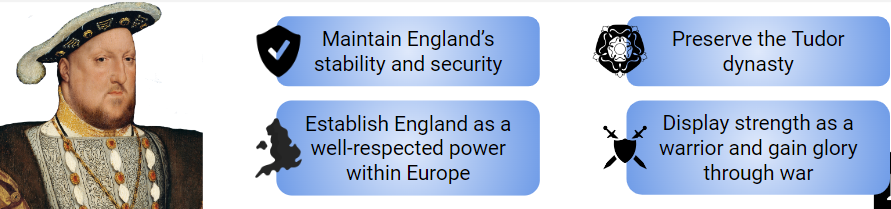
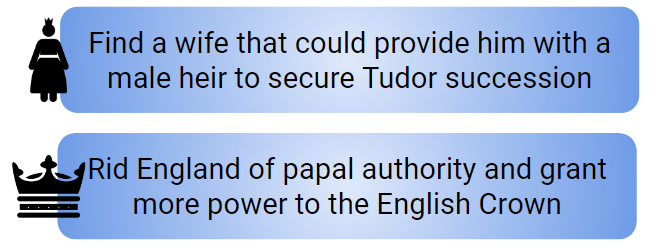
Early in his rule, Henry VIII aimed to legitimise his authority. He wanted to establish himself as the king of England while distancing from his father's unpopular policies. His focus changed by the end of the 1520s. The aims added to his list were:
The Legacy of Henry VII
Note
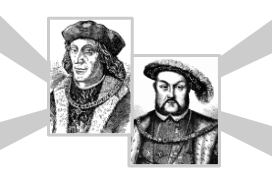
Henry VIII inherited the following legacies, which characterised the English throne during the period:
Finance: Around £300,000 and numerous sources of income
Loyal Servants: The Royal Council comprised of Henry VII's loyal servants such as Warham and Lovell
Peaceful Foreign Policy: England was unthreatened but with minor power
Conciliar Government:
The kingdom was run by specialised councils
Henry VIII's Government to 1529
Note
Wanting to distance himself from his father's unpopularity, Henry VIII created his personal style of government. He accepted some of the legacies that his father left him and changed some that would not serve his aims.
- He initially accepted the peaceful foreign policy that aided him in preserving his Tudor dynasty.
- His marriage with Catherine of Aragon was well received in England, and this allowed him a future alliance with Spain against France.
- He parted from his father's policy of removing the power of the nobility by ending 175 bonds and recognisances after closing the Council Learned in the Law and the execution of his father's financial enforcers, Empson and Dudley.
- Admiring Henry V's victory against France from 1415-1422, he revived a warlike foreign policy against France.
- He invaded France in 1513 and the nobility played a significant role in leading campaigns in France and Scotland.
- He accepted the conciliar government and chose to rely on two groups for advice and guidance: the Royal Council and the Privy Chamber.
- Unlike his father who personally supervised day-to-day government, Henry VIII disliked routine tasks.
Note
Whilst some of the nobility remained a threat to Tudor rule, the nobility were allowed to gain back their influence on politics.
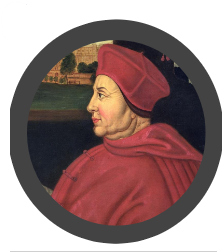
Lord Chancellor Thomas Wolsey
Note
Henry VIII initially continued to depend on his father's trusted advisors, Sir Thomas Lovell**,** Richard Foxe and Archbishop Warham, appointing them to important positions in his government. However, he soon grew tired of their conservative ideologies and preferred like-minded people who would carry out a great deal of his work. Thomas Wolsey, who came from humble origins and began as the Royal Almoner in 1509, was appointed as Lord Chancellor of England in 1515.
What was his role in the government?
Wolsey's success in delivering a well-equipped and supplied army for war with France allowed him to gain the king's trust and the top position in the government. He encouraged the king's attitude towards administration and carried out the tedious tasks that Henry VIII wanted to avoid.
Wolsey's position in the government and multiple appointments in the Church resulted in him being referred to as an Alter Rex, or 'second king'. Henry VIII allowed this comparison because of his trust and respect towards Wolsey and he still had the ultimate decision on the most important matters of state.
Finances and Laws
Note
The king's aggressive foreign policy was expensive and Wolsey had to come up with solutions to be able to fund the king's aims. Wolsey made use of the existing system of raising revenues and introduced reforms that would best serve the king's interest. He improved direct taxation with the subsidy, a tax based on an up-to-date assessment of a person's income, in essence, the greater a person's income, the more tax they paid.
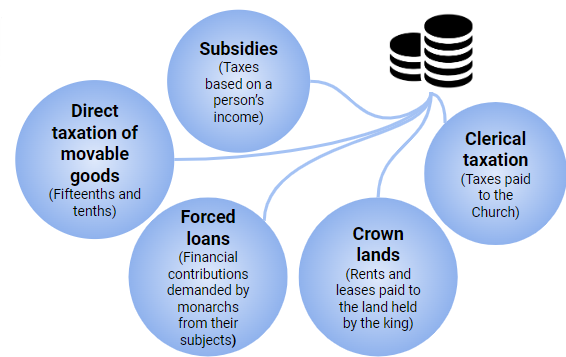
Amount raised by sources of revenue (1513-29)
Direct taxation of movable goods £118,000
Subsidy £322,000
Forced loans £260,000
Clerical taxation £240,000
Note
This system is similar to how tax is calculated in England today.
Enclosure
- Wolsey tried to find a solution for the problem brought by Enclosure.
- Enclosure = the practice of individual landowners fencing off land for profitable sheep rearing.
- Farmers were driven off their land and villagers were forced out of common areas where they grazed their animals because of this practice.
- In 1517, Wolsey's investigation of enclosed lands without proper permission led to over 260 court cases against landowners.
- Until 1523, when the angry landowners in parliament forced Wolsey to cease his investigations.
- His intentions were for the benefit of the poor, but his actions contributed to his increasing unpopularity.
Amicable Grant
Note
In 1525, Wolsey approved a tax called the Amicable Grant, which secured one-third of the proceeds of clerical and secular institutions. Since the subsidies and forced loans were already used up, he came up with this taxation to possibly fund Henry VIII's campaign to invade France at its most vulnerable, when the French king, Francis I, was defeated by Charles V in Italy.
However, several revolts broke out against the taxation and the king ordered the Amicable Grant to be stopped. Without the funds for Henry VIII's military campaign, England was forced to sign a peace treaty with France.
Henry VIII and Wolsey
Note
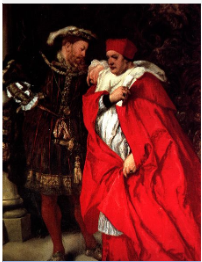
Wolsey's unpopularity further increased. This marked the beginning of Wolsey's fall from power.
The Eltham Ordinances
- Wolsey introduced reforms in the domestic and political aspects of the king's household by establishing a set of rules at the court.
- These came to be known as the Eltham Ordinances. The rules were outlined in 79 chapters with the intent of creating order within the court.
- The rules included the need to diminish the expenses of food and lodging for servants, reducing the members within the Privy Chamber, expelling from the court servants who were sick, and so on.
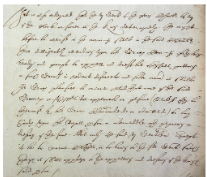
Extract from the Ordinances of Eltham
Note
Gentlemen of the Chamber were the staff of the Privy Chamber.
Note
EXAMINE: How did Wolsey's origins affect the policies he pursued as chief minister? How did the people react to his policies?
Aside from managing the royal finance and domestic policies, Wolsey was also responsible for the legal system in England as Lord Chancellor. He was aware of the flaws of the system and recognised the need for reforms that would give fair treatment to both the nobility and the poor. He favoured the use of the Star Chamber, a royal court founded during the reign of Henry VII, to secure fairer justice.
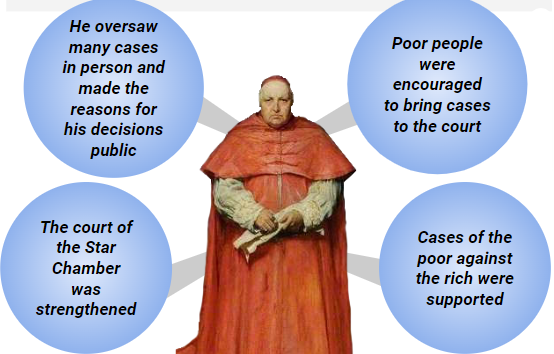
An example of his fair treatment was the imprisonment in 1515 of Henry Percy, Earl of Northumberland, one of the heroes of the 1513 Battle of the Spurs, for breaking the law.
Wolsey's attempts to improve the legal system were criticised, especially by the nobility, who felt that the Lord Chancellor was motivated to get back at them.
Foreign Policy
Note
Wolsey was responsible for developing foreign policies that would help the king accomplish his aims for England, i.e. to achieve military glory through war against France.
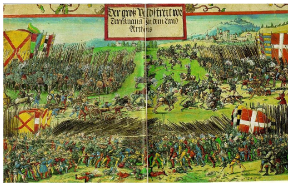
A depiction of the 1513 Battle of the Spurs
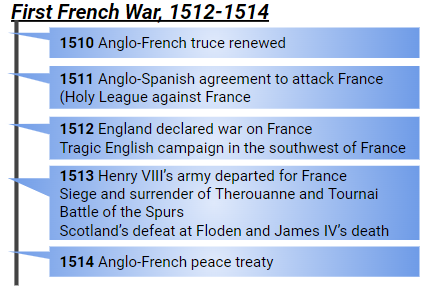
The war against France (1512-1514) gave Wolsey a significant opportunity to demonstrate his ability in foreign affairs. Wolsey was able to maintain a large number of troops throughout the war which contributed to England's success. He played a key role in negotiating the Anglo-French Treaty of 1514, which secured a temporary peace between the two nations. The treaty was further sealed with the marriage of Louis XII and Henry VIII's younger sister, Mary.
Treaty of London, 1518
Note
WHAT WAS IT? It was a pact of non-aggression designed by Wolsey and signed in 1518 between 20 European nations.
Note
WHO SIGNED IT? The Kingdom of France, the Kingdom of England, the Kingdom of Spain, the Holy Roman Empire, the Papal States, the Duchy of Burgundy, and the Netherlands.
Note
WHAT DID IT ESTABLISH? Each state had to commit itself to implementing a non-aggression foreign policy. The signatory countries had to declare war on those nations that broke the terms of the treaty.
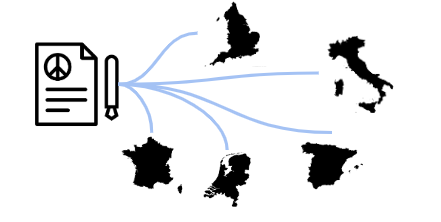
The Treaty of London was successful, but only for a very short time. A year later, a war broke out between the King of France, Francis I and Emperor Charles V. In 1523, the Kingdom of Denmark and the Kingdom of Sweden entered the war. The Treaty of London was, therefore, the last peace treaty between the European nations, before the Congress of Vienna in 1815.
Note
WHAT WAS ITS PURPOSE? The treaty put an end to England's war against France. Pope Leo X wanted the European nations to reconcile to launch a crusade against the Ottoman Empire which was invading the Balkans.
The Field of the Cloth of Gold, 1520
Note
The Field of the Cloth of Gold was another example of Wolsey's diplomatic policy. Wolsey organised this grand meeting between Francis I of France and Henry VIII: about 5,000 followers accompanied him. Although it seemed to open the door to peace negotiations with France, it was an opportunity for the English court to show Europe its wealth and power through celebrations and flamboyant events.
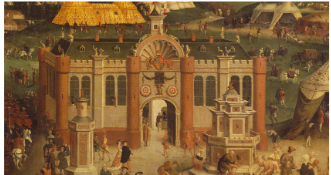
Field of the Cloth of Gold, 1520
The royal summit left a great impression but its political result was minimal. Soon after the event, Wolsey arranged an alliance with Charles V, who declared war on France later that year.
The Treaty of Bruges, 1521
Wolsey signed the Treaty of Bruges with Charles V during the 1521-26 Italian war, which stated that England would join Spain in the war against France. This was a secret treaty that ignored the Treaty of London. Relations between Rome and England became awkward: although Pope Leo X had encouraged the Treaty of London, the Vatican believed that Wolsey played a central role in asserting England's power over Europe.
Relations with the Church
The Role of Wolsey within the Church
Note
Wolsey became one of England's most important churchmen during the period. His ecclesiastical appointments during the reign of Henry VIII included Canon of Windsor in 1511, Bishop of Lincoln, and Archbishop of York in 1514. In 1515, he was created cardinal by Pope Leo X, which granted him precedence over all other English clergy.
- In 1518, Wolsey was made papal legate in England, a position he used to organise a peace treaty involving 20 nations.
- He aimed for the popedom but failed after expressing his intentions a few times.
- Due to his significant appointments both in the Church and government, Wolsey was able to live in great luxury.
- Using his authority as papal legate, 30 decayed monasteries in Ipswich and Oxford were dissolved in 1524 and 1527.
- He used the proceeds to establish a grammar school in Ipswich and Cardinal College in Oxford.
- Wolsey showed intentions to bring reforms to the English Church but did nothing to follow through on his plans.
- Despite this, the Church became more centralised under his control and churchmen were accustomed to orders from the Crown.
- This was advantageous to Henry VIII**.**
- Whilst the Church was not free of corruption and abuses, it appeared to be stable, powerful and relatively popular among the people.
Note
The Archbishop of York was the second most important role in the English Church.
The Annulment of Henry VIII's Marriage to Catherine of Aragon
Note
Conflict arose in 1527 when Wolsey was caught between his ecclesiastical obligation and his position as Henry's minister. The king sought an annulment of his marriage to Catherine of Aragon, who gave him a daughter, Mary, but failed to provide a male heir. He believed that female rule in England would be contested and could lead to civil wars such as had happened during the Wars of the Roses. To have a male heir, Henry VIII wanted an annulment to pursue his marriage to Anne Boleyn. Wolsey was tasked to find a solution to the king's 'great matter'.
What were Henry VIII's reasons for annulling his marriage?
- He believed that his marriage was against God's will.
- He needed a legitimate male heir to secure Tudor succession and dynasty.
- He gave up on his marriage with Catherine and was swept away when he met Anne Boleyn.
Note
Only the Pope of the Roman Catholic Church had the power to dissolve marriages.
The Role of Wolsey in the Annulment
Wolsey had to persuade the Pope to grant the annulment. First, he questioned the sufficiency of the papal dispensation issued for the marriage of Henry VIII and Catherine. Then, he encouraged Pope Clement VII to allow the annulment to be discussed at a trial in England, where he could decide on the outcome as papal legate. The Pope agreed but required the presence of another papal legate, Cardinal Campeggio. However, Campeggio's arrival in England kept being delayed and the proceedings dragged on for years.
The Annulment Hearing
Finally, in 1529, the hearing was held at Blackfriars. Catherine of Aragon refused to be annulled by Henry VIII, appeared in court, and asked the king for mercy. The Pope closed the English trial in favour of Catherine of Aragon and concluded that the next hearing should be held only in Rome. However, another hearing in Rome never came about.
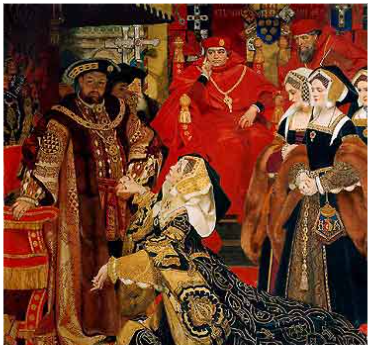
Henry VIII and Catherine of Aragon before Wolsey and Campeggio at Blackfriars
The Downfall of Wolsey
Although Wolsey was confident that the annulment would be resolved easily due to his powerful position in the Church, the circumstances that were out of his hand led to the failure of a great task placed upon him. This failure, coupled with the pressure from Anne Boleyn and her family, left Wolsey in a dangerous position. Henry VIII began to doubt the chief minister's motives and lost his trust in him. Consequently, Wolsey was stripped of his title of Lord Chancellor with all his possessions and properties confiscated and accused of treason. He pleaded to the king while in exile and attempted to gather support for his reinstatement. Wolsey's death due to an illness in 1530 spared him from the execution that possibly awaited him in London.