Catholic Restoration and Persecution (OCR A-Level History A): Revision Notes
📚Revision Notes
Catholic Restoration and Persecution
Note
Mary I aimed to restore Catholicism in England. When her ascension was welcomed by the English people, she presumed that they were also in support of the return of England to the 'true religion'. However, her assumption was probably baseless since the outburst of popular support was due to her dynastic legitimacy. Nevertheless, in 1553, Mary I's reintroduction of Catholicism faced no opposition.
Catholic Restoration
September 1553 Protestant churchmen such as Cranmer**,** Bradford**,** Rogers**,** Hooper and Latimer were arrested and imprisoned.
October 1553: The First Statute of Repeal restored the Church to the position that it had been in during the last years of Henry VIII's reign.
-
Henry VIII and Catherine of Aragon's marriage was declared valid.
-
Edward VI's religious laws were abolished.
-
Mary I wanted to go further but was advised against it by her main supporters. 1554: Catholic bishops replaced Protestant bishops.
-
All bishops were ordered to adhere only to legislation passed in the reign of Henry VIII.
-
Latin became the language of the Church again and clerical marriage was outlawed.
-
Mary I required the papal blessing to fully restore Catholicism. Cardinal Reginald Pole returned to England as papal legate. November 1554: The Second Statute of Repeal restored England's religious position to that of 1529, complete with Papal authority.
-
Heresy laws as they were under Henry VIII were also restored.
Outcomes
- Religious innovations since 1529 were withdrawn.
- Mary I failed to restore monastic lands and monasteries.
- English monarch and Parliament continued to exercise great control over the Church.
- Only papal authority, not supremacy, was restored in the kingdom.
Note
The success of the Marian settlement greatly depended on the support of the nobility and gentry represented in parliament.
Catholic Persecution
- The restoration of the heresy laws by parliament put the lives of the Protestants in England at risk.
- Prominent Protestants were tried for heresy and executed when found guilty.
- The burning at the stake began on 4 February 1555.
- Some of the leading Protestants who were executed were Hooper**,** Ridley**,** Latimer and Cranmer**.**
- Between 1555 and 1558, an estimated 284 religious executions were carried out.
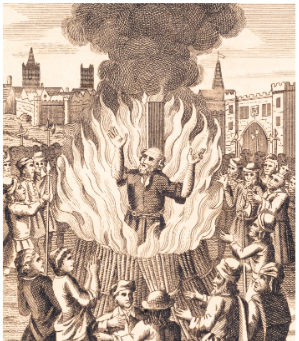
Heretic burnt at the stake
Note
The persecution of Protestant heretics under Mary I's reign gained her the nickname 'Bloody Mary'.
Outcomes
- Around 800 Protestants fled to the continent in exile.
- Protestant martyrs inspired the committed resistance to Catholicism.
- Mary I's popularity suffered.
Note
Being burnt at the stake was a typical punishment for heresy.