Mary I: Succession, Gender Challenges, and Marriage to Philip (OCR A-Level History A): Revision Notes
📚Revision Notes
Mary I: Succession, Gender Challenges and Marriage to Philip
The Reign of Mary I**,** 1553-1558
Note
Born in 1516, Mary I was the daughter of Henry VIII and Catherine of Aragon.
As a child, she received a thorough education in classical and modern languages. She was intelligent and well-educated as it was assumed that she would inherit the throne being Henry VIII's first child. The question of her legitimacy was raised during her father's quest for annulment. When the annulment was finally granted in 1533, she was separated from her mother.
Succession to the Throne
- Character and aims
- Issues of her gender
- Marriage to Philip
Counter-Reformation
- Marian policies
- Catholic restoration and persecution
Conflict and Rebellion
- Northumberland's Plot 1553
- Wyatt's Rebellion 1554
- Factional conflict
Economy
- Issues and solutions With the death of Catherine of Aragon and the execution of Anne Boleyn**,** Mary's situation was much improved. She made formal submissions to her father's views and for the rest of his reign had a household suited to her rank. When Henry VIII died in 1547, his will placed her next in succession to the throne after her brother Edward VI and his children.
Though she had her difficulties under the Protestant government of Edward VI, she was not badly treated, and in 1553 succeeded him as the monarch of England, having defeated the attempt of the Duke of Northumberland to place Lady Jane Grey on the throne.
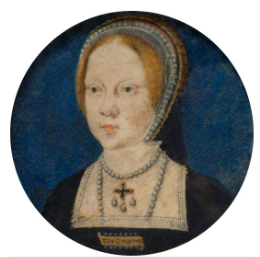
Princess Mary in 1522
Family Tree of Mary I
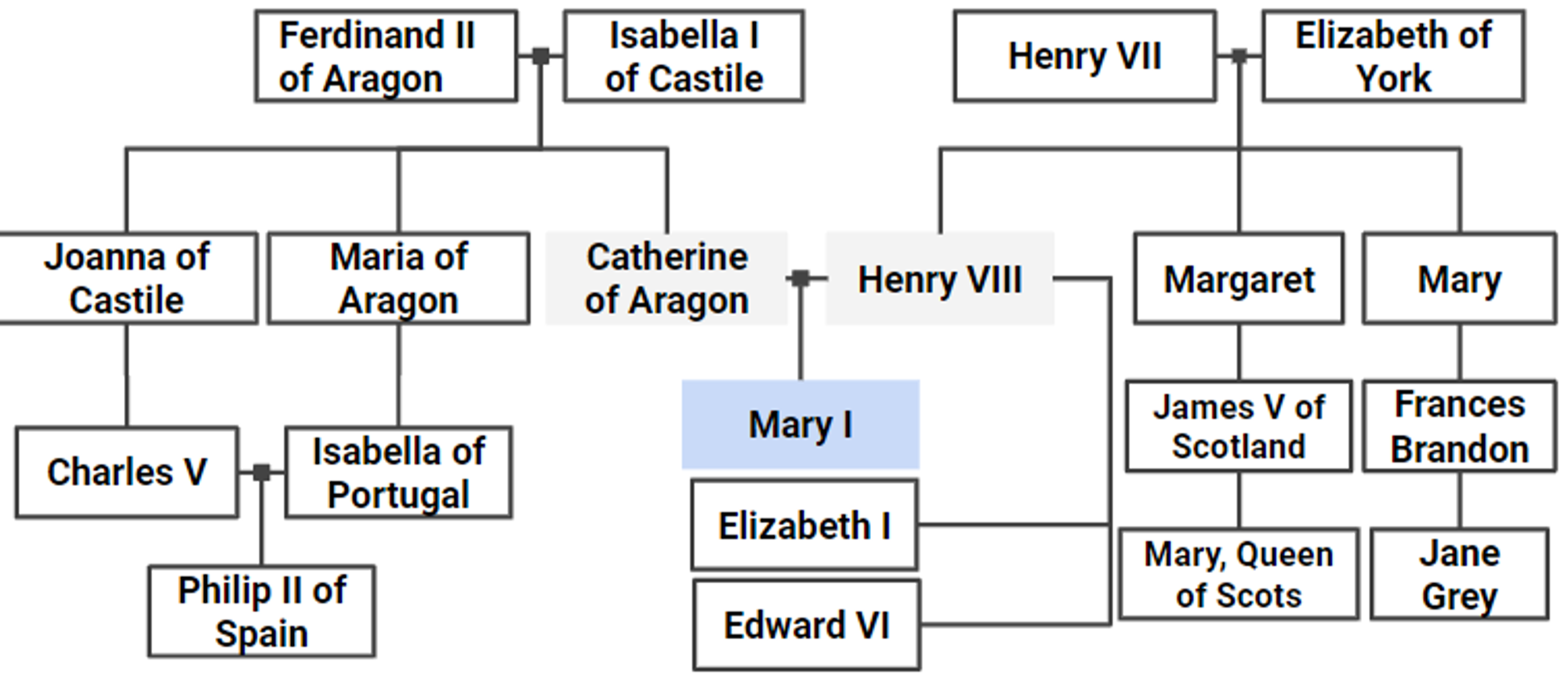
Mary I's Character and Claim to the Throne
Mary I's claim to the throne had been difficult because of Edward VI's decision to exclude her from the succession. However, she gained popular support in 1553 because people believed in her dynastic legitimacy. The Privy Council, which initially supported Lady Jane Grey**,** changed its decision and received Mary I openly in London. For the first time in 400 years, the English throne was held by a woman in her own right.
Note
Mary I was pious and remained loyal to her Roman Catholic faith when she was pressured by Edward VI to renounce her beliefs. Her loyalty to Catholicism influenced her aims when she succeeded to the English throne.
Problems in Succession - Mary I's Gender
Note
Mary I successfully ascended the throne after support for Northumberland collapsed in 1553.
- The English people celebrated and welcomed her to London with a procession of over 800 nobles and gentlemen.
- Whilst her legitimacy mattered more than her gender, she faced problems in asserting her rule.
- During this period, women were believed to be inferior to men.
- The English did not forbid a woman from claiming the throne but there were no strong precedents for this.
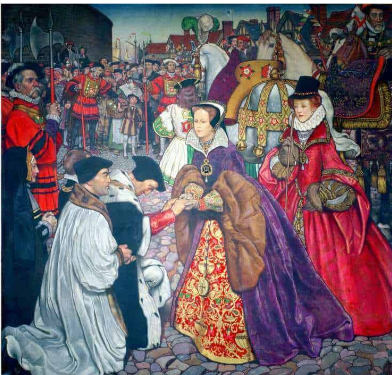
Entry of Queen Mary I with Princess Elizabeth into London in 1553
- When a woman, Queen Matilda, inherited the throne in 1135, she was challenged by her male cousin which led to a civil war.
- Her attempt to rule was challenged but her male heir was allowed to reign.
- Likewise, Henry VII ascended the throne even though his mother's claim was as strong as his.
- The lack of a male Tudor heir in 1553 changed the course of the History of England.
- However, Mary I being a Queen Regnant gained opponents who were against female rule.
"And such be al women, compared vnto man in bearing of authoritie. For their sight in ciuile regiment, is but blindnes: their strength, weakness: their counsel, foolishness: and judgement, phrenesie, if it be rightlie considered." - John Knox, Scottish reformer, 1558
John Knox targeted Mary I in his pamphlet titled 'The First Blast of the Trumpet Against the Monstrous Regiment of Women', explaining that a female rule went against the natural order of things. Making references to the Bible, his analysis originated from Eve coming after Adam in the order of creation.
Mary I's Marriage to Philip
Note
Besides her gender, Mary I was faced with the issue of marriage. Since female rule was uncommon at the time, she was expected to marry a person who would best assist her in governing. She made negotiations with Charles V's son, Philip, trusting that a marriage would be helpful to her reign and an heir would solidify her aims for England.
- Prince Philip of Spain was the heir apparent to vast territories in Continental Europe and the New World.
- Fearing that England would be inferior and dependent on the Habsburgs, Mary I was persuaded to consider marrying an Englishman.
- She insisted on marrying Philip, which was met with discontent and diminished her popularity.
- Mary and Philip's marriage was agreed on under the Act for the Marriage of Queen Mary to Philip of Spain.
- This ensured that England would not become a satellite of Spain.
- Parliament was to be called under the joint authority of the couple.
- Philip was a devout Catholic and saw himself as the defender of Catholic Europe.
- In essence, Mary's marriage to the prince could be seen as a necessary step for her aims.
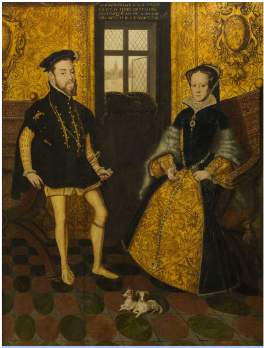
Portrait of Queen Mary & Philip II of Spain
Mary I's Aims
- Restore Catholicism in England.
- Provide an heir to the throne
Note
Mary I inherited England when it was institutionally Protestant.