Northumberland’s Plot, Wyatt’s Rebellion, and Factional Conflict (OCR A-Level History A): Revision Notes
📚Revision Notes
Northumberland's Plot, Wyatt's Rebellion, and Factional Conflict
Note
What you need to know - Factional conflict between Paget and Gardiner under Mary, cause and nature of rebellions 1553 (Lady Jane Grey) and 1554 (Wyatt)
Northumberland's Plot 1553
Note
Edward VI's death was followed by the succession of Lady Jane Grey, as stated in the late king's 'devise'.
This was supported by Northumberland and the Privy Council. Lady Jane Grey was originally fifth in the line of succession according to Henry VIII's will but due to her religion and the influence of councillors, Edward VI had intended to leave her the throne.
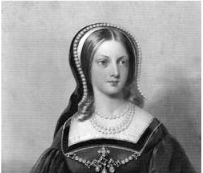
Lady Jane Grey
Causes of Northumberland's plot
- Opposition to Mary's ascension
- Northumberland wanted to keep his power
Note
Lady Jane Grey was known as the Nine Days' Queen of England.
At age sixteen, Lady Jane Grey's reign lasted from 10 July to 19 July 1553.
- With the support for Northumberland withered, the Privy Council switched sides and proclaimed Mary Queen.
- Northumberland and Jane were arrested whilst all classes showed considerable loyalty to the Tudor dynasty.
Wyatt's Rebellion, 1554
- Lord Chancellor Stephen Gardiner supported the restoration of Catholicism in England but disagreed with the marriage of the Queen to Prince Philip.
- Instead, he argued that Edward Courtenay**,** Earl of Devon, was a more acceptable choice to the English people.
- Courtenay was rejected in favour of Philip and many people disagreed with the public announcement of the marriage between the Queen and Philip.
- This resulted in Wyatt's Rebellion led by Sir Thomas Wyatt the Younger, Sir James Croft**,** Sir Peter Carew and Duke of Suffolk, and encouraged by the French ambassador.
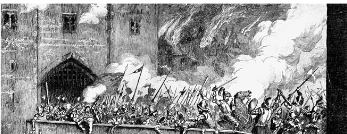
Sir Thomas Wyatt the Younger's attack on London
Note
Wyatt and the other leaders had all supported Mary I over Lady Jane.
Causes and Aims
Causes
- Protestant fear of a Catholic monarch
- Fear of the introduction of the Spanish Inquisition
Aims
- To persuade Mary not to marry Philip.
- To overthrow Mary
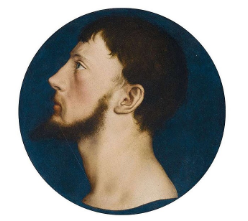
Sir Thomas Wyatt
Key Events
- Wyatt and other rebel leaders plotted to raise armies in different parts of the country and converge upon London.
- The plans were uncovered and Courtenay turned against Wyatt. Most conspirators failed to fulfil their part in the plan.
- Wyatt was able to raise an army of some 3,000 men in Kent, and marched on London, counting on its citizens to rise and join him in his rebellion.
- The first troops sent against him changed sides and joined him.
- Mary personally went to the London Guildhall and urged the citizens to come to her aid. 20,000 men volunteered to act as militia against the rebels.
- Wyatt's men reached London on 3 February 1554, but the support for the rebellion never came.
- Wyatt had a minor battle at Hyde Park Corner on 7 February and was able to escape.
- Wyatt reached Ludgate on 8 February but was unable to break down the gate. Finally, he retreated and was captured at Temple Bar.
- Wyatt was taken to Whitehall and imprisoned in the Tower of London.
- 480 rebels were tried and convicted. About 100 were executed, but 400 were pardoned.
Outcomes
- Wyatt was tried for treason on 15 March 1554 and was questioned about the involvement of Princess Elizabeth in the plot.
- He was executed on 11 April and in his final address, he took full responsibility for the failed rebellion, denying the alleged involvement of the princess.
- However, Princess Elizabeth was imprisoned in the Tower of London and then spent a year under house arrest in Woodstock.
- One unintended consequence of Wyatt's rebellion was the execution of Lady Jane Grey, whose father, Duke of Suffolk, was involved in the plot against Mary I**.**
Factional Conflict between Paget and Gardiner
Note
As Queen of England, Mary I appointed her supporters to the Privy Council such as Gardiner but also kept experienced councillors who were previously Northumberland's allies such as Sir William Paget. Although she was lenient to some, she handled the opposition in the government by ordering the arrest and imprisonment of Thomas Cranmer, John Hooper**,** Nicholas Ridley and other leading Protestant bishops.
- Gardiner was eager to regain the Queen's favour after he was blamed for his enthusiasm to reverse religious changes that contributed to Wyatt's rebellion.
- A talented government minister with strong Catholic beliefs, he attempted to hasten the removal of Protestantism in the kingdom.
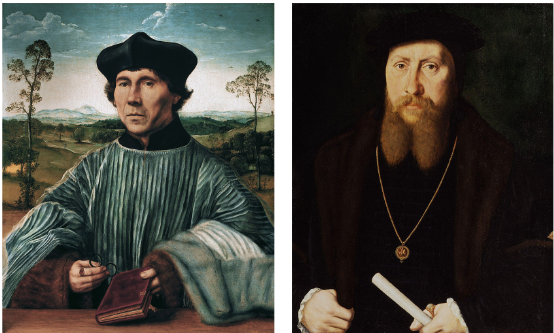
Stephen Gardiner Sir William Paget
- He targeted the married clergy, demanding they give up their wives and families to be able to keep their lives.
- Furthermore, he persuaded parliament to reintroduce the heresy laws.
- These actions were opposed by Paget.
- Paget was a member of the reformist faction in the council.
- He earned the trust of both the Queen and King with his handling of the marriage negotiations.
- However, Paget's opposition to Gardiner's extreme religious legislation cost him Mary I's favour.