Hemispheric lateralisation (OCR A-Level Psychology): Revision Notes
📚Revision Notes
6.3.2 Hemispheric lateralisation
Hemispheric lateralisation: The idea that the two hemispheres perform different functions and each hemisphere is mainly responsible for certain behaviours
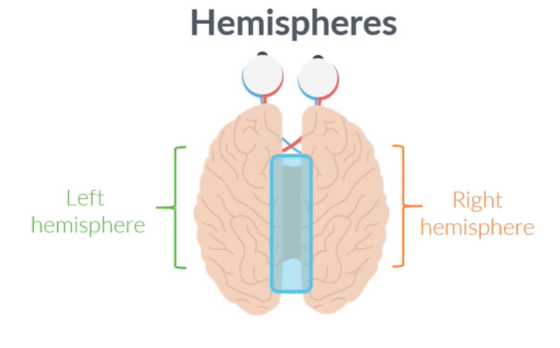
- Spatial skills are hemispherically lateralised to the right hemisphere
- Language skills are hemispherically lateralised to the left hemisphere
Organised contralaterally:
The left hemisphere controls the right side of the body, and the right hemisphere controls the left side of the body
e.g. movement, vision and touch are organised contralaterally
The two hemispheres are connected by the corpus callosum
Corpus callosum: A bundle of nerve axons that enable communication between the two hemispheres
Sperry's split-brain research:
Split brain patients:
Someone who has had their corpus callosum cut
Sperry conducted split-brain research on epileptic patients who had a commissurotomy (corpus callosum cut).
- Research support for hemispheric lateralisation
- Image or word was presented to the patient's right visual field, and so would be processed by the left hemisphere. Another image or word was presented to their left visual field, and so would be processed by the right hemisphere
- Patients were then asked to respond to the stimulus (either by describing it verbally or by pointing to the stimulus that matched the one they were shown).
Findings:
Found that patients could only describe an image verbally if it was presented to their left hemisphere (right visual field), suggesting that the left hemisphere is responsible for language skills
When a word was presented to the right hemisphere (left visual field), patients were able to write it down, but unable to say it, suggesting that the right hemisphere is responsible for spatial skills
Evaluation:
(1)
Note
P: It has been argued that the findings are not generalisable
Note
E: This is because his research involved a small number of patients with brain abnormalities and a history of epileptic seizures, this may have influenced the way they responded to the stimuli. For instance, the use of epilepsy drugs may have affected the brains of participants and thus could be responsible for the results
Note
E: Issues such as this reduce the internal validity of the research as extraneous variables could've explained the findings and also reduce its generalisability to other groups in society
(2)
Note
P: Split brain research, for instance by Sperry has strengthened our understanding of the differences in functions between the two hemispheres
Note
E: Sperry's research supports the conclusion that the left hemisphere is more responsible for language tasks, whereas the right hemisphere is better at spatial tasks. This has strengthened the understanding of how the brain works.
Note
E: These findings have made key contributions to our understanding or brain processes and furthered our knowledge considerably