Diffusion in Multicellular Organisms (AQA GCSE Biology Combined Science): Revision Notes
📚Revision Notes
1.3.3 Diffusion in Multicellular Organisms
Note
Diffusion is essential for transporting substances in multicellular organisms, but due to the complexity and size of these organisms, diffusion alone is often not enough to meet their needs, particularly over longer distances.
Challenges in Multicellular Organisms:
- Distance: In large multicellular organisms, many cells are located far from the external environment. Diffusion over long distances is slow and inefficient.
- Surface Area to Volume Ratio: As organisms grow larger, their volume increases more rapidly than their surface area, reducing the relative surface area available for diffusion. This makes it difficult for direct diffusion across the outer surface to supply all cells adequately.
Adaptations to Enhance Diffusion:
Multicellular organisms have developed specialised structures like lungs, gills, and intestines to maximise diffusion efficiency. These surfaces typically have:
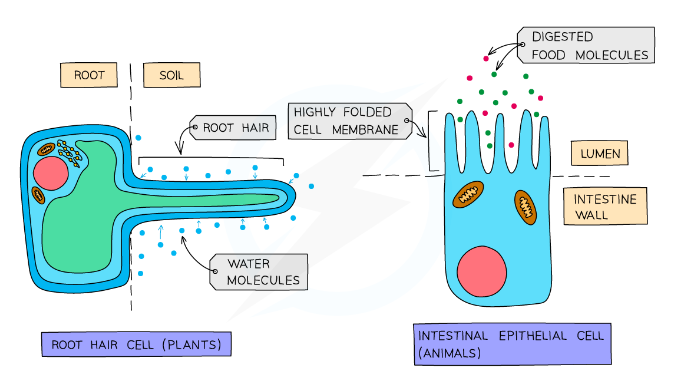
Large Surface Area: Structures such as the alveoli in the lungs or villi in the intestines provide a large surface area for diffusion.
Thin Membranes: Thin barriers reduce the distance over which diffusion occurs, speeding up the process.
Rich Blood Supply: Blood vessels are often close to these surfaces, helping to transport substances quickly away from or to the cells.
Ventilation Mechanisms: In the lungs, breathing helps maintain concentration gradients by continually bringing in fresh oxygen and removing carbon dioxide.
Examples of Diffusion in Multicellular Organisms:
- Gas Exchange in Lungs: Oxygen diffuses from the alveoli into the blood while carbon dioxide diffuses from the blood into the alveoli, facilitated by the large surface area and thin walls of the alveoli.
- Nutrient Absorption in the Small Intestine: The villi and microvilli increase the surface area for nutrients to diffuse into the bloodstream after digestion.
- Waste Removal in the Kidneys: Diffusion is involved in the filtration process where waste products like urea are removed from the blood.
Transport Systems:
- In addition to specialised exchange surfaces, multicellular organisms have developed transport systems (such as the circulatory system) to move substances more efficiently. The blood circulatory system, for example, transports oxygen, nutrients, and waste products to and from cells, complementing diffusion.
Importance of Diffusion:
Despite the complexity of multicellular organisms, diffusion remains a fundamental process for maintaining cellular function. It is integral to processes like respiration, nutrient uptake, and waste removal, ensuring that cells receive what they need to survive and function.
Summary:
In multicellular organisms, diffusion alone cannot meet all the demands of the organism due to limitations like distance and surface area. To overcome these challenges, these organisms have evolved specialised structures and transport systems that enhance diffusion efficiency and ensure that all cells receive the necessary substances for life.