Active transport (AQA GCSE Biology Combined Science): Revision Notes
📚Revision Notes
1.3.6 Active transport
Note
Active transport is the process by which particles move from an area of lower concentration to an area of higher concentration, going against their concentration gradient. Unlike diffusion, active transport is not a passive process; it requires energy, which is provided by respiration. This is why the process is termed "active."
Key Points:
Note
KEY POINTS:
- Energy Requirement:
- Active transport requires energy because it moves particles against their natural tendency to diffuse from high to low concentration.
- This energy is provided by ATP (adenosine triphosphate), which is produced during cellular respiration.
Example
Examples of Active Transport:
-
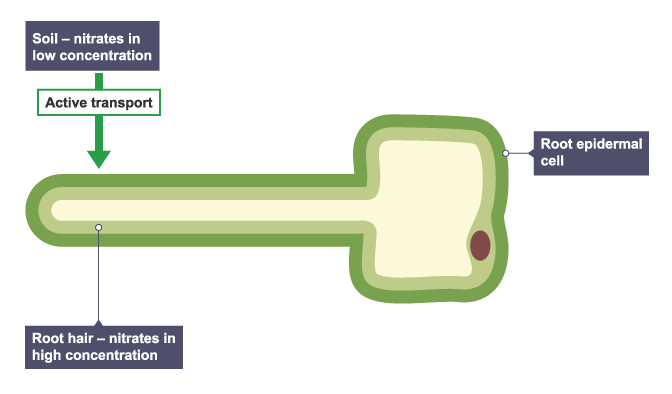
In Root Hair Cells:
-
Function: Root hair cells absorb water and essential mineral ions from the soil, which are crucial for healthy plant growth.
-
Challenge: The concentration of mineral ions is often higher inside the root hair cells than in the surrounding soil, so diffusion alone cannot move these ions into the cells.
-
Solution: Active transport is used to move these mineral ions into the root hair cells, even when the concentration gradient would naturally push them out. This process requires energy from respiration to function effectively.
-
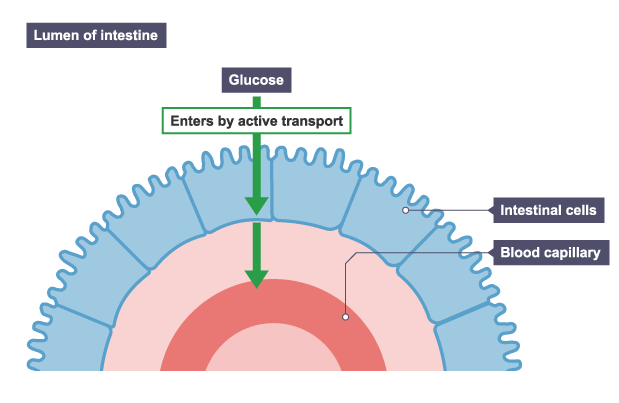
In the Gut:
-
Function: The gut absorbs nutrients such as glucose and amino acids from digested food into the bloodstream, where they can be transported to cells for energy and growth.
-
Challenge: Sometimes, the concentration of glucose and amino acids in the gut may be lower than in the blood, which would prevent diffusion from occurring.
-
Solution: Active transport is required to move these nutrients from the gut into the bloodstream against their concentration gradient. This ensures that the body can absorb all available nutrients, even when their concentrations are lower in the gut than in the blood.
Importance of Active Transport:
- Nutrient Absorption: Active transport allows cells to take in nutrients even when they are in lower concentrations outside the cell, ensuring that the body or plant gets the necessary nutrients for survival and growth.
- Maintaining Concentration Gradients: It helps maintain essential concentration gradients across cell membranes, which are crucial for processes like nerve impulse transmission and muscle contraction.
Note
Active transport is a vital biological process that ensures cells can acquire the necessary substances they need, even when conditions are not favourable for passive processes like diffusion. This ability to actively move substances is key to maintaining life functions in both plants and animals.