Particle Theory & its Limitations (AQA GCSE Chemistry Combined Science): Revision Notes
📚Revision Notes
2.2.2 Particle Theory & its Limitations
What is Particle Theory?
Note
Particle theory is a scientific model used to explain the properties and behaviours of substances in all three states: solids, liquids, and gases. According to this theory, all matter is made up of tiny particles that are constantly moving. How these particles are arranged and how they move depends on the state of the substance.
Note
How Particle Theory Describes States of Matter:
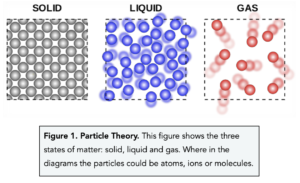
- Solids: In a solid, particles are closely packed together in a regular pattern. They vibrate in fixed positions but don't move from place to place. This is why solids have a fixed shape and volume.
- Liquids: In a liquid, particles are still close together but are arranged more randomly than in a solid. They can move around each other, which is why liquids can flow and take the shape of their container, but they still have a fixed volume.
- Gases: In a gas, particles are far apart and move freely in all directions. This is why gases can expand to fill any container and don't have a fixed shape or volume.
Limitations of the Particle Theory:
While particle theory is useful for understanding the basic properties of solids, liquids, and gases, it has several limitations:
- Assumes All Particles Are Spheres and Solids:
- Particle theory simplifies particles by treating them as solid spheres. In reality, particles (atoms, ions, or molecules) have different shapes and structures, and they aren't necessarily solid. For example, some particles have complex structures or are more elongated rather than spherical.
- Doesn't Show Forces Between Particles:
- The theory doesn't show the forces that hold particles together or push them apart. In reality, particles interact with each other through forces like attractions (e.g., van der Waals forces, ionic bonds) and repulsions, which affect how they behave in different states.
- Doesn't Differentiate Between Atoms, Ions, and Molecules:
- Particle theory treats all particles the same, but in reality, particles can be atoms (like in noble gases), ions (like in salts), or molecules (like in water). Each type of particle behaves differently because of its structure and the forces acting on it.
- Doesn't Account for Different Particle Sizes:
- The theory assumes all particles are the same size, but in reality, particles can vary greatly in size. For example, a helium atom is much smaller than a protein molecule. This difference in size can affect how particles interact with each other.
Note
Why Understanding These Limitations is Important: Knowing the limitations of particle theory helps us understand why it's a simplified model. It's a good starting point for learning about the states of matter, but it doesn't capture all the complexities of how particles really behave. Scientists use more detailed models and theories to study specific behaviours, like bonding or chemical reactions, that the basic particle theory doesn't explain.