Reaction Profiles (AQA GCSE Chemistry Combined Science): Revision Notes
📚Revision Notes
5.1.3 Reaction Profiles
Note
Reaction profiles (also known as energy diagrams) are graphs that show how the energy of a system changes during a chemical reaction. These profiles help us understand whether a reaction is endothermic or exothermic and indicate the amount of energy required for the reaction to occur, known as the activation energy.
Understanding Reaction Profiles
- Y-Axis (Energy Level): Represents the energy of the system.
- X-Axis (Reaction Progress): Represents the progress of the reaction from reactants to products.
Note
The key features of a reaction profile include:
- The energy levels of the reactants and products.
- The activation energy, which is the energy "hump" that must be overcome for the reaction to proceed.
- The overall energy change, which shows whether the reaction releases or absorbs energy.
Exothermic Reaction Profiles
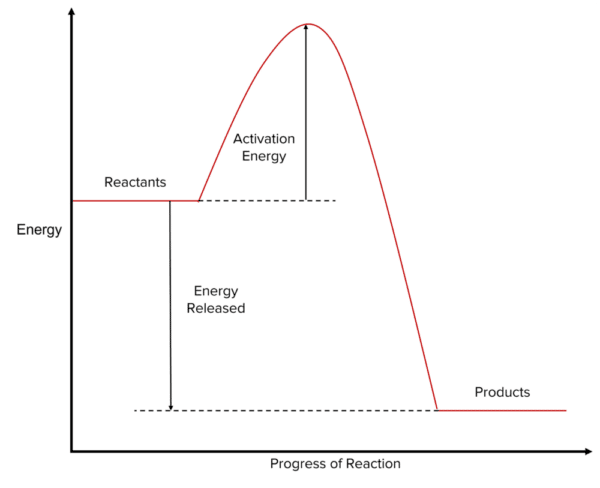
In exothermic reactions, the energy stored in the reactants is higher than the energy stored in the products. This means:
- The reactants are drawn at a higher level along the y-axis compared to the products.
- The difference in height between the reactants and products represents the energy released to the surroundings during the reaction.
The reaction profile includes a "hump," which represents the activation energy. This is the minimum energy required to start the reaction:
- The height of the hump above the reactants indicates the energy needed for the reactants to collide with sufficient force to react.
- Once the reactants overcome this activation energy, the reaction proceeds, releasing energy.
Note
In an exothermic reaction, the overall energy change is negative because energy is lost as heat to the surroundings.
Endothermic Reaction Profiles
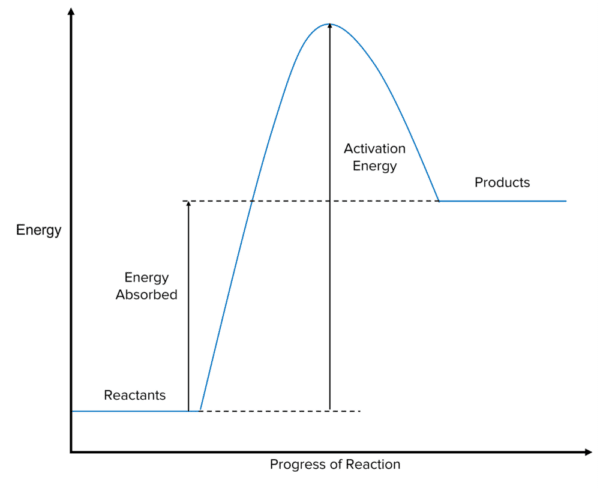
In endothermic reactions, the energy stored in the products is higher than the energy stored in the reactants. This means:
- The reactants are drawn at a lower level along the y-axis compared to the products.
- The difference in height between the reactants and products represents the energy absorbed from the surroundings during the reaction.
Like in exothermic reactions, the reaction profile features a hump representing the activation energy:
- The height of the hump above the reactants indicates the energy required for the reactants to collide and react.
- For the reaction to occur, the system must absorb enough energy to overcome this activation energy barrier.
Note
In an endothermic reaction, the overall energy change is positive because the system absorbs energy from the surroundings.