Maths skills 2 (AQA GCSE Design and Technology): Revision Notes
📚Revision Notes
Maths skills 2
This topic covers essential mathematical skills you'll need for calculations involving precision, large numbers, and proportional relationships. Understanding these concepts will help you tackle real-world problems with confidence.
Decimal and standard form
Understanding decimal places
When working with measurements and calculations, you don't always need extreme precision. Decimal places help you express numbers to an appropriate level of accuracy. The number of decimal places tells you how many digits appear after the decimal point.
For example, if you're measuring the volume of a cube and get 65.83756 cm³, you might only need this expressed to two decimal places as 65.84 cm³. This gives you the right level of precision without unnecessary detail.
Note
The number of decimal places you use depends on the context of your problem. In chemistry, you might need more precision than in everyday measurements like cooking or construction.
Standard form notation
Standard form provides a neat way to write very large or very small numbers using powers of 10. This method makes calculations much easier and helps you avoid writing lots of zeros.
The pattern works like this:
- Large numbers: or
- Even larger:
- Very large:
- Small numbers:
Important
The key is to move the decimal point until you have a number between 1 and 10, then count how many places you moved to determine the power of 10.
Significant figures and rounding
What are significant figures
Significant figures show the level of accuracy needed in your calculations. They represent the meaningful digits in a number that contribute to its precision.
For instance, when measuring a cylinder's volume as 345.3247 cm³, expressing this to four significant figures gives you 345.3 cm³. This provides appropriate accuracy without false precision.
Important
Common Mistake to Avoid: Don't include meaningless digits that suggest false accuracy. If your measuring instrument only reads to the nearest millimetre, don't express your answer to micrometres!
Rounding with significant figures
Understanding when to round up or down is crucial for accurate calculations. The rule depends on the digit that comes after your desired precision:
When rounding to the nearest 10, 100, or 1000, look at the last digit. If it's 5, 6, 7, 8, or 9, round the number upward. For example, 47 becomes 50 when rounded to the nearest ten. However, if the last digit is 0, 1, 2, 3, or 4, round downward - so 43 becomes 40.
Working with ratios, scales, fractions and percentages
Understanding ratios
Ratios demonstrate how quantities relate to each other in proportional relationships. They're particularly useful when you need to divide something into specific parts or combine materials in precise amounts.
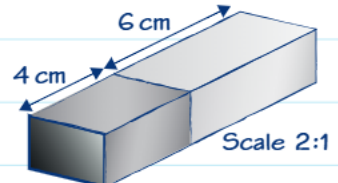 Consider a steel bar that's 10 cm long, divided in the ratio 2:3. This means the material splits into 5 total parts (2 + 3), with the sections measuring according to these proportions.
Note
When working with ratios, always add up all the parts to find the total number of sections. For ratio 2:3, you have 2 + 3 = 5 total parts.
Using scales effectively
Scales enable you to represent large objects in smaller drawings while maintaining accurate proportions. When you see "Scale 2:1" on a technical drawing, this indicates the drawing is twice the actual size. Conversely, if something appears 5 cm long on the page, the real object measures 10 cm when built at full scale.
Any measurements you take from the scaled drawing will need converting to find the actual dimensions of the finished object.
Fractions as proportions
Fractions represent parts of a whole, helping you understand proportional relationships. A proper fraction like shows a portion less than the complete amount, while an improper fraction like represents more than one whole unit.
Percentage applications
Percentages express ratios or fractions as parts of 100, making them easy to understand and compare. When you see "50%", this equals one-half or the ratio 1:2.
Worked example with real applications
Example
Worked Example: Chemistry Mixing Problem
Let's work through a practical chemistry problem that combines several of these mathematical skills. Imagine you're mixing liquid polyester resin with its hardener in a laboratory setting.
The resin and hardener must combine in the ratio 100:3 for proper curing.
Problem a) If you need 50 litres of polyester resin, how much hardener do you require?
Using the ratio calculation: litres of hardener needed.
Problem b) What percentage of the final mixed solution consists of hardener?
Step 1: Find the total volume: 51.5 litres (50 + 1.5) Step 2: Calculate: Step 3: For 1.5 litres:
Problem c) Express this percentage to 1 significant figure: 3%
Problem d) Express this percentage to 1 decimal place: 2.9%

This example shows how mathematical skills connect in real-world situations, from basic ratio calculations to percentage conversions and appropriate rounding.
Practice makes perfect
Try working with different scenarios involving volumes, measurements, and proportional relationships. The more you practice these skills, the more confident you'll become at recognising which mathematical tools to use in different situations.
Note
Practice Tip: Start with simple numbers when learning these concepts, then gradually work with more complex calculations. This builds your confidence and understanding step by step.
Remember that accuracy matters, but so does using appropriate precision for your specific context. A measurement doesn't need to be calculated to 10 decimal places if your situation only requires whole numbers!
Summary
Key Points to Remember:
- Standard form makes large and small numbers manageable by using powers of 10 - move the decimal point to create a number between 1 and 10
- Significant figures help you express the right level of precision - don't include meaningless digits that suggest false accuracy
- Rounding rules depend on the following digit: 5 and above rounds up, 4 and below rounds down
- Ratios, fractions, and percentages are different ways to express the same proportional relationships - practice converting between them
- Real-world problems often combine multiple mathematical skills, so break complex problems into smaller, manageable steps