Maths skills 4 (AQA GCSE Design and Technology): Revision Notes
📚Revision Notes
Maths skills 4: Units and measurements
International system of units (SI units)
Understanding the International System of Units (SI units) is essential for working with measurements in science, technology, and mathematics. These standardised units help us communicate measurements clearly and accurately across different fields and countries.
The basic SI units you need to know include measurements for length, mass, electrical current, capacity, and angles. Each unit has a specific name and standard abbreviation that scientists and engineers use worldwide.
Note
The standardisation of SI units ensures that a metre measured in Japan is exactly the same as a metre measured in Brazil or any other country. This universal consistency is crucial for international collaboration in science, engineering, and trade.
| Name | Unit | Abbreviation |
|---|---|---|
| length | metre | m |
| mass | gramme | g |
| current | ampere | A |
| capacity | litre | l |
| angle | degree | ° |
These base units form the foundation for all other measurements. For example, when measuring the length of a room, you would use metres (m), while the mass of ingredients in cooking would be measured in grammes (g).
Converting between units
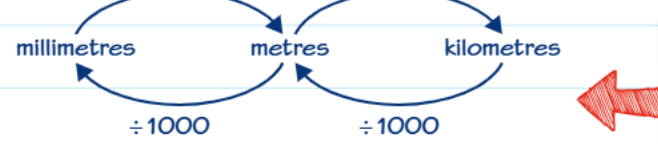
Converting between different units within the metric system follows a logical pattern based on powers of 10. The most common conversions you'll encounter involve length measurements between millimetres, metres, and kilometres.
Important
The key principle to remember is that when converting from smaller to larger units, you divide by 1000. When converting from larger to smaller units, you multiply by 1000. This systematic approach makes metric conversions much simpler than other measurement systems.
Example
Worked Example: Unit Conversion
To convert 3200 metres to kilometres: km
To convert the same distance to millimetres: mm
Understanding multiples and submultiples of SI units
The metric system uses prefixes to create multiples and submultiples of base units. These prefixes represent specific multipliers that make it easier to work with very large or very small measurements.
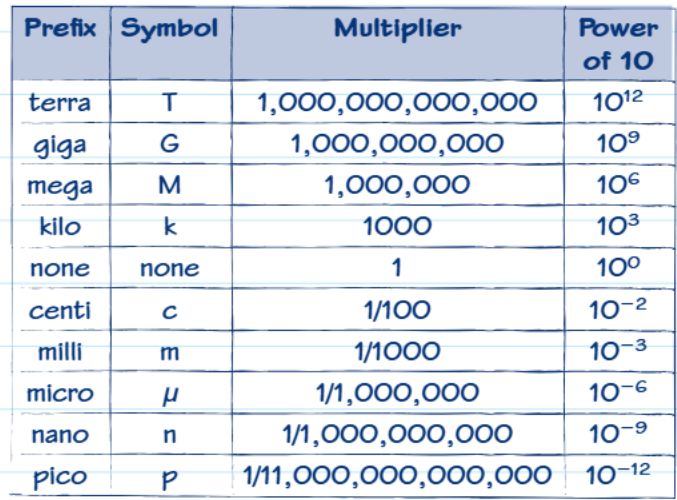 Each prefix corresponds to a specific power of 10, making calculations straightforward. For instance, when you see "kilo" (k), you know it means 1000 times the base unit. A kilogramme is 1000 grammes, and a kilometre is 1000 metres.
For smaller measurements, prefixes like "milli" (m) mean 1/1000 of the base unit. A millimetre is 1/1000 of a metre, and a milliamp is 1/1000 of an ampere.
Note
When choosing units for measurements, always select the most appropriate scale for the situation. You might measure a table's height in centimetres, but a screw's length in millimetres, because this gives you the most practical numbers to work with.
Angular measure
Angles are fundamental to geometry and are measured in degrees. Understanding different types of angles and their measurements helps you solve problems involving shapes, rotations, and directional changes.
A complete circle contains 360 degrees (360°). This division allows us to measure any angle as a fraction of a full rotation. A right angle, which forms the corner of a square, measures exactly 90°.
Note
The division of a circle into 360° dates back to ancient civilizations and provides a convenient way to measure rotations and directional changes. This system remains the standard for most practical applications today.
Angles can be classified into several types based on their size:
- Acute angles are smaller than 90°
- Right angles measure exactly 90°
- Obtuse angles are between 90° and 180°
- Straight angles measure exactly 180° (forming a straight line)
- Reflex angles are between 180° and 360°
- Full rotation completes the circle at 360°
Recognising these different angle types helps you identify them in geometric problems and understand their relationships in various contexts.
Triangles and their properties
Triangles have special properties that make them incredibly useful in mathematics and real-world applications. The most important property is that all angles in any triangle always add up to exactly 180°.
Important
This angle sum property means that if you know two angles in a triangle, you can always calculate the third angle by subtracting the sum of the known angles from 180°. This rule applies to ALL triangles, regardless of their shape or size.
For right-angled triangles (triangles containing a 90° angle), Pythagoras' theorem provides a powerful tool for calculating unknown side lengths. The theorem states that , where 'c' represents the hypotenuse (the longest side opposite the right angle), and 'a' and 'b' represent the other two sides.
Example
Worked Example: Using Pythagoras' Theorem
Find the length of the hypotenuse in a right-angled triangle where the two shorter sides are 3 cm and 4 cm.
Using : cm
This relationship allows you to find missing side lengths when you know the lengths of any two sides in a right-angled triangle, making it invaluable for solving practical problems involving distances, heights, and dimensions.
Practical applications
These mathematical skills have numerous real-world applications. In construction, workers use unit conversions to ensure materials are ordered in the correct quantities. Engineers apply Pythagoras' theorem to calculate structural dimensions, while designers use angular measurements to create precise technical drawings.
Understanding appropriate units for different situations is crucial. You wouldn't measure the length of a football pitch in millimetres or the thickness of a sheet of paper in kilometres. Choosing suitable units makes your calculations more manageable and your results more meaningful.
Note
When working with measurements, always consider the precision required for your specific application. Sometimes approximate measurements are sufficient, while other situations demand exact calculations.
Summary
Key Points to Remember:
- The metric system is based on powers of 10, making conversions straightforward by multiplying or dividing by factors like 1000
- Prefixes like kilo, centi, and milli represent specific multipliers that help you work with different scales of measurement
- All angles in a triangle add up to 180°, regardless of the triangle's shape or size
- Pythagoras' theorem () applies specifically to right-angled triangles and helps calculate unknown side lengths
- Always choose the most appropriate units for your measurements to make calculations practical and meaningful