Style and Register (AQA GCSE English Language): Revision Notes
📚Revision Notes
Style and register
Understanding how writers use style and register is crucial for analysing language effectively. Every piece of writing you encounter will have been crafted using specific stylistic choices and an appropriate register to achieve its purpose and connect with its intended audience.
What is style?
Style refers to the overall manner in which a text is written. Think of it as the writer's unique 'voice' or approach to presenting their ideas. Style encompasses several key elements that work together to create the text's distinctive character.
The main components of style include the writer's choice of vocabulary, the types of sentence structures they use, and how they organise their ideas. For instance, some writers might favour short, punchy sentences to create drama, while others might use longer, more complex sentences to develop detailed arguments.
Note
Style is made up of multiple interconnected elements:
- Vocabulary choices - the specific words and phrases selected
- Sentence structures - how ideas are constructed and connected
- Organisation - how content is arranged and presented
- Tone - the attitude or mood conveyed through language
You'll encounter many different styles in your reading. A cinematic style might make you feel like you're watching a film unfold, using vivid imagery and dynamic action. Journalistic style, on the other hand, presents information in a balanced, factual manner that helps readers understand news events clearly.
What is register?
Register is the specific level of language a writer chooses to match their writing to the social situation they're addressing. It's about selecting the right type of language for the right audience and context.
Different situations call for different registers. The language you'd use in a formal letter to your local MP would be very different from the language you'd use when chatting with friends. This is because your audience and purpose are completely different in each case.
Important
Register is not just about being formal or informal - it's about choosing the most appropriate language level for your specific audience and context. Getting this wrong can damage your credibility or fail to connect with your readers.
Formal register
When writing to authority figures or in professional contexts, writers typically use formal register. This might include:
- Standard English grammar and vocabulary
- Polite, respectful tone
- More complex sentence structures
- Avoiding contractions and slang
Example
Worked Example: Formal Register in Action
If you were writing to your local MP about a leisure centre closure, you might use phrases like "the closure will have a detrimental effect" because you're addressing someone in authority whom you don't know personally.
This formal approach shows respect and professionalism through:
- Standard vocabulary ("detrimental effect" rather than "really bad")
- Complete sentence structures
- Respectful, measured tone
Informal register
When writing to friends or peers, or when trying to create a casual, friendly atmosphere, writers use informal register. This might include:
- Colloquial language and slang
- Contractions and non-standard grammar
- More personal, conversational tone
- Shorter, simpler sentences
Example
Worked Example: Informal Register in Action
If you were telling a friend about the same leisure centre closure, you might say "it'll be rubbish when it shuts" because you're speaking to someone familiar and friendly.
This informal approach creates connection through:
- Contracted words ("it'll" instead of "it will")
- Colloquial vocabulary ("rubbish" instead of "detrimental")
- Direct, conversational tone
How writers adapt their choices
Successful writers carefully adapt their style and register to suit both their purpose (what they want to achieve) and their audience (who they're writing for). This adaptation helps them connect effectively with their readers and achieve their intended impact.
Note
The most effective writers are those who can seamlessly adjust their style and register to match different situations. A journalist might write formally for a news report but informally for a lifestyle piece, demonstrating their versatility and understanding of audience needs.
Analysing style and register
When analysing how writers use style and register, you need to identify specific language choices and explain their effects on the reader. Look for patterns in vocabulary, sentence structure, and tone that reveal the writer's approach.
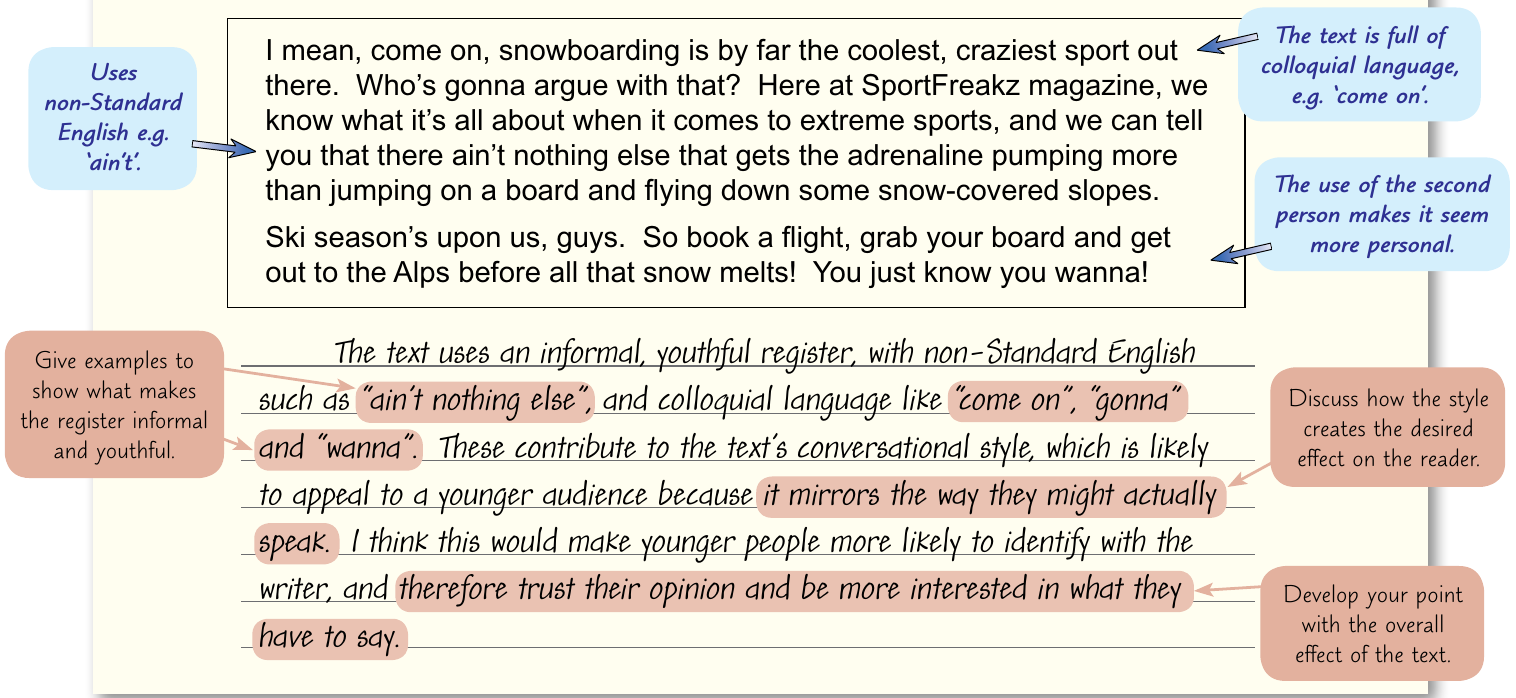
How does the writer use language here to appeal to a younger audience?
Example
Worked Example: Analysing Informal Register
The example above shows how a writer uses informal register to appeal to a younger audience. The text about snowboarding uses colloquial language like "come on", "gonna", and "wanna", along with non-standard English such as "ain't nothing". This creates a conversational style that mirrors how young people might actually speak.
Step-by-step analysis:
- Identify the language choices: colloquialisms, contractions, non-standard grammar
- Consider the target audience: young people interested in snowboarding
- Explain the effects: creates authenticity and relatability
- Evaluate the overall impact: builds trust and engagement with the target demographic
The writer's use of second person ("you") makes the text feel personal and direct, whilst phrases like "who's gonna argue with that?" create an inclusive, friendly tone. The exclamation "you just know you wanna!" builds excitement and enthusiasm about the activity.
These linguistic choices work together to create a style that feels authentic and relatable to younger readers, making them more likely to engage with the content and trust the writer's opinions about snowboarding.
Key analytical techniques
When writing about style and register in your analysis, remember to:
- Give specific examples of the language choices you've identified
- Explain how these choices create particular effects on the reader
- Discuss how the overall style helps achieve the writer's purpose
- Consider how the register makes the text appropriate for its intended audience
- Develop your points about the cumulative impact of these choices
Important
Never just identify stylistic features - always explain their effects! Your analysis should demonstrate understanding of how and why these choices work to influence readers.
Style encompasses many different elements working together - language choices, vocabulary, sentence structure, and tone all contribute to the overall effect. By understanding how these elements combine, you'll be better equipped to analyse any text you encounter.
Summary
Key Points to Remember:
- Style is the overall way a text is written, including language choices, sentence forms, and structure
- Register is the specific language level chosen to suit the audience and social situation
- Writers adapt their style and register to match their purpose and connect with their intended readers
- Informal register uses colloquial language, contractions, and conversational tone to create familiarity
- Formal register uses standard English and polite, respectful language for professional contexts
- Always support your analysis with specific examples and explain the effects these choices have on readers