Understanding Texts (AQA GCSE English Language): Revision Notes
📚Revision Notes
Understanding 19th-century texts
Why 19th-century texts matter for your GCSE
When you sit your GCSE English Language exam, you'll encounter a 19th-century non-fiction text in Paper 2. Since you probably weren't around in the 1800s, understanding these texts can feel challenging at first. However, once you grasp the key features of 19th-century writing and the social context of the time, you'll find these texts much more accessible and interesting to analyse.
Note
The 19th-century text will always be a non-fiction piece - this could be a letter, diary entry, travel writing, or newspaper article. Understanding the historical context is crucial for effective analysis.
Distinctive features of 19th-century writing
Language and style differences
Writing from the 19th century often sounds quite different from modern texts, but this doesn't mean it's impossible to understand. The main differences you'll notice include the use of more formal language, even in personal correspondence between family members or friends. Writers of this period typically employed what we call a "formal register" - a more official and respectful tone than we might use today.
Sentence structure and word patterns
One of the most noticeable features of 19th-century writing is the sentence construction. Writers often used longer, more complex sentences with different word ordering than we're used to. Don't worry if you encounter sentences that seem confusing at first - try reading them slowly and identifying the main subject and verb to understand the core meaning.
Example
Worked Example: Comparing Modern and 19th-century Phrasing
Modern version: "Albert had gone and the two of us were left alone." 19th-century version: "Albert being gone and we two left alone."
Modern version: "I think it's necessary to give up this terrible plan." 19th-century version: "I believe it necessary to abandon this foul enterprise."
Notice how the 19th-century versions use more formal vocabulary ("abandon" instead of "give up", "foul enterprise" instead of "terrible plan") and different sentence structures.
The vocabulary choices and sentence structures reflect the formal education and social expectations of the period.
Understanding 19th-century society
The class system and social divisions
To properly understand 19th-century texts, you need to appreciate how different society was back then. The early 19th century saw a rigid class system that divided people into distinct social groups. The wealthy upper classes owned land and lived comfortably, while the working classes laboured in often difficult conditions.
Throughout the century, the Industrial Revolution created new opportunities for people to earn money and improve their social position. This led to the growth of the middle classes, who gained increasing influence and numbers as the century progressed. Understanding these social divisions helps explain many of the attitudes and perspectives you'll encounter in 19th-century texts.
Note
The Industrial Revolution didn't just change how people worked - it fundamentally altered social structures and created new opportunities for social mobility that hadn't existed before.
Education and learning
Education in the 19th century was very different from today. In the early part of the century, few children attended school, particularly those from poorer families who often worked to help support their families financially. Wealthy families typically sent their children to boarding schools or employed a governess to live with the family and provide private education at home.
Later in the century, education reforms made schooling compulsory for all young people, reflecting changing social attitudes about the importance of learning and literacy.
Women's roles and expectations
Women's positions in 19th-century society were significantly different from today. After marriage, most women were expected to focus on managing the household and caring for children. They had fewer legal rights than men - they couldn't vote in elections and often couldn't control their own money or property.
However, upper-class women were expected to be accomplished in various skills such as speaking European languages, playing musical instruments like the harp, and demonstrating refined social behaviour. These accomplishments were seen as markers of good breeding and social status.
Important
Understanding women's restricted roles in 19th-century society is crucial for analysing texts from this period. Many attitudes and perspectives in these texts reflect the limited opportunities and expectations placed on women at the time.
Religious and moral influences
Christianity played a major role in 19th-century life, with most middle and upper-class families attending church regularly. Religious values strongly influenced social behaviour and moral expectations. However, as the century progressed, scientific discoveries began to challenge some traditional religious beliefs, creating interesting tensions that sometimes appear in the literature of the period.
Analysing a 19th-century text example
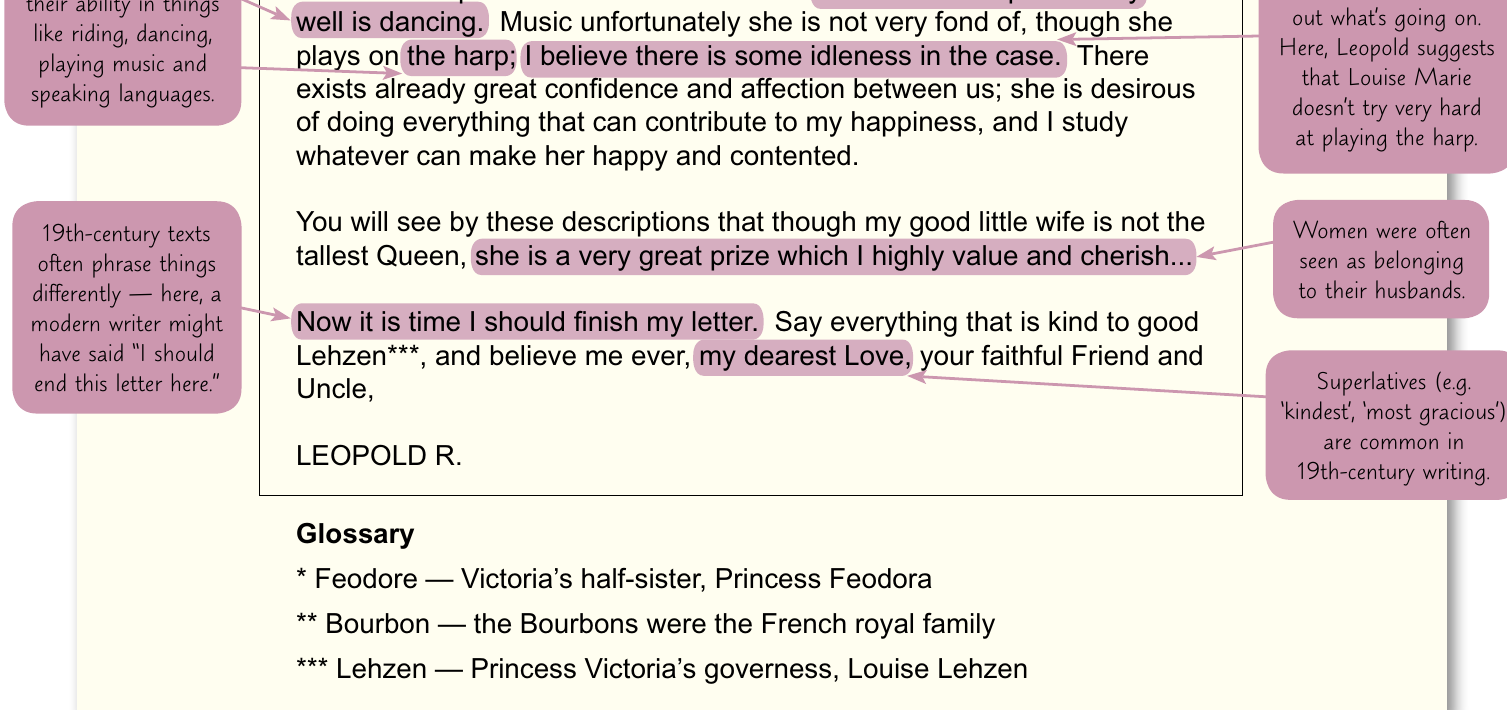
Looking at this letter from King Leopold of Belgium to Princess Victoria provides an excellent example of how 19th-century writing works in practice. The letter demonstrates many of the features we've discussed.
Language and tone
Notice how Leopold addresses Victoria as "MY DEAREST LOVE" and signs off as "your faithful Friend and Uncle." While this might seem overly formal today, such affectionate but respectful language was typical of family correspondence in the 19th century. The tone throughout is caring but maintains the formal register expected in upper-class communication.
Social attitudes and values
The letter reveals much about 19th-century attitudes towards women and marriage. Leopold describes his new wife in terms of her virtues, accomplishments, and appearance - focusing on qualities that were considered most important for women of the upper classes. He mentions her ability to speak multiple languages, her musical skills, and her gentle, virtuous character.
Note
The emphasis on being "virtuous" was particularly important in 19th-century society, especially for women. This concept encompassed moral behaviour, proper conduct, and strong character - qualities that were seen as essential for a good wife and mother.
Historical context
The letter also provides insights into the specific world of European royalty and aristocracy. References to Princess Feodora, the Bourbon royal family, and Princess Victoria's governess Louise Lehzen help us understand the interconnected nature of European royal families and their social circles.
Tips for success with 19th-century texts
When you encounter a 19th-century text in your exam, remember that understanding the historical and social context is just as important as analysing the language. The content might seem more like a history lesson than an English exercise, but this background knowledge will genuinely help you write better, more insightful responses.
Important
Don't be put off by unfamiliar vocabulary or complex sentence structures. Take your time to work through the meaning, and remember that these texts won't contain modern elements like emojis or informal language - they follow the conventions and expectations of their time period.
Summary
Key Points to Remember:
- 19th-century writing uses formal language and complex sentence structures, even in personal letters
- Understanding the social context - including class divisions, women's roles, and religious influences - helps you interpret the texts more effectively
- The Industrial Revolution and education reforms created significant social changes throughout the century
- Upper-class women were expected to be accomplished in languages, music, and social skills
- Religious and moral values strongly influenced writing and social attitudes of the period