Information and Ideas (AQA GCSE English Language): Revision Notes
📚Revision Notes
Information and ideas
Understanding what texts tell us
When you're reading any text, you need to understand the basic information and ideas it contains. This forms the foundation for more advanced analysis and helps you pick up marks in exam questions about information extraction and comparison.
Note
Understanding information and ideas is the fundamental skill that underpins all other text analysis techniques. Master this foundation and you'll find more complex analysis becomes much easier.
The information and ideas in texts can appear in two different ways: they can be explicit or implicit. Learning to recognise both types is essential for thorough text analysis.
Explicit information
Explicit information is straightforward - it's clearly stated in the text without any guesswork needed. When something is explicit, the author has written it directly and obviously.
Example
Worked Example: Identifying Explicit Information
If a text says "Last weekend, it rained a lot," you can immediately identify several explicit facts:
- It rained
- The rain happened last weekend
- There was a significant amount of rain ("a lot")
This information is right there in the text, requiring no interpretation or detective work from you as the reader.
Implicit information
Implicit information requires more detective work. This is information that isn't directly stated but can be worked out from what is written in the text. You need to read between the lines and make logical inferences.
Example
Worked Example: Finding Implicit Information
If a text describes "The castle was dark, decrepit and freezing cold," it's implied that the author doesn't like the castle very much. While this isn't stated outright, the negative descriptive words clearly suggest the author's unfavourable opinion.
Important
Remember: Implicit information requires you to make logical inferences based on evidence in the text. Don't guess randomly - always base your conclusions on what's actually written.
Extracting relevant facts from texts
When answering questions about information in texts, you need to identify and record the relevant facts systematically. A useful technique is to underline important information as you read.
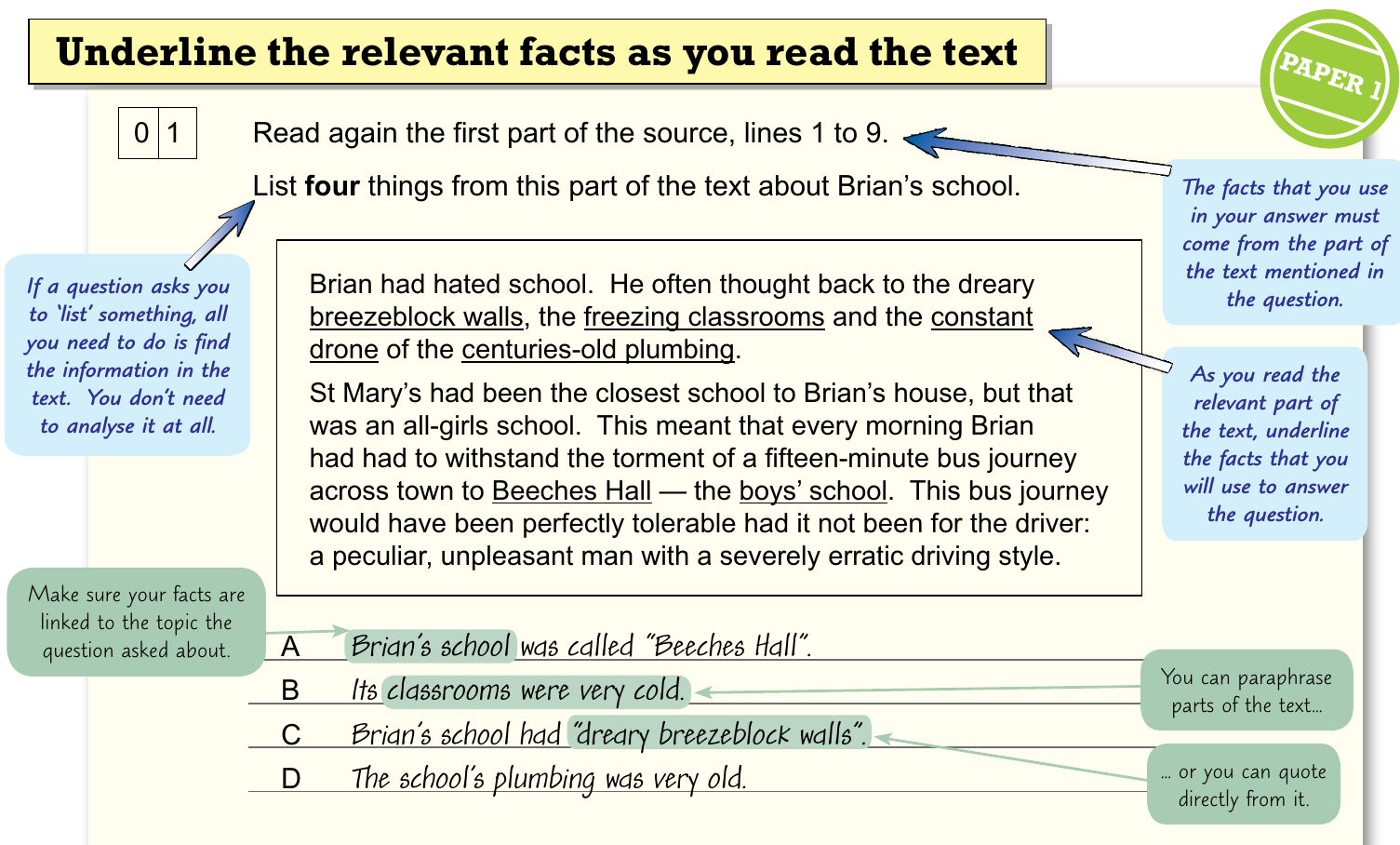
Here's how to approach fact extraction effectively:
- Read the question first - this tells you what specific information to look for
- Scan the relevant section - focus on the part of the text that relates to your question
- Underline key facts - mark information that directly answers the question
- Check relevance - ensure your facts actually relate to what's being asked
Note
The underlining technique is particularly effective in exams where you can write on the question paper. It helps you stay focused and organised when time is limited.
When listing facts, you have two options:
- Paraphrase - put the information into your own words
- Quote directly - use the exact words from the text
Both approaches are acceptable, but make sure your facts are clearly linked to the question topic.
Summarising information from multiple texts
Sometimes you'll need to work with information from two different texts on the same topic. This requires you to:
- Identify key information from each source
- Look for similarities and differences between the texts
- Support your points with specific examples from both sources
- Use appropriate linking words to show relationships between ideas
Note
When working with multiple texts, always keep track of which information comes from which source. This prevents confusion and helps you make clearer comparisons.
Using linking words for comparisons
Linking words are essential when writing about similarities and differences between texts. They help show that you're making deliberate comparisons and demonstrate clear analytical thinking.
For showing similarities, use:
- Similarly
- Equally
- Likewise
- Also
For showing differences, use:
- Whereas
- However
- Although
- But
Important
Don't just list similarities and differences - use these linking words to create smooth transitions between ideas and make your comparisons more sophisticated and easier to follow.
Making connections between texts
When comparing texts, you need to do more than just spot obvious differences. Look for:
- Tone differences - how each author feels about their subject
- Perspective variations - different viewpoints on the same topic
- Stylistic choices - how language use differs between sources
- Implicit meanings - what each text suggests rather than states directly
Use quotations from both texts to support your observations, and remember that comparison questions reward both explicit differences and more subtle implicit contrasts.
Note
The key is developing sharp observation skills - think of it as an elaborate game of spot the difference, but with deeper analysis of why those differences exist and what they reveal about each text.
Summary
Key Points to Remember:
- Explicit information is clearly written in the text, while implicit information needs to be worked out through careful reading
- Underline relevant facts as you read to help organise your thoughts and answers
- When summarising multiple texts, look for both similarities and differences between sources
- Linking words are essential for showing relationships between ideas - use "similarly" and "equally" for similarities, "whereas" and "however" for differences
- Support all points with specific examples or quotations from the texts to demonstrate your understanding