Writing Leaflets (AQA GCSE English Language): Revision Notes
📚Revision Notes
Writing leaflets
What are leaflets?
Leaflets are informational documents designed to provide readers with lots of information in a clear, organised manner. They serve as effective tools for communicating specific messages to targeted audiences, whether you're trying to inform, advise, or persuade your readers about particular topics.
Note
The key to successful leaflet writing is organisation - readers need to be able to find information quickly and understand it easily. This makes leaflets different from other forms of writing where you might develop ideas more gradually.
Understanding purpose and audience
Different purposes for leaflets
Leaflets can serve various functions depending on what you want to achieve. The most common purposes include:
Advising leaflets help readers make informed decisions or take specific actions. For example, you might create a leaflet advising students about opening a savings account or providing guidance on healthy lifestyle choices.
Persuasive leaflets aim to convince readers to adopt a particular viewpoint or support a cause. These might encourage people to vote for a political party or join a community initiative.
Identifying your audience
Your leaflet's effectiveness depends heavily on understanding who will read it. Consider whether you're writing for:
General audiences - These leaflets need to appeal to a broad range of people, so you'll use accessible language and cover topics with wide appeal, such as healthy eating advice.
Specific audiences - These target particular groups with tailored content and language. For instance, a leaflet advertising a museum exhibition would use more specialised vocabulary and assume certain interests.
Important
Critical Rule: Always identify your audience before you start writing. A leaflet that tries to appeal to everyone often ends up appealing to no one. Ask yourself: "Who exactly am I writing for?" and "What do they need to know?"
Essential structural elements
Creating a clear framework
Effective leaflets require a well-organised structure that helps readers navigate information easily. This structure should include several key components:
Clear titles grab readers' attention immediately and tell them exactly what the leaflet covers. Your title should be memorable and relevant to your content.
Subheadings break up your content into manageable sections, making it easier for readers to find specific information quickly. These act as signposts throughout your leaflet.
Bullet points present information in digestible chunks, making complex details more accessible and reducing visual overwhelm.
Information boxes highlight particularly important details or provide additional context without cluttering the main text.
Why structure matters
Good structure serves multiple purposes in leaflet writing. It helps readers process information efficiently, ensures they don't miss crucial details, and makes your leaflet look professional and trustworthy. Remember that readers often scan leaflets quickly, so clear organisation helps them find what they need.
Example
Worked Example: Structuring a Health Leaflet
Title: "Stay Fit at University: Your Complete Guide"
Subheadings:
- Why fitness matters for students
- Quick exercises for busy schedules
- Healthy eating on a budget
Bullet points under each section:
- Simple, actionable tips
- Specific examples and times
- Cost-effective solutions
Information box: "Did you know? Just 20 minutes of exercise can boost your concentration for 2 hours!"
Language techniques for engagement
Grabbing and maintaining attention
Successful leaflets use specific language techniques to keep readers engaged throughout. These techniques help ensure your audience remembers the information you've provided.
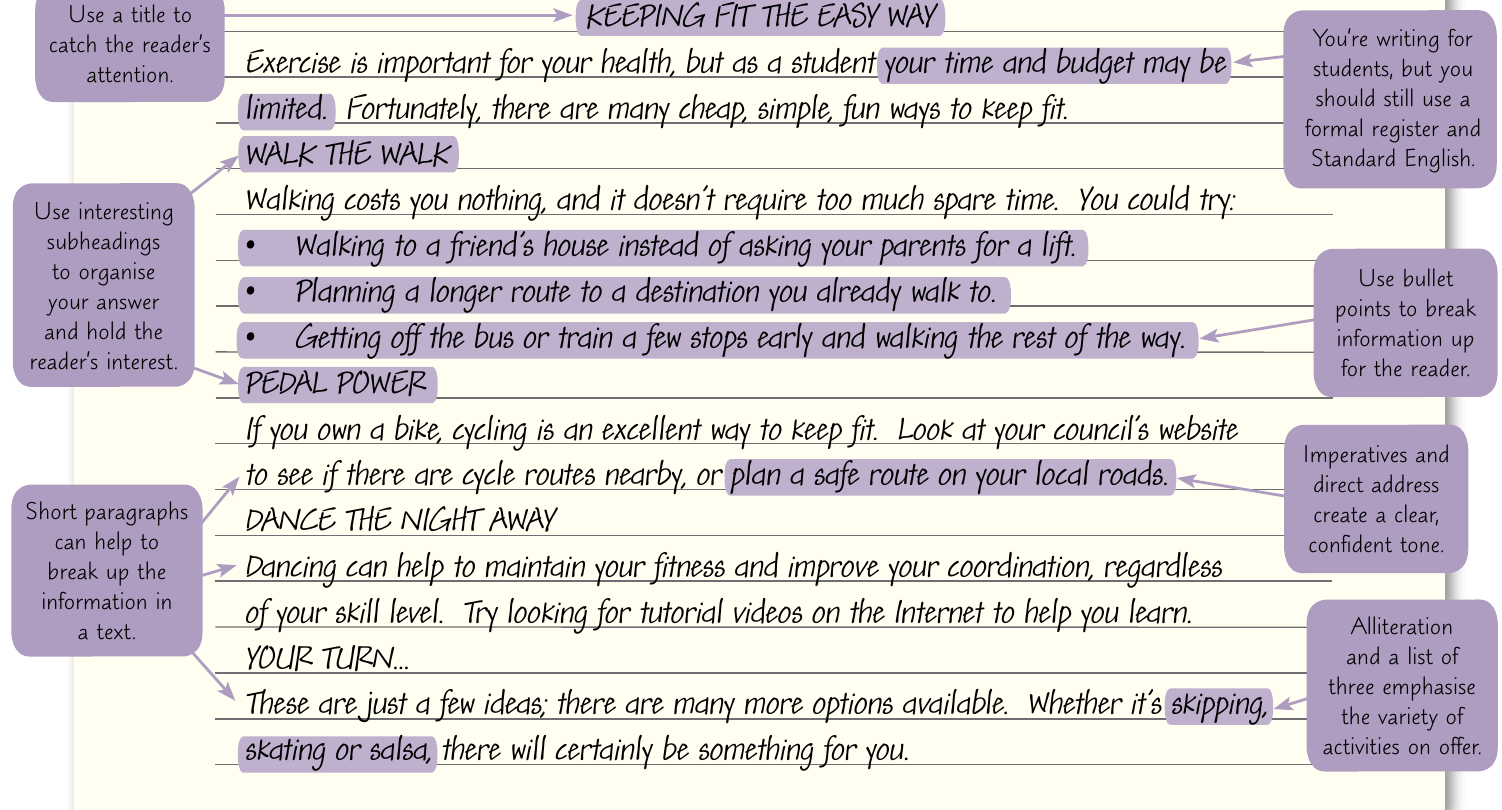
Direct address involves speaking directly to your readers using "you" and "your." This creates a personal connection and makes readers feel the information applies specifically to them.
Lists of three present information in groups of three points, which readers find particularly memorable and satisfying. This technique works well for highlighting key benefits or steps.
Alliteration uses repeated initial sounds to make phrases more memorable and appealing. This technique can make your headings and key points stick in readers' minds.
Maintaining appropriate tone
Your language should match your audience and purpose while remaining clear and accessible. Even when writing for students, maintain a formal but friendly tone that shows respect for your readers' intelligence.
Example
Worked Example: Language Techniques in Action
Direct address: "You can improve your fitness in just 20 minutes a day"
Lists of three: "Exercise will help you feel stronger, think clearer, and sleep better"
Alliteration: "Simple Steps to Student Success" or "Fit, Focused, and Fantastic"
Note
Notice how professional leaflets combine all these techniques naturally. The language feels conversational but informative, and the structure guides readers through the information logically.
Formatting and presentation tips
Visual elements that enhance readability
Effective leaflets combine good writing with smart presentation choices. Consider how your leaflet looks as well as what it says.
Short paragraphs prevent your text from appearing dense and overwhelming. Break up longer sections into smaller, more manageable chunks.
Visual breaks using white space, borders, or different text formatting help readers' eyes rest and make information easier to process.
Consistent formatting throughout your leaflet creates a professional appearance and helps readers understand how information is organised.
Practical presentation considerations
Remember that leaflets are often read quickly, so prioritise clarity over complexity. Use formatting elements like bullet points and boxes strategically to highlight your most important information. Don't try to cram too much onto each section - it's better to be selective and clear.
Note
Formatting Tip: White space is your friend! Don't feel you need to fill every inch of the page. Strategic use of space makes your leaflet more readable and professional-looking.
Adapting to your specific task
When writing leaflets for different purposes, adjust your approach accordingly. Consider what your specific audience needs to know and how they're likely to use your leaflet. A leaflet for teenagers will use different language and examples than one for business professionals, even if covering similar topics.
Your writing style should always match your intended audience, using appropriate vocabulary, examples, and tone while maintaining the clear, organised structure that makes leaflets effective.
Important
Common Mistake to Avoid: Don't assume your audience knows what you know. Always explain terms and concepts clearly, even if they seem obvious to you. It's better to over-explain than to leave readers confused.
Summary
Key Points to Remember:
- Leaflets must provide clear, well-organised information that readers can easily understand and remember
- Always consider your specific audience and purpose when choosing language, examples, and tone
- Use structural elements like titles, subheadings, bullet points, and boxes to make information accessible
- Employ language techniques such as direct address, lists of three, and alliteration to keep readers engaged
- Balance informative content with visual presentation to create professional, effective leaflets that achieve their intended purpose