Writing Reports and Essays (AQA GCSE English Language): Revision Notes
📚Revision Notes
Writing reports and essays
Understanding the similarities
Reports and essays share many fundamental characteristics that make them effective pieces of formal writing. Both require you to adopt an impersonal and objective tone throughout your work. This means you should present information and arguments without letting your personal feelings or biases show through. Instead of writing "I think this is wrong," you would write "Evidence suggests this approach may be ineffective."
The logical structure is essential for both types of writing. You need to guide your reader through your ideas in a clear, organised way that builds towards your conclusion. This structured approach helps your audience follow your reasoning and understand the points you're making.
Note
The shift from personal to impersonal writing can be challenging at first. Practice replacing phrases like "I believe" with "Evidence suggests" or "Research indicates" to develop this important academic writing skill.
Essential structure requirements
Both reports and essays follow a similar three-part structure that ensures your writing flows logically and covers all necessary points.
Your introduction should establish the main theme and set up what you'll be discussing. This opening section gives your reader a clear understanding of what to expect and why the topic matters.
The main body consists of well-structured paragraphs that systematically cover the strengths and weaknesses of the arguments you're presenting. Each paragraph should focus on one key point and provide evidence to support your analysis.
Your conclusion brings everything together and offers your own point of view based on the evidence you've presented. This final section should feel like a natural result of the analysis you've conducted throughout your writing.
Note
The Three-Part Structure:
- Introduction - Establishes main theme and scope
- Main Body - Well-structured paragraphs covering strengths and weaknesses
- Conclusion - Your viewpoint based on presented evidence
Key differences in audience
While reports and essays share structural similarities, they differ significantly in their intended audience. Understanding this difference is crucial for getting your tone and content right.
Important
Critical Audience Distinction:
- Essays = General audience (broader explanations needed)
- Reports = Particular audience (specific knowledge assumed)
This fundamental difference affects your language choice, level of detail, and presentation style throughout your writing.
Essays typically target a general audience, meaning you can assume your readers have basic knowledge but may need background information and broader explanations. Your language can be slightly more accessible while still maintaining formality.
Reports are normally written for a particular person or group of people, such as a board of governors, company executives, or specific department. This targeted audience means you can assume certain knowledge and use more specialised language appropriate to your readers.
Report writing techniques
Reports serve a specific function in formal communication. Their primary purpose is to inform readers about a situation, but they often go beyond simple information sharing to advise their audience on potential actions or decisions.
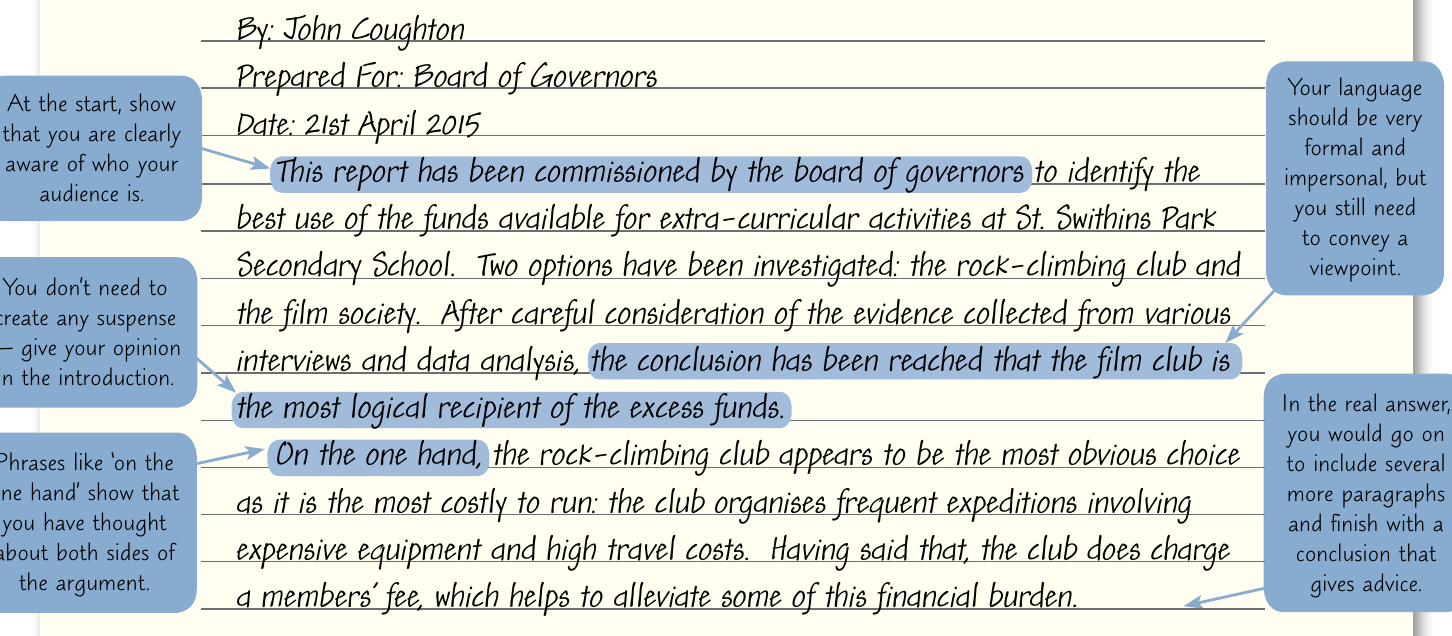
Effective report writing requires careful attention to your audience from the very beginning. You should demonstrate clearly that you understand who will be reading your work and what they need to know. This awareness should influence your choice of language, the level of detail you include, and the way you present your recommendations.
Your language should be very formal and impersonal throughout. This means avoiding casual expressions and maintaining a professional tone that reflects the serious nature of the document you're creating.
Note
When presenting different viewpoints, use transitional phrases effectively. Expressions like "on the one hand" and "on the other hand" help you present balanced arguments while maintaining the formal structure your audience expects.
Achieving objectivity and analysis
The most successful reports and essays demonstrate analytical thinking rather than simply presenting information. You need to examine evidence carefully, consider different perspectives, and draw logical conclusions based on your analysis.
This analytical approach means looking at both strengths and weaknesses of any argument or proposal. Rather than immediately taking sides, you should present a balanced view that acknowledges the complexities of the situation you're discussing.
Your writing should feel straightforward and focused on the facts rather than on creating dramatic effects or emotional responses. While this approach might seem less exciting than creative writing, it provides exactly the kind of clear, reliable information that your audience needs to make informed decisions.
Important
Avoid Common Pitfalls:
- Don't let personal bias show through your writing
- Resist the urge to create dramatic effects
- Focus on evidence-based conclusions rather than opinions
- Always present balanced arguments before drawing conclusions
Summary
Key Points to Remember:
- Both reports and essays require impersonal, objective writing with formal language and logical structure
- Structure is key - always include a clear introduction, well-organised paragraphs covering strengths and weaknesses, and a conclusion with your viewpoint
- Know your audience - essays target general readers while reports address specific individuals or groups
- Focus on analysis - examine evidence carefully and present balanced arguments rather than just stating opinions
- Maintain formality throughout - use professional language and transitional phrases to guide your reader through your arguments