Writing Reviews (AQA GCSE English Language): Revision Notes
📚Revision Notes
Writing reviews
What is a review?
A review is a piece of writing where you share your opinion about how good something is. This could be about a book, a piece of music, a film, a restaurant, or even an art exhibition. When people read reviews, they genuinely want to know what you think, which means your opinion really matters and carries weight.
The golden rule of reviews
Reviews should entertain as well as inform
This is perhaps the most important thing to remember when writing any review. Your writing needs to serve two purposes simultaneously - it should be enjoyable to read whilst also providing useful information to help your readers make decisions.
Understanding your audience and purpose
When writing a review, several factors will influence how you write:
Publication and audience
The place where your review will appear significantly affects your writing style and content. For example, a film review written for a teenage magazine would be quite different from one written for a serious broadsheet newspaper. The teenage magazine review might use more casual language and focus on different aspects compared to the more formal newspaper review.
Your review should serve multiple purposes
Every good review aims to achieve three main goals:
- Entertain the reader - make your writing engaging and enjoyable
- Inform the reader about the subject based on your own experience and opinion
- Advise the reader whether they should experience what you're reviewing
Key elements of effective review writing
Focus on your opinion
Important
Don't get caught up in describing every single detail. Instead, concentrate on expressing your thoughts and feelings clearly. Your readers want to know what you think, not just what happened.
Keep it engaging
Make your review interesting by focusing on the most captivating parts and using sophisticated language. This helps maintain your readers' attention throughout.
Be both informative and entertaining
Strike a balance between providing useful information and making your writing enjoyable to read. This dual approach keeps readers engaged while helping them understand your perspective.
Language and style considerations
Use figurative language
Incorporate metaphors, similes, and other literary devices to make your review more vivid and interesting. This helps bring your opinions to life and makes your writing more memorable.
Adapt your language to your audience
Consider who will be reading your review. A review for a school newspaper might use different vocabulary and tone compared to one for a national publication.
Make your opinion clear from the start
Don't leave your readers guessing about what you think. State your position early in the review so readers know where you stand.
Example structure and approach
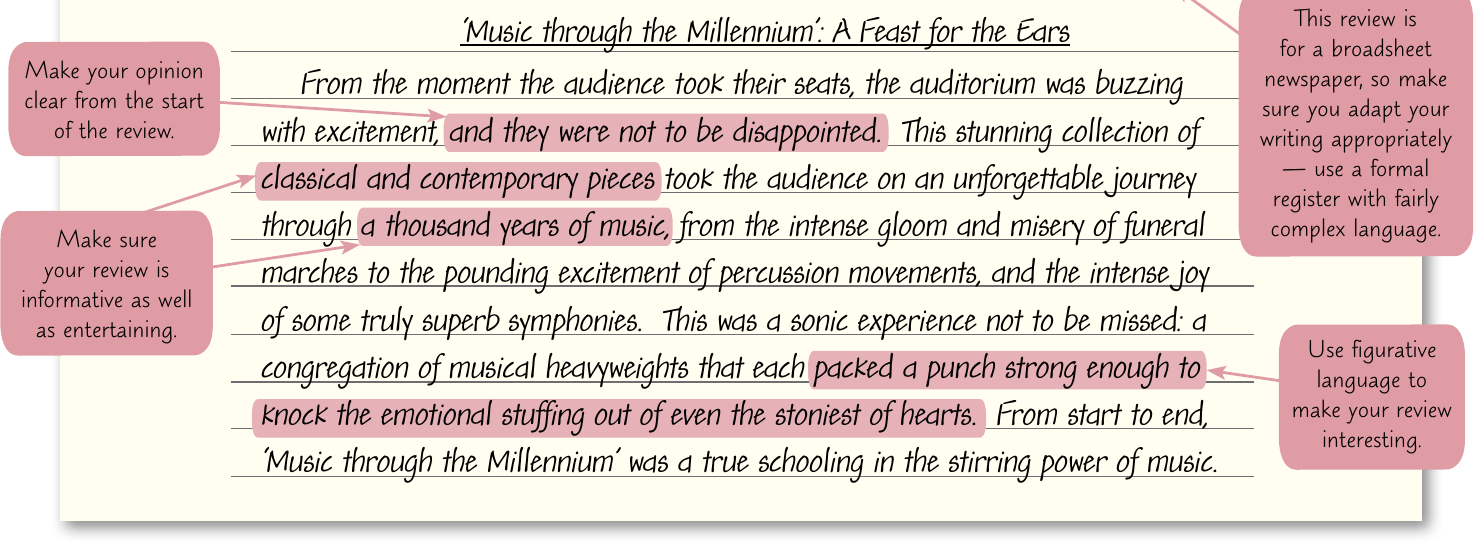
Example
When writing a review, you might encounter exam questions that specify the format and audience. For instance, you might be asked to write a review for a broadsheet newspaper about a music concert you attended. In such cases, remember to:
- Establish your opinion clearly from the beginning
- Ensure your review provides both information and entertainment
- Use appropriate language for your intended audience
- Include figurative language to make your writing more engaging
- Consider whether you're recommending the experience to others
Summary
- Reviews are all about expressing your opinion clearly and engagingly
- Always aim to both entertain and inform your readers
- Consider your audience and publication when choosing your language and style
- Focus on the most interesting aspects rather than describing everything in detail
- Use sophisticated and figurative language to make your writing more compelling