Much Ado About Nothing: Characters (AQA GCSE English Literature): Revision Notes
📚Revision Notes
Much Ado About Nothing: Characters
Key Characters in Much Ado About Nothing
- Beatrice
- Benedick
- Claudio
- Hero
- Don Pedro
- Don John
- Leonato
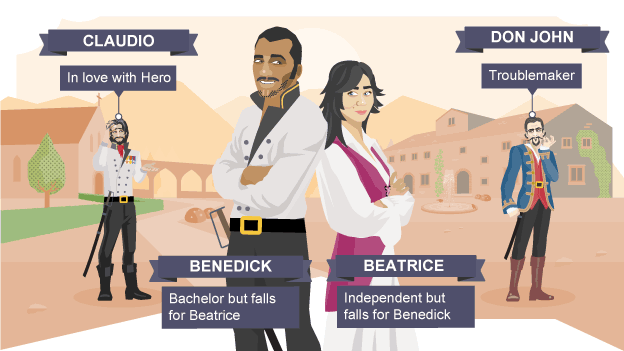
Beatrice
Quote: "I had rather hear my dog bark at a crow than a man swear he loves me."
Analysis: Beatrice's sharp wit and rejection of traditional romantic ideals highlight her independent spirit. Shakespeare uses her to challenge gender norms and to critique the superficiality of courtly love. Beatrice's refusal to be easily wooed sets her apart as a strong, modern woman who values authenticity over flattery.
Quote: "O that I were a man! I would eat his heart in the marketplace."
Analysis: Beatrice's desire to take action against Claudio for slandering Hero reflects her frustration with the limitations placed on women in a patriarchal society. Shakespeare uses this moment to show Beatrice's fierce loyalty and her longing for justice, highlighting the play's exploration of gender roles and power dynamics.
Benedick
Quote: "I do much wonder that one man, seeing how much another man is a fool when he dedicates his behaviours to love, will, after he hath laughed at such shallow follies in others, become the argument of his own scorn by falling in love."
Analysis: Benedick's initial disdain for love and mockery of those who fall for it reveals his fear of vulnerability. Shakespeare uses Benedick's transformation from a witty bachelor to a loving partner to explore themes of love, trust, and personal growth. His journey highlights the play's message that love can overcome cynicism and lead to personal fulfilment.
Quote: "I will live in thy heart, die in thy lap, and be buried in thy eyes."
Analysis: Benedick's romantic declaration to Beatrice marks his complete transformation from sceptic to lover. This line shows his deep emotional connection to Beatrice and reflects the play's celebration of true, mature love that goes beyond superficial attraction.
Claudio
Quote: "Can the world buy such a jewel?"
Analysis: Claudio's description of Hero as a "jewel" objectifies her and reflects his idealised, shallow view of love. Shakespeare uses Claudio to critique the dangers of infatuation and the way women are often valued for their appearance rather than their character. This moment foreshadows Claudio's quickness to doubt Hero's fidelity.
Quote: "Give not this rotten orange to your friend."
Analysis: Claudio's harsh rejection of Hero at the altar, based on false accusations, shows his impulsiveness and the fragility of his honour. Shakespeare uses this moment to explore themes of reputation, shame, and the consequences of placing too much value on public perception over personal trust.
Hero
Quote: "Some Cupid kills with arrows, some with traps."
Analysis: Hero's observation about love's different forms reflects her understanding of the complex dynamics of relationships. Shakespeare uses Hero to represent the ideal of quiet, obedient femininity, but also to show the vulnerability and resilience of women in a patriarchal society. Despite her traditional role, Hero's experience exposes the harsh consequences of gendered expectations.
Quote: "One Hero died defiled, but I do live."
Analysis: Hero's line after being vindicated from the false accusations against her highlights her symbolic "rebirth". Shakespeare uses this to emphasise themes of redemption and the power of forgiveness. Hero's survival and eventual happiness show the possibility of overcoming slander and restoring honour.
Don Pedro
Quote: "I will assume thy part in some disguise and tell fair Hero I am Claudio."
Analysis: Don Pedro's willingness to woo Hero on behalf of Claudio demonstrates his loyalty and the complex nature of friendships in the play. However, it also raises questions about identity and deception, as Shakespeare explores the fine line between helping friends and manipulating situations.
Quote: "In time the savage bull doth bear the yoke."
Analysis: Don Pedro's comment about Benedick eventually falling in love, despite his protests, reflects the inevitability of love's power. Shakespeare uses Don Pedro as a figure of authority and wisdom, whose insights often foreshadow the play's events and reinforce its themes of love and transformation.
Don John
Quote: "I am a plain-dealing villain."
Analysis: Don John's self-awareness of his villainy and refusal to hide it contrast sharply with the more deceptive characters in the play. Shakespeare uses Don John as the embodiment of malice and envy, driven by a desire to disrupt the happiness of others. His straightforward evil highlights the theme of deception and the impact of dishonesty.
Quote: "I had rather be a canker in a hedge than a rose in his grace."
Analysis: Don John's preference for being a "canker" (a wild rose) rather than a cultivated one reveals his resentment and rejection of social norms. Shakespeare uses this to show Don John's outsider status and his desire to cause discord, emphasising the destructive nature of jealousy and bitterness.
Leonato
Quote: "Do not live, Hero; do not ope thine eyes."
Analysis: Leonato's harsh words to Hero after she is accused of infidelity highlight his concern for family honour over his daughter's well-being. Shakespeare uses Leonato to explore the theme of reputation and the pressure on women to maintain their purity in a male-dominated society. His initial reaction shows the dangers of prioritising social standing over familial love.
Quote: "Thou hast belied mine innocent child."
Analysis: Leonato's defence of Hero after discovering the truth reflects his deep paternal love and the theme of justice. Shakespeare uses Leonato's change in attitude to show the importance of truth and the eventual triumph of love and loyalty over deception and false accusations.