Differentiation (AQA GCSE Further Maths): Revision Notes
📚Revision Notes
Differentiation
What is differentiation?
Differentiation is a fundamental concept in calculus that helps us find the exact rate of change of a function at any given point. Instead of trying to draw a perfectly accurate tangent line by hand, we use a mathematical approach that starts with easier-to-calculate chord gradients and then applies the concept of limits.
Note
Think of differentiation as a mathematical magnifying glass - it allows us to zoom in on a curve until we can see the exact slope at any single point, no matter how curved the line appears.
Understanding chords and gradients
When we have a curve, we can draw straight lines connecting any two points on that curve. These connecting lines are called chords or secant lines. The gradient (or slope) of a chord tells us the average rate of change between those two points.
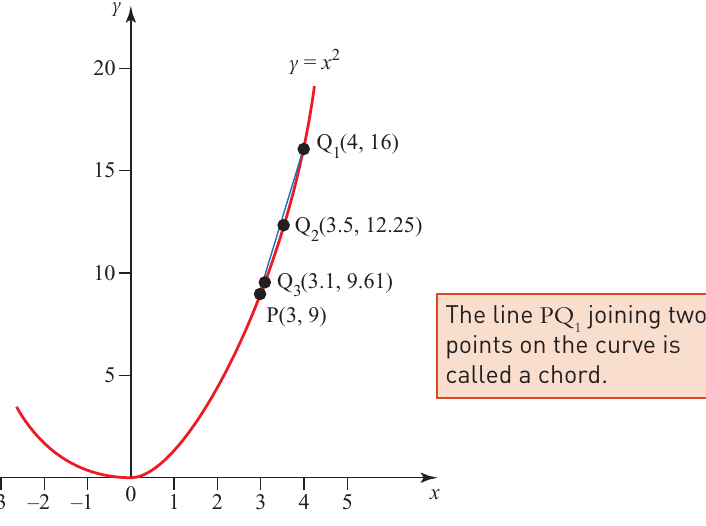
Let's look at the parabola . If we take point P at and connect it to various other points Q on the curve, we can calculate the gradient of each chord using the familiar formula:
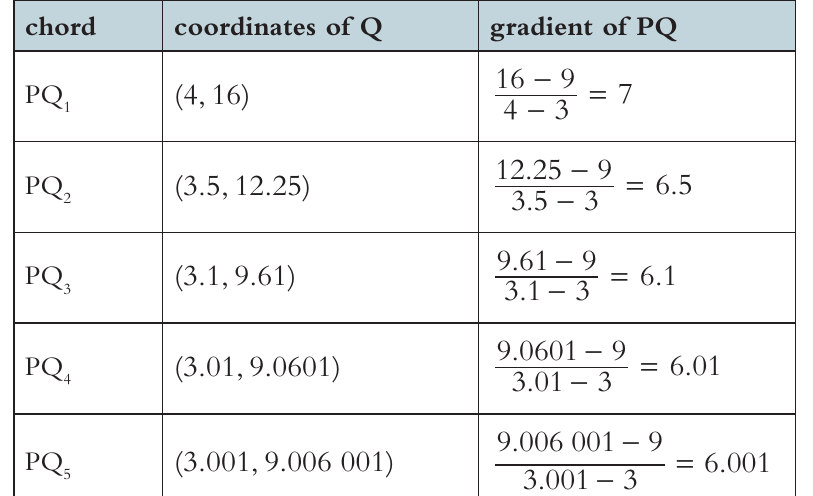
Notice something fascinating in this table: as point Q gets closer and closer to point P, the chord gradients are getting closer and closer to the value 6. This suggests that the gradient of the tangent line at is exactly 6.
The limit approach
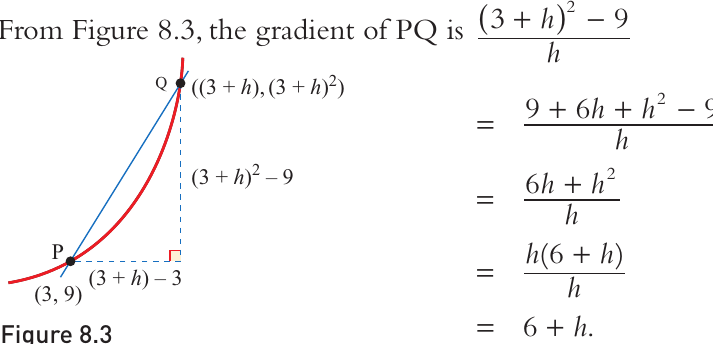
To understand this process more generally, let's consider what happens when we make the distance between our two points infinitely small.
Example
Worked Example: Finding the Tangent Gradient Using Limits
Starting with point P at and point Q at , we can calculate the gradient of chord PQ:
Step 1: Set up the gradient formula
Step 2: Expand and simplify
- So the gradient becomes:
Step 3: Factor and cancel
Step 4: Apply the limit As , the gradient approaches .
This limit process gives us the exact gradient of the tangent at point P.
The gradient function
Rather than calculating the gradient at just one specific point, we can develop a general formula that works for any point on the curve.
Worked example: Finding the gradient function for
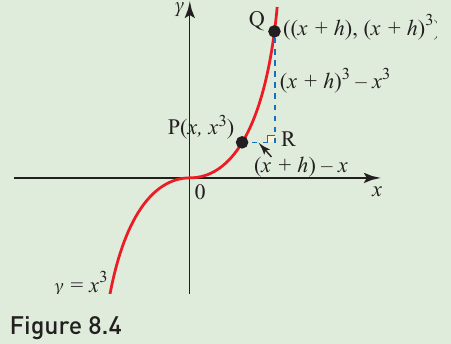
For the curve , let's take a general point P at and point Q at . This approach will give us a formula that works for any x-value.
Example
Worked Example: Deriving the General Gradient Function
Step 1: Set up the gradient formula for general points
Step 2: Expand the numerator
Step 3: Simplify the fraction
Step 4: Apply the limit as The gradient approaches
Result: For the curve , the gradient at any point is .
Important
This means we now have a gradient function! Instead of calculating the gradient at individual points, we have a formula that instantly tells us the slope at any x-coordinate on the curve .
General method
This same approach works for any polynomial function. The key steps are:
- Take two points: P at and Q at
- Calculate the gradient of the chord PQ
- Simplify the expression
- Find what happens as approaches zero
Alternative notation
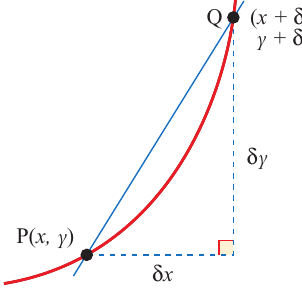
Mathematicians often use different symbols to represent small changes. Instead of , we might use (delta x) to represent a small change in x, and (delta y) for the corresponding small change in y.
The gradient of a chord becomes .
When we take the limit as approaches zero, we write this as:
Note
This notation is read as "dy by dx" and represents the derivative of y with respect to x. It's one of the most important pieces of mathematical notation you'll encounter in calculus.
Key differentiation rules
From our work above, we can establish some important patterns that will save you enormous amounts of time:
Important
The Power Rule for Differentiation
- If , then
- If , then
- If , then
In general: If , then
This is called the power rule for differentiation and is your most powerful tool for differentiating polynomial functions.
Understanding the terminology
The process we've described is called differentiation. When we differentiate a function, we find its derivative.
Note
What the derivative represents:
- The gradient of the tangent to the curve at any point
- The instantaneous rate of change of y with respect to x
- How quickly y is changing compared to x at that exact moment
Think of it as the "speedometer reading" of how fast your function is changing at any given instant.
Summary
Key Points to Remember:
- Chords connect two points on a curve and give us average rates of change
- Tangents touch the curve at exactly one point and give us instantaneous rates of change
- The limit process allows us to find exact gradients by making chord lengths approach zero
- notation represents the derivative and means "rate of change of y with respect to x"
- The power rule is your most important differentiation tool for polynomial functions