Equation of a circle (AQA GCSE Further Maths): Revision Notes
📚Revision Notes
Equation of a circle
Introduction to circle equations
When you want to describe a circle mathematically, you need to know two key pieces of information: where the centre is located and how big the circle is (its radius). The equation of a circle comes from applying the distance formula, which itself is based on Pythagoras' theorem.
Think of it this way: every point on a circle is exactly the same distance (the radius) from the centre. This constant distance relationship is what gives us the circle's equation.
Note
The beauty of circle equations lies in their geometric meaning - they represent all points that are equidistant from a fixed centre point. This fundamental concept connects algebra with geometry in a powerful way.
Circles with centre at the origin (0, 0)
Let's start with the simplest case - a circle centred at the origin of a coordinate system.
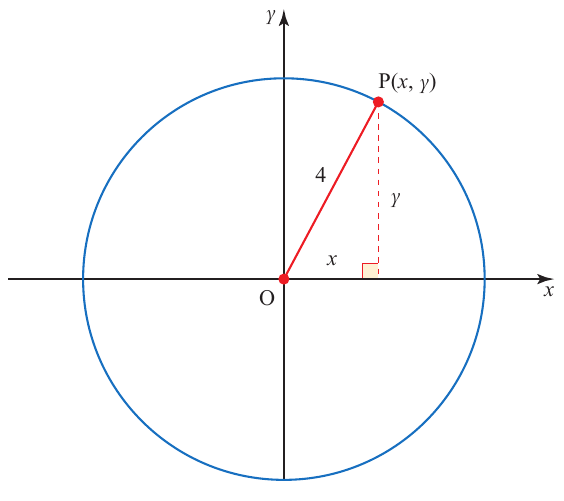
For a circle with centre at the origin and radius , any point on the circle satisfies a special relationship. Using Pythagoras' theorem, the distance from the origin to point is:
Since this distance equals the radius , we get:
Squaring both sides to eliminate the square root:
Important
This is the standard equation for a circle centred at the origin. Remember: the equation comes directly from the definition that all points on the circle are distance from the centre.
Circles with centre at (a, b)
Now let's look at circles that aren't centred at the origin.
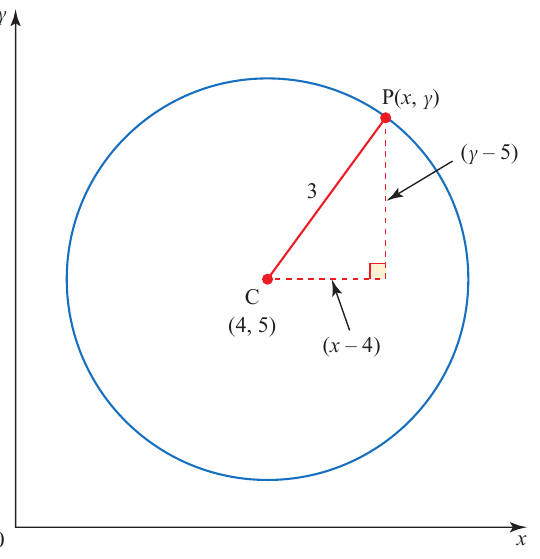
For a circle with centre and radius , any point on the circle is distance from the centre. Using the distance formula:
Since this distance equals the radius :
Squaring both sides:
Important
This is the standard form of a circle equation with centre and radius . This is the most useful form for identifying the centre and radius directly.
Expanded form
Sometimes circle equations appear in expanded form. If we multiply out the standard form:
We get:
Rearranging:
Note
Key features of this expanded form:
- The coefficients of and are both equal to 1
- There is no term
- The equation can be rearranged to equal zero
When you see an equation with these features, you know it represents a circle!
Finding centre and radius from equations
Method 1: Comparing with standard form
When given an equation like , compare it directly with the standard form .
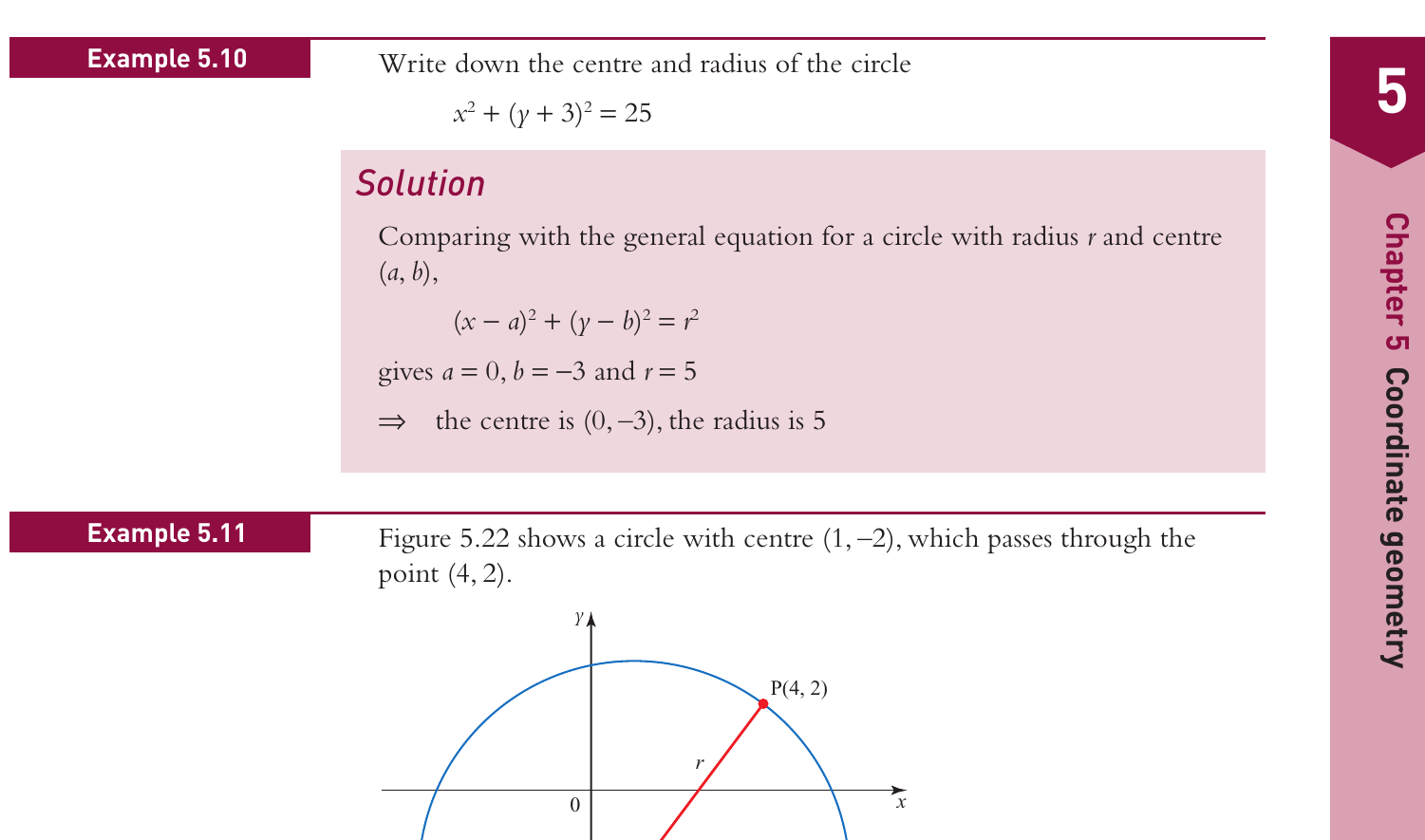
Example
Worked Example: Finding Centre and Radius
Find the centre and radius of
Solution: Comparing with :
- , so
- , so
- , so
Therefore: centre , radius
Method 2: Completing the square
When the equation is in expanded form, use completing the square to find the centre and radius.
Example
Worked Example: Completing the Square
Show that represents a circle and find its centre and radius.
Solution: Starting with:
Rearrange:
Complete the square for terms:
Complete the square for terms:
Adding the completing square values to both sides:
This represents a circle with centre and radius .
Circle geometry facts and theorems
Understanding these geometric properties helps solve coordinate geometry problems involving circles.
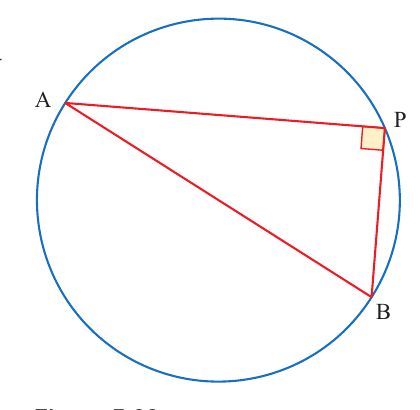
The angle in a semicircle is 90°
Important
Thales' Theorem: When a triangle is inscribed in a circle such that one side is a diameter, the angle opposite the diameter is always 90°.
If is a diameter and is any point on the circle, then .
This theorem is incredibly useful in coordinate geometry - whenever you see a diameter of a circle, you know that any angle subtended by it on the circle is a right angle.
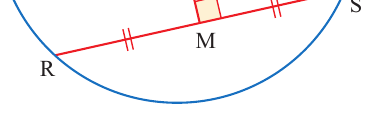
The perpendicular from the centre to a chord bisects the chord
Important
When you draw a line from the centre of a circle perpendicular to any chord, it always passes through the midpoint of that chord. This property is very useful for solving coordinate problems involving chords.
The angle between a tangent and radius is 90°
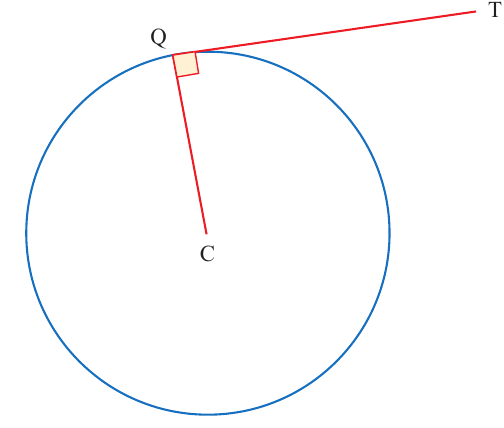
A tangent line touches a circle at exactly one point. At this point of contact, the tangent is always perpendicular to the radius.
Important
Tangent-Radius Theorem: The angle between a tangent and the radius at the point of contact is always 90°.
This perpendicular relationship is the key to solving most tangent problems in coordinate geometry.
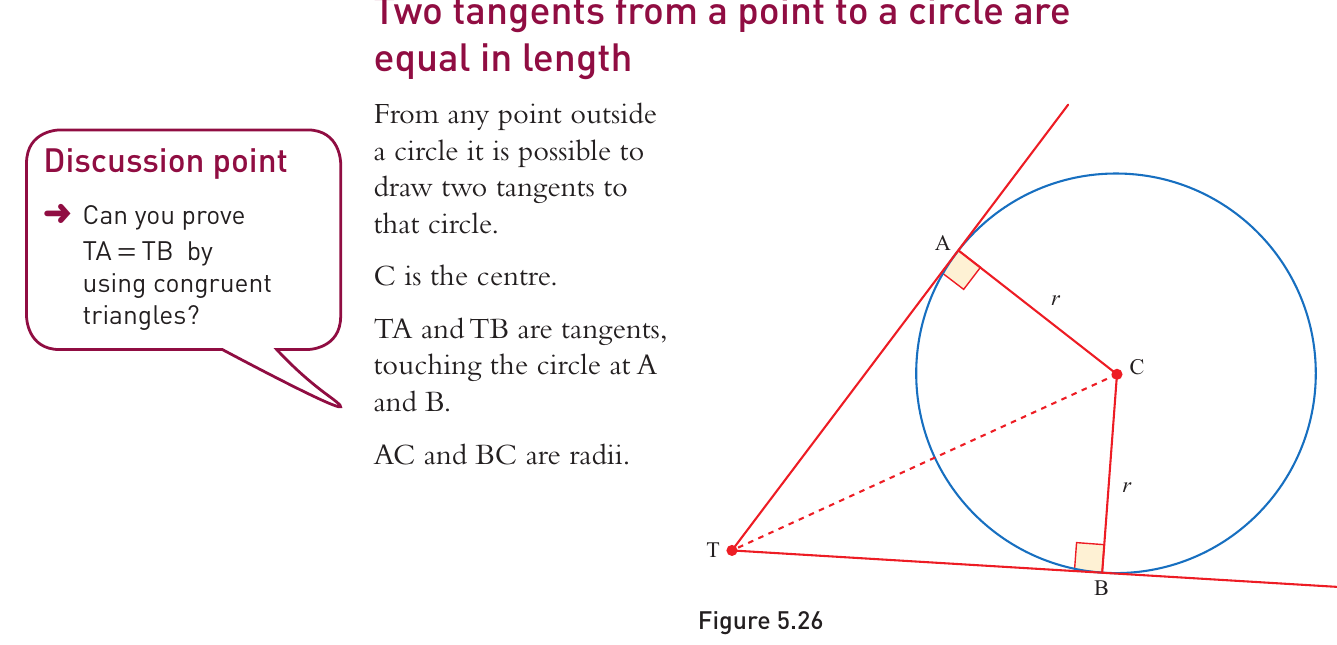
Two tangents from an external point are equal in length
Note
From any point outside a circle, you can draw exactly two tangent lines to the circle. These two tangent segments always have equal length. This property is often used in coordinate geometry problems.
Working with tangent lines
Tangent problems often involve finding equations of tangent lines or using the perpendicular relationship with radii.
Example
Worked Example: Finding Tangent Equation
Find the equation of the tangent to the circle at point .
Solution: First, find the gradient of the radius from centre to point : Centre is , point is
Gradient of
Since the tangent is perpendicular to the radius: Gradient of tangent (negative reciprocal)
Using point-slope form with point :
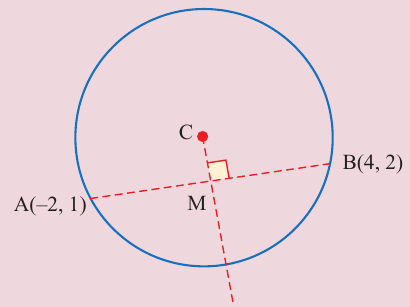
Perpendicular from centre to chord
When solving problems involving chords, remember that the perpendicular from the centre to a chord bisects the chord.
Example
Worked Example: Perpendicular to Chord
A circle has centre and passes through and . Find the equation of the line perpendicular to that passes through .
Solution: The perpendicular from centre to chord passes through the midpoint of .
Midpoint
Gradient of
Gradient of perpendicular
Using point-slope form through :
Converting to standard form:
Summary
Key Formulas Summary:
Circle equations:
- Centre at origin:
- Centre at :
- Expanded form:
Distance formula:
- Distance between and :
Completing the square:
- becomes
Circle theorems:
- Angle in semicircle = 90°
- Tangent ⟂ radius at point of contact
- Two tangents from external point are equal in length
- Perpendicular from centre bisects chord
Summary
Key Points to Remember:
- The equation of a circle always comes from the fact that every point on the circle is the same distance (radius) from the centre
- For a circle with centre and radius , use the form
- When the equation is expanded, complete the square to find the centre and radius
- Tangent lines are always perpendicular to the radius at the point where they touch the circle
- The angle in a semicircle is always 90° - this is very useful for solving coordinate geometry problems