Parallel and perpendicular lines (AQA GCSE Further Maths): Revision Notes
📚Revision Notes
Parallel and perpendicular lines
Understanding gradients in coordinate geometry
When working with lines on a coordinate grid, the gradient (also called slope) tells us how steep a line is and which direction it's going. This is a fundamental concept that helps us understand the relationship between different lines.
To find the gradient of a line that passes through two points, we use a specific formula. If you have two points with coordinates and , the gradient can be calculated using:
This formula essentially tells us how much the y-coordinate changes for every unit change in the x-coordinate. Think of it as "rise over run" - how much the line rises (or falls) compared to how much it runs horizontally.
Note
The gradient formula is your foundation for understanding all line relationships. The numerator represents the vertical change, while the denominator represents the horizontal change.
Parallel lines and their gradients
Parallel lines are lines that never meet, no matter how far you extend them. They maintain the same distance apart throughout their entire length. In coordinate geometry, there's a simple rule that determines when two lines are parallel.
Key rule for parallel lines: m₁ = m₂
This means that if two lines have exactly the same gradient, they will be parallel to each other. For example, if one line has a gradient of 3 and another line also has a gradient of 3, these lines will be parallel.
Note
Parallel lines maintain constant separation because they have identical rates of change. Since they rise and run at exactly the same rate, they can never intersect.
Perpendicular lines and their gradients
Perpendicular lines are lines that meet at exactly 90 degrees (a right angle). Unlike parallel lines, perpendicular lines have a special relationship between their gradients that involves multiplication.
Key rule for perpendicular lines: m₁ × m₂ = -1
This means that when you multiply the gradients of two perpendicular lines together, you always get -1. For instance, if one line has a gradient of 2, a line perpendicular to it would have a gradient of -1/2, because .
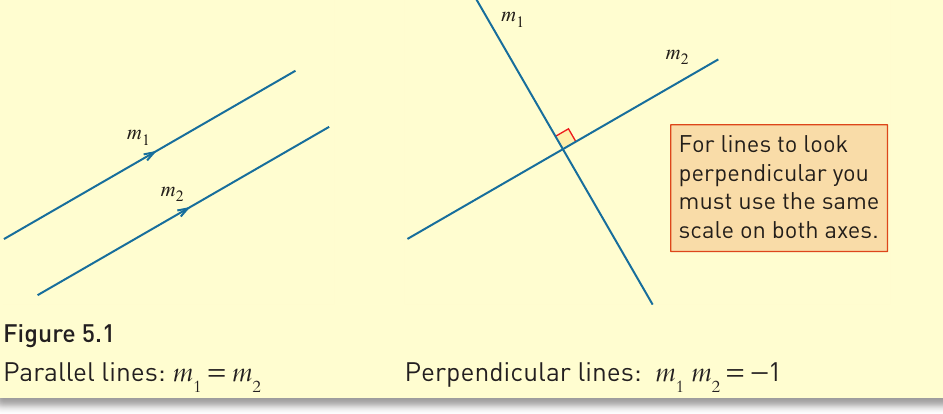
The diagram above illustrates both concepts clearly. On the left side, you can see two parallel lines with the same gradient, and on the right side, two perpendicular lines whose gradients multiply to give -1.
Note
The relationship can also be written as . This means if you know one gradient, you can immediately find the perpendicular gradient by taking the negative reciprocal.
Important visual consideration
Important
You must use the same scale on both axes for lines to look perpendicular. If your x-axis and y-axis have different scales, lines that are mathematically perpendicular might not appear to meet at right angles visually.
Step-by-step worked example
Example
Worked Example: Determining Line Relationships
Determine if the following pairs of lines are parallel, perpendicular, or neither:
- Line A passes through (1, 2) and (3, 8)
- Line B passes through (0, 1) and (2, 7)
Step 1: Calculate the gradient of Line A
Step 2: Calculate the gradient of Line B
Step 3: Compare the gradients Since , the lines are parallel.
Common exam tips and traps
Note
Exam Tip 1: Always be careful with negative signs when calculating gradients. A common mistake is getting the sign wrong, especially when dealing with points where coordinates decrease.
Note
Exam Tip 2: For perpendicular lines, remember that if one line has gradient , the perpendicular line has gradient . This is often quicker than using the product rule.
Important
Common Trap: Don't assume lines are perpendicular just because they look like they meet at right angles on a diagram - always check the gradients mathematically.
Note
Exam Tip 3: When finding perpendicular gradients, be extra careful with fractions. If a line has gradient , the perpendicular line has gradient .
Remember!
Summary
Key Points to Remember:
-
Gradient formula: - this is your starting point for all parallel and perpendicular line problems
-
Parallel lines have identical gradients: If , the lines are parallel and will never meet
-
Perpendicular lines have gradients that multiply to -1: If , the lines meet at exactly 90 degrees
-
Same scale rule: Use the same scale on both axes when drawing perpendicular lines to ensure they look correct visually
-
Check your arithmetic: Small calculation errors with gradients can lead to wrong conclusions about whether lines are parallel or perpendicular