The intersection of two lines (AQA GCSE Further Maths): Revision Notes
📚Revision Notes
The intersection of two lines
What is the intersection of two lines?
When two straight lines meet or cross each other on a coordinate plane, the point where they meet is called their intersection point. This intersection point has coordinates that satisfy both line equations simultaneously. Understanding how to find this point is essential in coordinate geometry and has many practical applications.
The intersection point represents the solution to a system of two linear equations, and there are two main methods to find it: algebraically (using simultaneous equations) and graphically (by plotting both lines).
Note
The intersection point is unique for two non-parallel lines, meaning there is exactly one point where they meet. This concept forms the foundation for solving many real-world problems involving linear relationships.
Methods for finding intersection points
Algebraic method - solving simultaneous equations
The algebraic method involves solving the two line equations simultaneously to find the exact coordinates of the intersection point. This method gives precise results and is particularly useful when exact values are needed.
Steps for the algebraic method:
- Write down both equations clearly
- Rearrange one equation to make one variable the subject (if needed)
- Substitute this expression into the other equation
- Solve for the remaining variable
- Substitute back to find the other coordinate
- Check your answer by substituting both coordinates into both original equations
Important
Always verify your solution by substituting the coordinates back into both original equations. This step catches calculation errors and confirms your answer is correct.
Graphical method - plotting and reading coordinates
The graphical method involves drawing both lines on the same coordinate grid and reading the coordinates where they intersect. While this method provides visual understanding, it may have limited accuracy depending on the scale and precision of the graph.
Steps for the graphical method:
- Create a table of coordinates for each line (usually 3 points per line)
- Plot both lines on the same coordinate grid
- Identify where the lines cross
- Read the coordinates of the intersection point from the graph
Worked example 1: algebraic solution
Example
Worked Example: Finding Intersection Algebraically
Let's find where the lines and intersect.
Step-by-step solution:
First, we have our two equations:
- Equation ①:
- Equation ②:
Since equation ② already has as the subject, we can substitute this into equation ①:
Substituting into :
Now substitute back into equation ②:
Therefore, the intersection point is (3, 1).
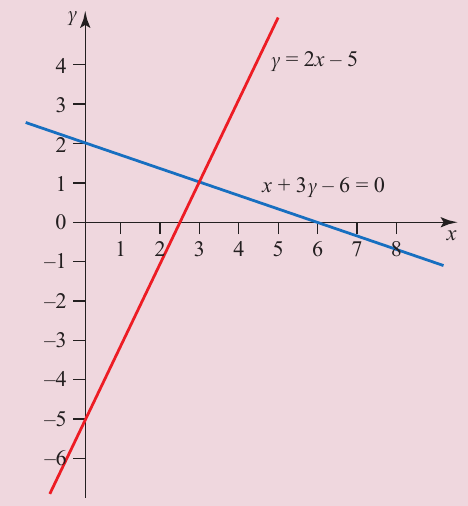
The graph shows both lines clearly intersecting at the point (3, 1), confirming our algebraic solution.
Worked example 2: graphical solution
Example
Worked Example: Finding Intersection Graphically
Let's find where the lines and intersect using the graphical method.
Creating coordinate tables:
For (rearranged as ):
- When ,
- When ,
- When ,
For (rearranged as ):
- When ,
- When ,
- When ,
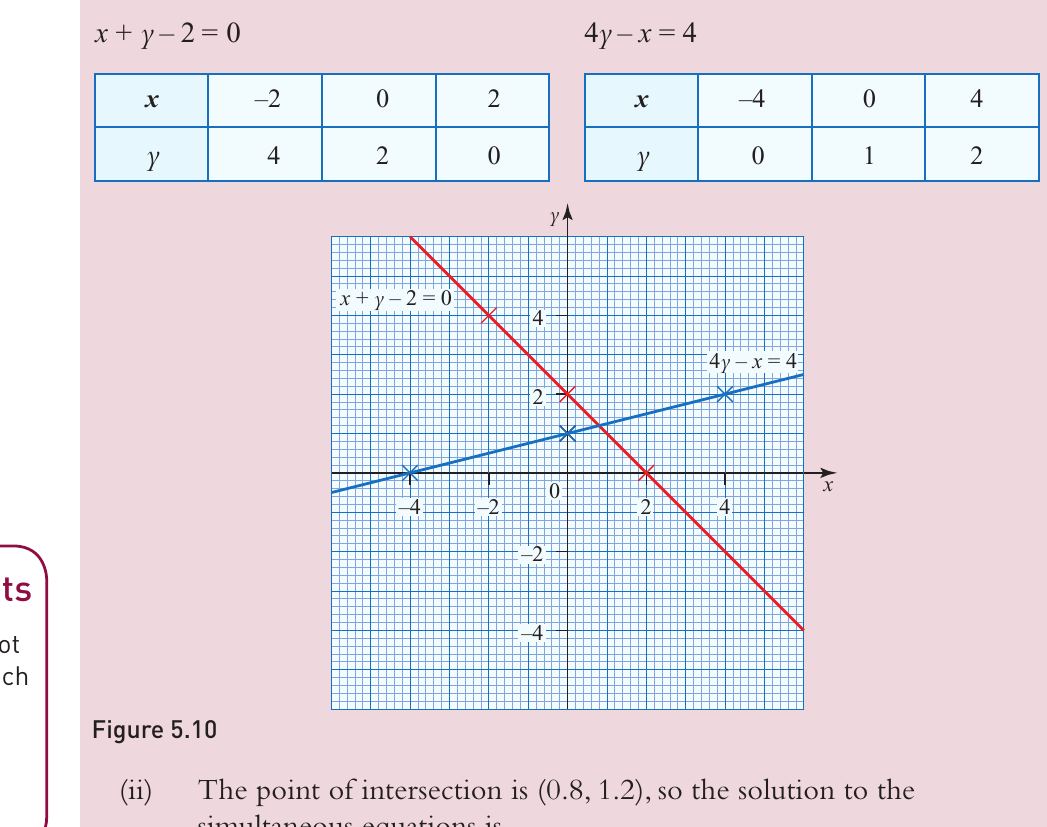
By plotting both lines on the same graph and reading where they intersect, we can see the intersection point is at (0.8, 1.2).
Verification using algebra: We can verify this graphical result algebraically:
- → multiply by 2 →
- → rearrange →
Adding the equations: and This gives:
From , we get Substituting:
Therefore
This confirms our graphical reading: the intersection point is (0.8, 1.2).
Important considerations
Important
Accuracy of graphical methods:
While graphical methods provide excellent visual understanding, they have significant limitations in accuracy. The precision depends on:
- The scale of your graph
- How carefully you plot the points
- Your ability to read coordinates accurately from the grid
For exam purposes, algebraic methods typically provide more reliable and exact answers.
Note
When lines don't intersect:
Sometimes two lines may not intersect at all. This happens when the lines are parallel (have the same gradient but different y-intercepts). In such cases, there is no solution to the simultaneous equations.
Key formulas and techniques
The standard forms of linear equations you'll encounter are:
Note
Standard form of linear equations:
- (general form)
- (slope-intercept form)
Essential steps for simultaneous equations:
- Elimination method: multiply equations to make coefficients equal, then add or subtract
- Substitution method: solve one equation for a variable, substitute into the other
- Always check your solution in both original equations
Summary
Key Points to Remember:
- The intersection point of two lines satisfies both line equations simultaneously
- Algebraic methods (simultaneous equations) provide exact answers and are generally preferred for exams
- Graphical methods offer visual understanding but may have limited accuracy
- Always verify your solution by substituting the coordinates back into both original equations
- If two lines are parallel, they will not intersect and there will be no solution to the simultaneous equations