Geometry I (AQA GCSE Further Maths): Revision Notes
📚Revision Notes
Solution of trigonometric equations
The tangent graph
Understanding the tangent function is essential for solving trigonometric equations. The tangent of an angle can be calculated using the relationship , or alternatively using the ratio .
Note
Unlike sine and cosine functions, the tangent function has some unique characteristics that make it behave very differently when solving equations.
Understanding asymptotes
The tangent function has some unique characteristics that make it different from sine and cosine. Most importantly, the tangent function becomes undefined at certain angles. This occurs when , and similar values where the cosine equals zero (since we'd be dividing by zero).
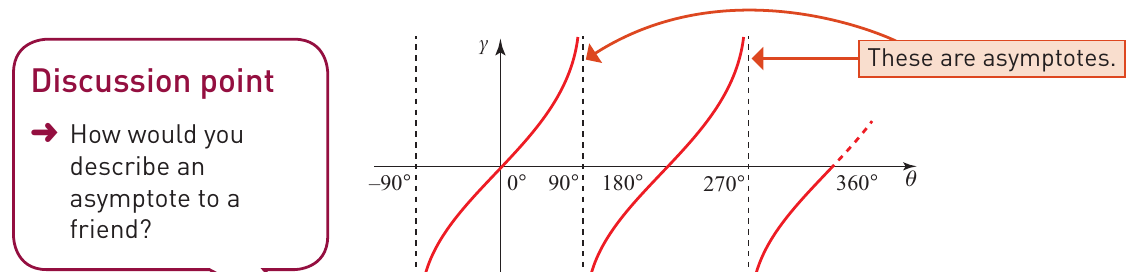
When we look at the graph of the tangent function, we can see vertical dashed lines at these problematic angles. These lines are called asymptotes - they represent values that the function approaches but never actually reaches. The function shoots up to positive infinity on one side and drops to negative infinity on the other side of each asymptote.
Important
Critical Concept: Asymptotes occur because we cannot divide by zero. When , the expression becomes undefined.
Periodic nature of tangent
Just like sine and cosine, the tangent function is periodic, meaning it repeats its pattern at regular intervals. However, while sine and cosine have a period of 360°, the tangent function repeats every 180°. This shorter period is crucial when finding all solutions to tangent equations.
Finding solutions to trigonometric equations
When solving equations like , your calculator will give you one answer - but this is just the beginning. Trigonometric equations typically have multiple solutions within any given range.
Using your calculator effectively
Note
Calculator Setup: To solve , you would press the calculator sequence: shift, sin, 0, ., 5, =
This gives you the answer 30°, but it's important to check your calculator is set to degrees mode (look for 'D' or 'DEG' on the screen).

Understanding principal values
The value your calculator gives you (like 30° for ) is called the principal value. This is just one solution, and there are specific ranges where calculators give principal values:
- For cosine: between 0° and 180°
- For sine: between -90° and 90°
- For tangent: between -90° and 90°
Finding all solutions
Let's examine how many solutions exist by looking at graphs. When we plot and draw a horizontal line at , we can see multiple intersection points.
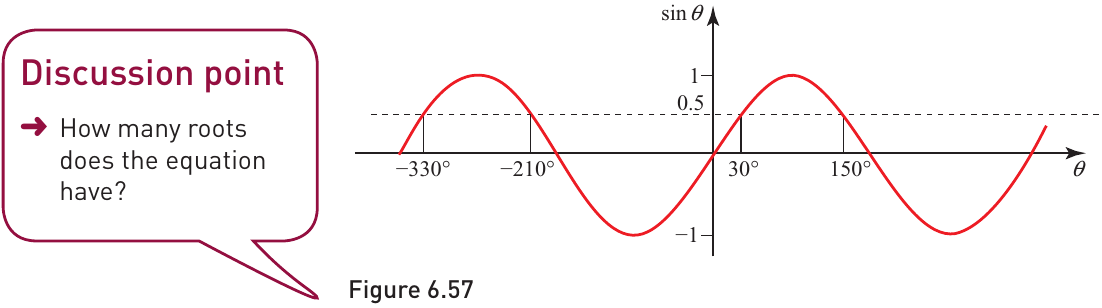
The graph shows that has solutions at 30° and 150° within one complete cycle, and this pattern repeats every 360°. So all solutions would be:
Worked examples
Example
Worked Example: Solving cos θ = 0.4
Let's work through finding all values of θ between 0° and 360° where .
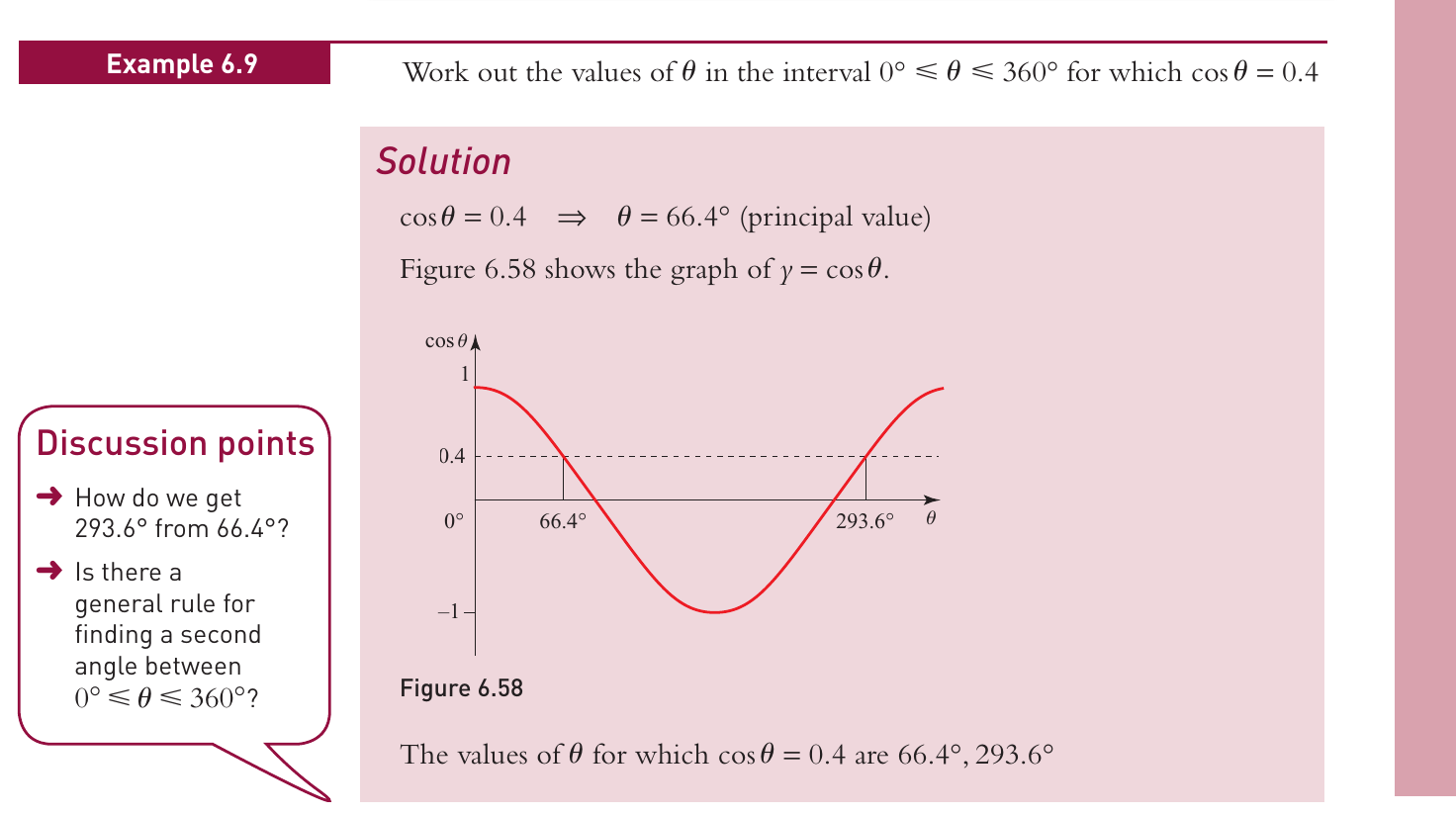
Step 1: Find the principal value , so (from calculator)
Step 2: Find the second solution Looking at the cosine graph, we can see it's symmetrical about the y-axis within one period.
The graph shows two intersection points with the line . The second solution is at .
Therefore, the complete solution is θ = 66.4°, 293.6°.
Example
Worked Example: Solving tan x = -3
For the equation , we first rearrange:
Step 1: Find the principal value (from calculator)
Step 2: Use the tangent graph to find other solutions Since tangent has a period of 180°, we add 180° repeatedly to find more solutions within our required range of .
The solutions are: x = -251.6°, -71.6°, 108.4°, 288.4°
Systematic method for solving trigonometric equations
Important
Universal Method for Any Trigonometric Equation:
Here's a reliable four-step method that works for any trigonometric equation:
Step 1: Use , , or to find the principal value θ.
Step 2: Find a second angle using these relationships:
- For sine: second angle =
- For cosine: second angle =
- For tangent: second angle =
Step 3: Add 360° to both angles repeatedly until you reach the upper limit of your range.
Step 4: Subtract 360° from both angles repeatedly until you reach the lower limit of your range.
Example
Worked Example: Solving 10sin θ + 3 = 0
Let's apply this method to solve for .
Rearrange: , so
Step 1: Principal value =
Step 2: Second angle =
Step 3: Adding 360°:
- and
Step 4: Subtracting 360°:
- (too low for our range)
Final answer: θ = -162.5°, -17.5°, 197.5°, 342.5°, 557.5°, 702.5°
Summary
Key Points to Remember:
- The tangent function has asymptotes (undefined values) at 90°, 270°, etc., where it shoots to infinity
- Your calculator gives the principal value - there are usually multiple solutions to trigonometric equations
- Sine and cosine repeat every 360°, but tangent repeats every 180°
- Use the systematic four-step method: find principal value, find second angle, add 360° until upper limit, subtract 360° until lower limit
- Always check your calculator is in degrees mode when solving these problems